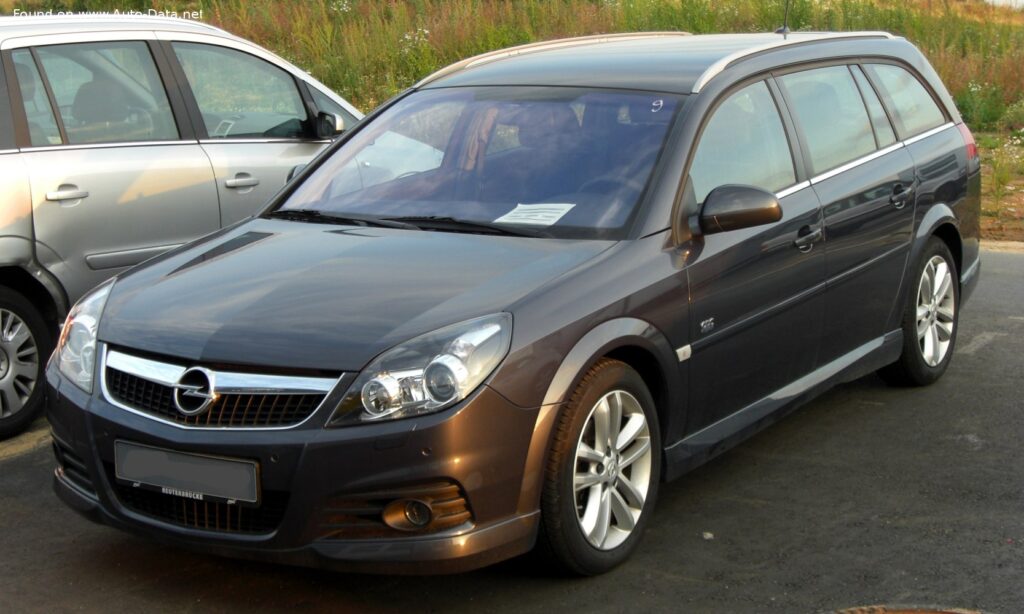
The Opel Vectra C Caravan, specifically the facelifted 2005 model equipped with the 1.9 CDTI (120 Hp) engine, represented a significant offering in the competitive European mid-size family car segment. As a product of General Motors’ German subsidiary, Opel, the Vectra C generation (produced from 2002 to 2008) aimed to blend practicality, comfort, and modern diesel efficiency for a discerning European market. The “Caravan” designation, synonymous with “station wagon” or “estate” in US English, underscored its primary appeal as a versatile family hauler and a preferred choice for business fleets requiring substantial cargo capacity. This particular iteration, introduced in 2005, benefited from a mid-cycle refresh that refined its aesthetics and incorporated updated technological features, ensuring its relevance against rivals in a segment where utility and running costs were paramount.
The Opel Vectra C Caravan (facelift 2005) in the European Market
Opel, a long-standing pillar of the European automotive industry, has consistently provided practical and reliable vehicles designed to meet the diverse needs of its home continent. The Vectra C generation, launched in 2002, succeeded the popular Vectra B and aimed to elevate Opel’s presence in the D-segment. The 2005 facelift brought a refreshed front fascia, including new headlights, grille, and bumper designs, giving the car a more contemporary and assertive appearance. Interior enhancements focused on material quality and ergonomics, aiming to improve the overall driver and passenger experience. While never officially sold in the United States under the Opel badge, some of its platform architecture and components found their way into North American vehicles, such as the Saab 9-3, reflecting its global engineering lineage.
The station wagon variant, the Opel Vectra C Caravan (facelift 2005), was particularly important in Europe, where estate cars traditionally hold a strong market share due to their blend of passenger comfort and cargo versatility without the larger footprint or higher fuel consumption of SUVs. With its substantial dimensions and thoughtful interior packaging, the Vectra Caravan was designed to compete with popular models from Ford, Volkswagen, and Peugeot, offering a compelling package for families, small businesses, and fleet operators who prioritized space, efficiency, and a comfortable ride for long journeys. Its robust build and an array of practical features cemented its reputation as a dependable workhorse and a capable family vehicle across various European nations.
Powertrain and Performance: The 1.9 CDTI Engine
At the heart of the Opel Vectra C Caravan (facelift 2005) discussed here is the 1.9 CDTI engine, a four-cylinder inline diesel unit known for its balance of efficiency and usable torque. This particular variant produces 120 horsepower at 3500 rpm, a figure that, while not overtly sporty, provides ample motivation for daily driving and highway cruising. More importantly for a vehicle of its class, the engine delivers a healthy 206.52 lb.-ft. of torque, peaking impressively between 2000 and 2750 rpm. This broad torque band ensures strong pulling power from low engine speeds, making the vehicle feel responsive in city traffic and capable of effortless overtaking on the open road, even when fully loaded.
The 1.9 CDTI engine, designated as Z19DT, features a sophisticated common-rail direct fuel injection system, which precisely controls fuel delivery to optimize combustion, reduce emissions, and enhance fuel economy. Further boosting its efficiency and power output is a turbocharger coupled with an intercooler, which cools the compressed air before it enters the engine, increasing its density and thus the amount of oxygen available for combustion. With a compression ratio of 18:1 and an OHC valvetrain operating two valves per cylinder, the engine is engineered for durability and consistent performance. Its displacement of 1910 cm3 (approximately 1.9 Liters or 116.56 cubic inches) contributes to its robust character.
In terms of performance, the Opel Vectra C Caravan with the 1.9 CDTI (120 Hp) engine accelerates from 0 to 60 mph in a respectable 11.6 seconds, with a maximum speed of 121.17 mph. These figures are well-suited for a family-oriented station wagon. Fuel efficiency was a key selling point, with a combined fuel economy rating of 39.9 US mpg (5.9 l/100 km). In urban driving, it achieved 31.4 US mpg (7.5 l/100 km), while extra-urban driving could yield an impressive 49 US mpg (4.8 l/100 km). This economy, combined with a 15.85 US gallon (60-liter) fuel tank, provided a considerable cruising range, a crucial attribute for European drivers covering long distances. Power is delivered to the front wheels via a smooth and efficient 6-speed manual transmission, offering precise control and further contributing to the vehicle’s economical operation.
Design, Practicality, and Features
The Opel Vectra C Caravan (facelift 2005) embraced a design language that balanced contemporary aesthetics with a strong emphasis on practicality. Its exterior, measuring 190.51 inches in length, 70.79 inches in width, and 59.06 inches in height, provided a substantial road presence while ensuring ample interior volume. The 2005 facelift subtly refined the car’s lines, giving it a more cohesive and upmarket appearance, particularly at the front where redesigned headlights and a bolder grille signaled its refreshed status. The elongated roofline and expansive rear window characterized its station wagon utility, flowing into a rear section designed for easy loading and maximum cargo space.
Inside, the Vectra C Caravan was configured to comfortably accommodate five occupants, with five doors providing convenient access to both front and rear seats. The true highlight of the Caravan body style was its cargo capacity. With the rear seats in place, it offered a generous 18.72 cubic feet (530 liters) of trunk space. For larger items, folding down the rear seats expanded this volume dramatically to an cavernous 65.33 cubic feet (1850 liters), making it exceptionally versatile for hauling luggage, sports equipment, or even furniture. This flexibility was crucial for its target demographic, positioning it as a highly functional vehicle for diverse lifestyles.
Underneath, the Vectra C Caravan featured a well-engineered chassis designed for comfort and stable handling. The front suspension utilized a Spring Strut system, a common and effective setup for front-wheel-drive vehicles, providing a good balance between ride comfort and handling precision. The rear suspension, employing several levers and rods (often referred to as a multi-link setup), offered enhanced stability and improved ride quality, particularly when the vehicle was loaded. Braking performance was assured by ventilated discs at the front and solid discs at the rear, complemented by an Anti-lock Braking System (ABS) for enhanced safety during emergency stops. The steering system, a rack and pinion setup, provided direct and predictable control. Standard tire size was 195/65 R15 on 6.5J X 15 wheel rims, offering a comfortable ride and good grip for everyday conditions. The Opel Vectra C Caravan was a testament to Opel’s commitment to delivering a well-rounded and practical vehicle for the European market.
Technical Specifications
| Brand | Opel |
| Model | Vectra |
| Generation | Vectra C Caravan (facelift 2005) |
| Type (Engine) | 1.9 CDTI (120 Hp) |
| Start of production | 2005 year |
| End of production | August, 2008 year |
| Powertrain Architecture | Internal Combustion engine |
| Body type | Station wagon (estate) |
| Seats | 5 |
| Doors | 5 |
| Fuel consumption (economy) – urban | 31.4 US mpg (7.5 l/100 km) |
| Fuel consumption (economy) – extra urban | 49 US mpg (4.8 l/100 km) |
| Fuel consumption (economy) – combined | 39.9 US mpg (5.9 l/100 km) |
| Fuel Type | Diesel |
| Acceleration 0 – 60 mph | 11.6 sec |
| Acceleration 0 – 100 km/h | 12.2 sec |
| Maximum speed | 121.17 mph (195 km/h) |
| Weight-to-power ratio | 13.5 kg/Hp, 73.8 Hp/tonne |
| Weight-to-torque ratio | 5.8 kg/Nm, 172.3 Nm/tonne |
| Power | 120 Hp @ 3500 rpm |
| Power per litre | 62.8 Hp/l |
| Torque | 206.52 lb.-ft. (280 Nm) @ 2000-2750 rpm |
| Engine layout | Front, Transverse |
| Engine Model/Code | Z19DT |
| Engine displacement | 1.9 Liters (1910 cm3 / 116.56 cu. in.) |
| Number of cylinders | 4 |
| Engine configuration | Inline |
| Cylinder Bore | 3.23 in. (82 mm) |
| Piston Stroke | 3.56 in. (90.4 mm) |
| Compression ratio | 18:1 |
| Number of valves per cylinder | 2 |
| Fuel injection system | Diesel Commonrail |
| Engine aspiration | Turbocharger, Intercooler |
| Valvetrain | OHC |
| Engine oil capacity | 4.54 US qt (4.3 l) |
| Coolant | 7.4 US qt (7 l) |
| Kerb Weight | 3582.51 lbs. (1625 kg) |
| Max. weight | 4761.98 lbs. (2160 kg) |
| Max load | 1179.47 lbs. (535 kg) |
| Trunk (boot) space – minimum | 18.72 cu. ft. (530 l) |
| Trunk (boot) space – maximum | 65.33 cu. ft. (1850 l) |
| Fuel tank capacity | 15.85 US gal (60 l) |
| Length | 190.51 in. (4839 mm) |
| Width | 70.79 in. (1798 mm) |
| Height | 59.06 in. (1500 mm) |
| Wheelbase | 111.42 in. (2830 mm) |
| Front track | 60.47 in. (1536 mm) |
| Rear (Back) track | 60.04 in. (1525 mm) |
| Drivetrain Architecture | The Internal combustion engine (ICE) drives the front wheels of the vehicle. |
| Drive wheel | Front wheel drive |
| Number of gears and type of gearbox | 6 gears, manual transmission |
| Front suspension | Spring Strut |
| Rear suspension | Several levers and rods |
| Front brakes | Ventilated discs |
| Rear brakes | Disc |
| Assisting systems | ABS (Anti-lock braking system) |
| Steering type | Steering rack and pinion |
| Tires size | 195/65 R15 |
| Wheel rims size | 6.5J X 15 |