
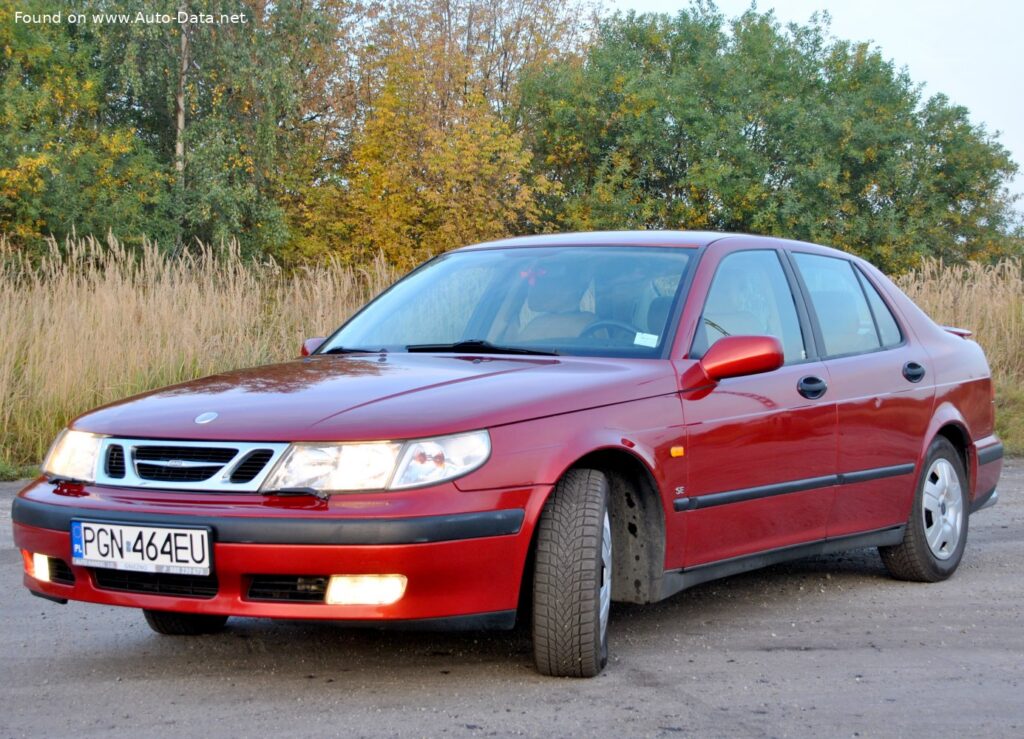
The Saab 9-5 2.3i T (170 Hp), produced from 1998 to 2001, represented a pivotal offering from the Swedish automaker in the competitive executive sedan segment. As the successor to the long-running Saab 9000, the first-generation 9-5 was tasked with carrying forward Saab’s distinctive blend of Scandinavian design, turbocharged performance, and unwavering commitment to safety. While not always a direct competitor in terms of sheer sales volume against mainstream German rivals in the global market, the 9-5 carved out a niche for discerning buyers who valued its unique character, advanced ergonomics, and robust engineering. This particular variant, powered by a 2.3-liter turbocharged inline-four engine delivering 170 horsepower, exemplified Saab’s philosophy of deriving substantial power and torque from relatively modest displacement, focusing on real-world drivability and efficiency. Primarily sold in Europe and other international markets, the 9-5 showcased Saab’s innovative approach to automotive design and engineering, offering a compelling alternative to more conventional luxury vehicles.
The Saab 9-5 2.3i T (170 Hp): A Legacy of Innovation in the Executive Segment
The introduction of the Saab 9-5 marked a significant evolution for the brand, moving into a more contemporary design language while retaining core Saab elements. Positioned as a mid-size to large executive sedan, it aimed to attract buyers looking for a premium experience that prioritized intelligent design and safety over ostentatious luxury. The 9-5’s role in its primary European market was to provide a distinctively Swedish option in a class dominated by established German and, increasingly, Japanese brands. Its design, while often described as understated, was highly functional, emphasizing aerodynamic efficiency and timeless aesthetics that still hold a certain appeal today. The 1998-2001 generation, specifically the 2.3i T (170 Hp) variant, was a testament to Saab’s engineering prowess, offering a blend of performance, comfort, and practicality that was unique for its time.
Market Positioning and Design Philosophy
Saab’s design philosophy for the 9-5 was rooted in aviation heritage and a user-centric approach. The exterior, a four-door sedan body, was sleek and aerodynamic, with a drag coefficient that contributed to both fuel efficiency and reduced wind noise at speed. The distinctive Saab grille, wraparound windshield, and “hockey stick” waistline were all elements that paid homage to the brand’s identity. Inside, the focus was squarely on ergonomics and driver control. The cockpit-like layout, inspired by aircraft design, placed all essential controls within easy reach and sight of the driver. Materials were chosen for durability and a premium feel, reflecting a practical luxury rather than overt opulence. This particular variant, with its 170 horsepower engine, was positioned as a strong performer within the range, offering a compelling balance of power and economy for the daily commute or long-distance touring.
Engineering and Performance Dynamics
At the heart of the Saab 9-5’s appeal was its sophisticated powertrain, a hallmark of Saab engineering. The 2.3i T (170 Hp) variant utilized a finely tuned turbocharged engine that delivered a potent and remarkably flexible driving experience. Saab was a pioneer in turbocharging for passenger cars, and this expertise was evident in the 9-5.
The B235E Turbocharged Powertrain
The engine in question, designated B235E, was a 2.3-liter (2290 cubic centimeters or 139.74 cubic inches) inline-four configuration. Featuring a DOHC (Dual Overhead Camshaft) valvetrain with four valves per cylinder, it was designed for efficient breathing and robust performance. The engine’s cylinder bore and piston stroke were both 90 millimeters (3.54 inches), indicating a “square” design that typically balances torque and horsepower characteristics well. With a compression ratio of 9.3:1, it was optimized for the multi-port manifold injection system, which precisely controlled fuel delivery. The critical component, however, was the turbocharger. Unlike many turbocharged engines of its era that suffered from significant “turbo lag,” Saab’s implementation was renowned for its smooth, linear power delivery, providing a strong surge of torque from low RPMs. This engine produced a healthy 170 horsepower at 5500 rpm, translating to a power-per-liter figure of 74.2 horsepower per liter, which was competitive for a premium sedan of its time. More impressively, it generated a substantial 280 Nm (206.52 lb.-ft.) of torque at a remarkably low 1800 rpm, making for effortless acceleration and strong passing power without constantly needing to downshift.
Driving Experience and Efficiency
The performance figures for the Saab 9-5 2.3i T (170 Hp) underscore its capable nature. It could accelerate from 0 to 60 mph in a brisk 8.3 seconds (or 0-100 km/h in 8.7 seconds), and reach a maximum speed of 139.81 mph (225 km/h). These numbers placed it firmly in contention with other executive sedans. The power was delivered to the front wheels via a precise 5-speed manual transmission, offering an engaging driving experience for those who preferred to be more connected to the car. The drivetrain architecture, front-wheel drive, contributed to predictable handling characteristics and good traction in varied conditions. The suspension system, featuring Spring Struts at both the front and rear, provided a comfortable yet controlled ride, characteristic of European executive cars. Braking performance was handled by ventilated discs at the front and solid discs at the rear, augmented by an Anti-lock Braking System (ABS) for enhanced safety and stability during hard braking. Steering was via a hydraulic rack and pinion system, delivering direct feedback to the driver. Despite its performance, the 9-5 also offered reasonable fuel economy for its class, with an extra-urban (highway) consumption of 7.3 liters per 100 km, equivalent to approximately 32.2 US mpg, and urban (city) consumption of 13.9 liters per 100 km, or about 16.9 US mpg. The curb weight of 3328.98 lbs (1510 kg) and a weight-to-power ratio of 8.9 kg/Hp further illustrate the car’s balanced engineering.
Interior Refinement and Safety
Beyond its mechanical attributes, the Saab 9-5 was celebrated for its thoughtfully designed interior and its pioneering approach to safety, reflecting the brand’s core values.
Ergonomics and Practicality
The interior of the 9-5 was designed with the driver and passengers in mind. As a four-door sedan with seating for five, it offered generous space and comfort for all occupants. The trunk (boot) space was a respectable 500 liters (17.66 cubic feet), providing ample room for luggage, making it suitable for families and long journeys. The dimensions of the car—189.17 inches (4805 mm) in length, 70.55 inches (1792 mm) in width, and 57.05 inches (1449 mm) in height, with a wheelbase of 106.42 inches (2703 mm)—contributed to its stable road presence and spacious cabin. Saab’s commitment to safety was evident in features like the standard ABS, and the overall structural integrity of the vehicle, designed to protect occupants in a collision. The “Black Panel” function, which allowed the driver to turn off most dashboard lights at night, was a unique Saab feature designed to reduce distraction and enhance night vision, further highlighting the brand’s aviation-inspired user interface. The fuel tank capacity of 75 liters (19.81 US gallons) ensured a considerable cruising range, reinforcing its capability as a long-distance tourer.
Detailed Technical Specifications: Saab 9-5 2.3i T (170 Hp)
| Brand | Saab |
| Model | 9-5 |
| Generation | 9-5 |
| Type (Engine) | 2.3i T (170 Hp) |
| Start of production | 1998 year |
| End of production | 2001 year |
| Powertrain Architecture | Internal Combustion engine |
| Body type | Sedan |
| Seats | 5 |
| Doors | 4 |
| Fuel consumption (economy) – urban | 13.9 l/100 km (16.9 US mpg) |
| Fuel consumption (economy) – extra urban | 7.3 l/100 km (32.2 US mpg) |
| Fuel Type | Petrol (Gasoline) |
| Acceleration 0 – 60 mph | 8.3 sec |
| Maximum speed | 225 km/h (139.81 mph) |
| Weight-to-power ratio | 8.9 kg/Hp (112.6 Hp/tonne) |
| Weight-to-torque ratio | 5.4 kg/Nm (185.4 Nm/tonne) |
| Power | 170 Hp @ 5500 rpm |
| Power per liter | 74.2 Hp/l |
| Torque | 280 Nm (206.52 lb.-ft.) @ 1800 rpm |
| Engine layout | Front, Transverse |
| Engine Model/Code | B235E |
| Engine displacement | 2290 cm3 (139.74 cu. in.) |
| Number of cylinders | 4 |
| Engine configuration | Inline |
| Cylinder Bore | 90 mm (3.54 in.) |
| Piston Stroke | 90 mm (3.54 in.) |
| Compression ratio | 9.3:1 |
| Number of valves per cylinder | 4 |
| Fuel injection system | Multi-port manifold injection |
| Engine aspiration | Turbocharger |
| Valvetrain | DOHC |
| Engine oil capacity | 4 l (4.23 US qt) |
| Coolant | 7.4 l (7.82 US qt) |
| Kerb Weight | 1510 kg (3328.98 lbs) |
| Max. weight | 2020 kg (4453.34 lbs) |
| Max load | 510 kg (1124.36 lbs) |
| Trunk (boot) space – maximum | 500 l (17.66 cu. ft.) |
| Fuel tank capacity | 75 l (19.81 US gal) |
| Length | 4805 mm (189.17 in.) |
| Width | 1792 mm (70.55 in.) |
| Height | 1449 mm (57.05 in.) |
| Wheelbase | 2703 mm (106.42 in.) |
| Front track | 1522 mm (59.92 in.) |
| Rear (Back) track | 1522 mm (59.92 in.) |
| Drivetrain Architecture | The Internal combustion engine (ICE) drives the front wheels of the vehicle. |
| Drive wheel | Front wheel drive |
| Number of gears and type of gearbox | 5 gears, manual transmission |
| Front suspension | Spring Strut |
| Rear suspension | Spring Strut |
| Front brakes | Ventilated discs |
| Rear brakes | Disc |
| Assisting systems | ABS (Anti-lock braking system) |
| Steering type | Steering rack and pinion |
| Power steering | Hydraulic Steering |
| Tires size | 205/65 R15; 215/55 R16 |
| Wheel rims size | 6.5J x 15; 6.5J x 16 |
