The Peugeot 308 SW III (Phase I, 2021) 1.6 (225 Hp) Plug-in Hybrid e-EAT8 represents a compelling entry in the European compact segment, specifically targeting the highly competitive station wagon market. Launched in September 2021 as part of the third generation of the 308 line, this particular variant stands out as a sophisticated plug-in hybrid electric vehicle (PHEV), embodying Peugeot’s commitment to electrification and premium design. While not directly available in the United States, the 308 SW III showcases the advanced engineering and stylistic direction of Stellantis’s French marque, offering a blend of efficiency, performance, and practicality tailored for the discerning European consumer. This generation, produced until January 2024, builds upon its predecessors with a fresh design language, enhanced technology, and a focus on sustainable mobility, making the Peugeot 308 SW III (Phase I, 2021) 1.6 (225 Hp) Plug-in Hybrid e-EAT8 a significant model in its class.
Engine & Performance: The Peugeot 308 SW III (Phase I, 2021) 1.6 (225 Hp) Plug-in Hybrid e-EAT8 Powertrain
At the heart of the Peugeot 308 SW III (Phase I, 2021) 1.6 (225 Hp) Plug-in Hybrid e-EAT8 lies an advanced powertrain architecture that seamlessly integrates a conventional internal combustion engine with an electric motor. This PHEV system is designed for both exhilarating performance and remarkable fuel efficiency. The internal combustion component is a 1.6-liter (1598 cm3) four-cylinder inline petrol engine, featuring direct injection, a turbocharger, and an intercooler, producing a robust 180 horsepower at 6000 rpm and 184.39 lb.-ft. (250 Nm) of torque at a low 1750 rpm. This engine, designated DGY EP6FADTXHPD, utilizes a DOHC valvetrain and includes a particulate filter to meet stringent Euro 6d emission standards.
Complementing the gasoline engine is a potent electric motor, strategically placed between the combustion engine and the transmission. This electric motor contributes an additional 110 horsepower at 2500 rpm and a substantial 236.02 lb.-ft. (320 Nm) of torque across a broad range of 500-2500 rpm. Together, the combined system output culminates in an impressive 225 horsepower and a total system torque of 265.52 lb.-ft. (360 Nm), delivered to the front wheels. Power is managed by an advanced 8-speed automatic e-EAT transmission, ensuring smooth and responsive shifts whether operating in electric, hybrid, or pure combustion modes.
The performance figures underscore the dynamic capabilities of this hybrid system. The 308 SW III PHEV can accelerate from 0 to 60 mph in a swift 7.2 seconds (0-100 km/h in 7.6 seconds), and it can reach a maximum speed of 146.02 mph (235 km/h). Even in pure electric mode, the vehicle is capable of reaching speeds up to 83.89 mph (135 km/h), making it suitable for urban and moderate highway driving without engaging the gasoline engine.
Fuel efficiency and environmental responsibility are paramount for this vehicle. According to the WLTP cycle, the combined fuel consumption is an outstanding 1.2 liters per 100 km, which translates to an exceptional 196 US mpg. CO2 emissions are remarkably low, ranging from 26-27 g/km (WLTP). The gross battery capacity is 12.4 kWh, utilizing advanced Lithium-ion technology, with the battery pack cleverly located under the rear seats to maintain optimal weight distribution and interior space. This battery enables an all-electric range of 38.53 to 39.15 miles (62-63 km) on the WLTP cycle, providing significant flexibility for daily commutes and reducing reliance on fossil fuels. The average energy consumption in electric mode is between 15.6-15.8 kWh/100 km, equating to an impressive 134-133 MPGe, further highlighting its efficiency credentials.
Design & Features
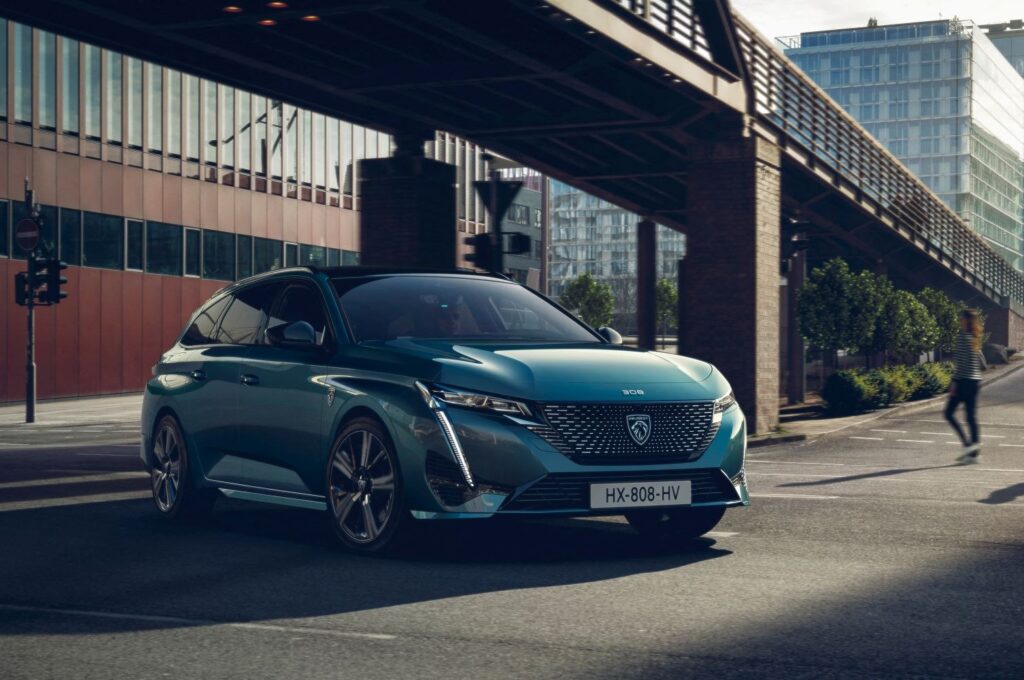
The Peugeot 308 SW III (Phase I, 2021) is presented in a sophisticated station wagon (estate) body style, offering a harmonious blend of sleek aesthetics and practical utility. With five doors and seating for five occupants, it is designed to cater to families and individuals requiring versatile cargo space without compromising on style. The exterior design adheres to Peugeot’s contemporary design language, characterized by sharp lines, a distinctive front grille, and the signature “fang” LED daytime running lights, giving it an aggressive yet elegant presence on the road. The vehicle’s aerodynamic profile, indicated by a drag coefficient (Cd) of 0.277, contributes to both its efficiency and quietness at speed.
In terms of dimensions, the 308 SW III measures 182.52 inches (4636 mm) in length, 72.91 inches (1852 mm) in width (or 81.18 inches / 2062 mm including mirrors), and 56.85 inches (1444 mm) in height. The wheelbase extends to 107.56 inches (2732 mm), providing a stable ride and generous interior volume. The practical nature of a station wagon is evident in its cargo capacity: a minimum trunk space of 19.35 cubic feet (548 liters) expands significantly to a maximum of 55.59 cubic feet (1574 liters) with the rear seats folded, making it highly adaptable for various hauling needs. The fuel tank capacity of 10.57 US gallons (40 liters) ensures adequate range, especially when combined with the electric powertrain.
The chassis and suspension setup is engineered for a balanced ride, combining comfort with agile handling. The front features an independent McPherson coil spring suspension, while the rear utilizes a torsion beam setup. Braking power is provided by ventilated discs at the front and disc brakes at the rear, complemented by an Anti-lock Braking System (ABS) for enhanced safety and control. The vehicle employs a precise electric power steering system with a rack and pinion steering type, offering a minimum turning circle of 35.1 feet (10.7 meters), which aids maneuverability in urban environments. The 308 SW III rides on 225/40 R18 tires, providing a good balance of grip and ride comfort. With a curb weight of 3719.2 lbs. (1687 kg) and a maximum permissible weight of 4784.03 lbs. (2170 kg), the vehicle also demonstrates robust structural integrity and load-carrying capability, including a permitted trailer load with brakes of 3196.7 lbs. (1450 kg).
Technical Specifications
| Brand | Peugeot |
| Model | 308 |
| Generation | 308 SW III (Phase I, 2021) |
| Type (Engine) | 1.6 (225 Hp) Plug-in Hybrid e-EAT8 |
| Start of production | September, 2021 year |
| End of production | January, 2024 year |
| Powertrain Architecture | PHEV (Plug-in Hybrid Electric Vehicle) |
| Body type | Station wagon (estate) |
| Seats | 5 |
| Doors | 5 |
| Combined fuel consumption (WLTP) | 1.2 l/100 km (196 US mpg) |
| CO2 emissions (WLTP) | 26-27 g/km |
| Fuel consumption (economy) – combined (NEDC) | 1.3 l/100 km (180.9 US mpg) |
| CO2 emissions (NEDC) | 30 g/km |
| Fuel Type | Petrol / electricity |
| Acceleration 0 – 60 mph | 7.2 sec |
| Maximum speed | 146.02 mph (235 km/h) |
| Emission standard | Euro 6d |
| Weight-to-power ratio | 7.5 kg/Hp (133.4 Hp/tonne) |
| Weight-to-torque ratio | 4.7 kg/Nm (213.4 Nm/tonne) |
| Gross battery capacity | 12.4 kWh |
| Battery technology | Lithium-ion (Li-Ion) |
| Battery location | Under the rear seats |
| All-electric range (WLTP) | 38.53 – 39.15 mi (62-63 km) |
| Average Energy consumption (WLTP) | 15.6-15.8 kWh/100 km (134 – 133 MPGe) |
| Max speed (electric) | 83.89 mph (135 km/h) |
| Electric motor power | 110 Hp @ 2500 rpm |
| Electric motor Torque | 236.02 lb.-ft. (320 Nm) @ 500-2500 rpm |
| Electric motor location | Between the combustion engine and the transmission |
| System power | 225 Hp |
| System torque | 265.52 lb.-ft. (360 Nm) |
| Internal combustion engine power | 180 Hp @ 6000 rpm |
| Power per litre | 112.6 Hp/l |
| Internal combustion engine torque | 184.39 lb.-ft. (250 Nm) @ 1750 rpm |
| Engine layout | Front, Transverse |
| Engine Model/Code | DGY EP6FADTXHPD |
| Engine displacement | 1.6 l (1598 cm3, 97.52 cu. in.) |
| Number of cylinders | 4 |
| Engine configuration | Inline |
| Cylinder Bore | 3.03 in. (77 mm) |
| Piston Stroke | 3.38 in. (85.8 mm) |
| Number of valves per cylinder | 4 |
| Fuel injection system | Direct injection |
| Engine aspiration | Turbocharger, Intercooler |
| Valvetrain | DOHC |
| Engine oil capacity | 4.25 l (4.49 US qt) |
| Engine systems | Particulate filter |
| Kerb Weight | 3719.2 lbs. (1687 kg) |
| Max. weight | 4784.03 lbs. (2170 kg) |
| Max load | 1064.83 lbs. (483 kg) |
| Trunk (boot) space – minimum | 19.35 cu. ft. (548 l) |
| Trunk (boot) space – maximum | 55.59 cu. ft. (1574 l) |
| Fuel tank capacity | 10.57 US gal (40 l) |
| Max. roof load | 187.39 lbs. (85 kg) |
| Permitted trailer load with brakes (12%) | 3196.7 lbs. (1450 kg) |
| Permitted trailer load without brakes | 1653.47 lbs. (750 kg) |
| Permitted towbar download | 154.32 lbs. (70 kg) |
| Length | 182.52 in. (4636 mm) |
| Width | 72.91 in. (1852 mm) |
| Width with mirrors folded | 73.23 in. (1860 mm) |
| Width including mirrors | 81.18 in. (2062 mm) |
| Height | 56.85 in. (1444 mm) |
| Wheelbase | 107.56 in. (2732 mm) |
| Front track | 61.38 in. (1559 mm) |
| Rear (Back) track | 61.18 in. (1554 mm) |
| Front overhang | 35.59 in. (904 mm) |
| Rear overhang | 39.37 in. (1000 mm) |
| Ride height (ground clearance) | 5.63 in. (143 mm) |
| Drag coefficient (Cd) | 0.277 |
| Minimum turning circle (turning diameter) | 35.1 ft. (10.7 m) |
| Drivetrain Architecture | The Internal combustion engine (ICE) and electric motor drive the front wheels of the car with the ability to work in full electric or mixed mode. |
| Drive wheel | Front wheel drive |
| Number of gears and type of gearbox | 8 gears, automatic transmission e-EAT |
| Front suspension | Coil spring, Independent type McPherson |
| Rear suspension | Torsion |
| Front brakes | Ventilated discs |
| Rear brakes | Disc |
| Assisting systems | ABS (Anti-lock braking system) |
| Steering type | Steering rack and pinion |
| Power steering | Electric Steering |
| Tires size | 225/40 R18 |