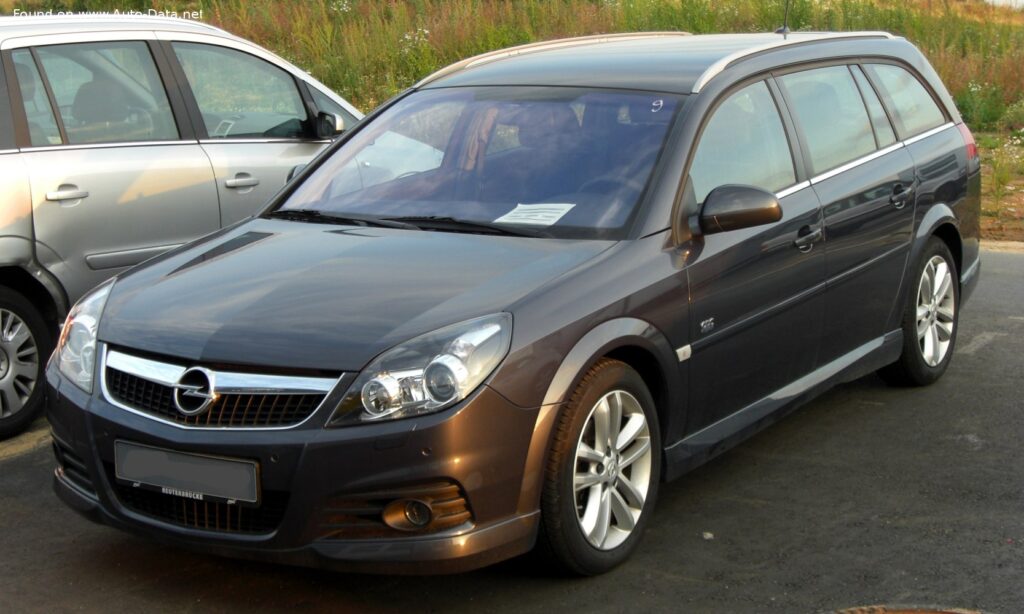
The Opel Vectra C Caravan (facelift 2005) 2.0i 16V Turbo (175 Hp) represents a significant offering in the European D-segment, a market segment characterized by mid-size family cars. As a versatile station wagon, or “estate” as it’s known across the Atlantic, this particular variant of the third-generation Vectra, introduced with a mid-cycle refresh in 2005, aimed to blend practicality with an engaging driving experience. While never officially sold in the United States, the Opel Vectra was a cornerstone of General Motors’ European portfolio, serving as a reliable and spacious option for families and business users alike. The 2005 facelift brought a refreshed exterior design, interior enhancements, and updated powertrain options, ensuring the Vectra remained competitive against rivals in its class until its production concluded in August 2008.
Engine & Performance of the Opel Vectra C Caravan
At the heart of the Opel Vectra C Caravan 2.0i 16V Turbo lies a robust and efficient Z20NET engine, a 2.0-liter (121.93 cu. in.) inline four-cylinder unit. This powerplant is distinguished by its 16-valve DOHC valvetrain, multi-port manifold injection system, and the crucial addition of a turbocharger paired with an intercooler. This forced induction setup allows the engine to produce a respectable 175 horsepower at 5500 rpm, delivering a potent blend of performance for a family-oriented vehicle. Torque figures are equally impressive, with 195.45 lb.-ft. (265 Nm) available from a low 2500 rpm, ensuring strong acceleration and flexible in-gear performance, particularly beneficial for a station wagon often laden with passengers and cargo.
Mated to a precise 6-speed manual transmission, the front-wheel-drive powertrain architecture ensures efficient power delivery and a direct connection to the road. The Vectra C Caravan with this engine variant demonstrates a commendable acceleration from 0 to 60 mph in an estimated 8.9 seconds (0-100 km/h in 9.4 seconds), making it capable of confident overtakes and merging onto highways. Its top speed of 137.94 mph (222 km/h) further underscores its capabilities as a long-distance cruiser. Despite its performance, Opel engineered the engine for a reasonable balance of power and fuel economy for its era. The combined fuel consumption is rated at 25.6 US mpg (9.2 l/100 km), with extra-urban driving achieving an even more efficient 34.1 US mpg (6.9 l/100 km). However, urban driving, as expected, sees consumption rise to 18 US mpg (13.1 l/100 km). The vehicle’s CO2 emissions stand at 222 g/km, reflecting the standard for turbocharged gasoline engines of its time.
The engine’s layout is front, transverse, contributing to the vehicle’s efficient packaging and front-wheel-drive dynamics. With a compression ratio of 9.5:1 and a square bore and stroke of 86 mm (3.39 in.), the engine is designed for both responsiveness and durability. The power-to-weight ratio of 9.1 kg/Hp (110.4 Hp/tonne) and torque-to-weight ratio of 6 kg/Nm (167.2 Nm/tonne) highlight the effective utilization of the engine’s output in propelling the 3494.33 lbs (1585 kg) kerb weight of the Vectra C Caravan.
Design & Features of the Opel Vectra C Caravan
The Opel Vectra C Caravan is a quintessential European station wagon, designed with a strong emphasis on practicality, comfort, and understated style. The facelift in 2005 brought subtle but effective updates, including revised front and rear fascias, updated lighting signatures, and new wheel designs, aligning its aesthetics with Opel’s contemporary design language. Measuring an ample 190.51 inches (4839 mm) in length, 70.79 inches (1798 mm) in width, and 59.06 inches (1500 mm) in height, the Vectra C Caravan offers substantial road presence and, more importantly, generous interior space.
Its five-door, five-seat configuration makes it an ideal family vehicle. The most compelling aspect of any station wagon is its cargo capacity, and the Vectra C Caravan excels here. It provides a minimum trunk space of 18.72 cu. ft. (530 liters), which expands to an cavernous 65.33 cu. ft. (1850 liters) with the rear seats folded down. This expansive and versatile cargo area makes it perfectly suited for transporting luggage, sports equipment, or even furniture, catering to the diverse needs of European families. The long 111.42-inch (2830 mm) wheelbase contributes directly to a spacious cabin, offering ample legroom for both front and rear passengers, ensuring comfort on long journeys.
From a chassis perspective, the Vectra C Caravan is equipped with a well-tuned suspension system. The front features a spring strut setup, a common and effective design for managing ride comfort and handling. The rear employs a more sophisticated multi-link arrangement, utilizing several levers and rods to provide a refined ride, improved stability, and better control, especially when the vehicle is loaded. Braking performance is handled by ventilated discs at the front and solid discs at the rear, ensuring strong and consistent stopping power. The inclusion of an Anti-lock Braking System (ABS) as a standard assisting system enhances safety by preventing wheel lock-up during hard braking, allowing the driver to maintain steering control. Power-assisted steering, specifically a steering rack and pinion system, provides precise and responsive feedback, making the large wagon surprisingly agile for its size. The vehicle rides on 215/55 R16 tires mounted on 6.5J X 16 wheel rims, a combination that balances ride comfort with adequate grip and handling characteristics.
Technical Specifications of the Opel Vectra C Caravan (facelift 2005) 2.0i 16V Turbo (175 Hp)
| Brand | Opel |
| Model | Vectra |
| Generation | Vectra C Caravan (facelift 2005) |
| Type (Engine) | 2.0i 16V Turbo (175 Hp) |
| Start of production | 2005 year |
| End of production | August, 2008 year |
| Powertrain Architecture | Internal Combustion engine |
| Body type | Station wagon (estate) |
| Seats | 5 |
| Doors | 5 |
| Fuel consumption (economy) – urban | 13.1 l/100 km (18 US mpg) |
| Fuel consumption (economy) – extra urban | 6.9 l/100 km (34.1 US mpg) |
| Fuel consumption (economy) – combined | 9.2 l/100 km (25.6 US mpg) |
| CO2 emissions | 222 g/km |
| Fuel Type | Petrol (Gasoline) |
| Acceleration 0 – 100 km/h | 9.4 sec |
| Acceleration 0 – 62 mph | 9.4 sec |
| Acceleration 0 – 60 mph (Calculated) | 8.9 sec |
| Maximum speed | 222 km/h (137.94 mph) |
| Weight-to-power ratio | 9.1 kg/Hp (110.4 Hp/tonne) |
| Weight-to-torque ratio | 6 kg/Nm (167.2 Nm/tonne) |
| Power | 175 Hp @ 5500 rpm |
| Power per litre | 87.6 Hp/l |
| Torque | 265 Nm @ 2500 rpm (195.45 lb.-ft. @ 2500 rpm) |
| Engine layout | Front, Transverse |
| Engine Model/Code | Z20NET |
| Engine displacement | 1998 cm3 (121.93 cu. in.) |
| Number of cylinders | 4 |
| Engine configuration | Inline |
| Cylinder Bore | 86 mm (3.39 in.) |
| Piston Stroke | 86 mm (3.39 in.) |
| Compression ratio | 9.5:1 |
| Number of valves per cylinder | 4 |
| Fuel injection system | Multi-port manifold injection |
| Engine aspiration | Turbocharger, Intercooler |
| Valvetrain | DOHC |
| Engine oil capacity | 6 l (6.34 US qt) |
| Coolant | 7.5 l (7.93 US qt) |
| Kerb Weight | 1585 kg (3494.33 lbs) |
| Max. weight | 2120 kg (4673.8 lbs) |
| Max load | 535 kg (1179.47 lbs) |
| Trunk (boot) space – minimum | 530 l (18.72 cu. ft.) |
| Trunk (boot) space – maximum | 1850 l (65.33 cu. ft.) |
| Fuel tank capacity | 60 l (15.85 US gal) |
| Length | 4839 mm (190.51 in.) |
| Width | 1798 mm (70.79 in.) |
| Height | 1500 mm (59.06 in.) |
| Wheelbase | 2830 mm (111.42 in.) |
| Front track | 1536 mm (60.47 in.) |
| Rear (Back) track | 1525 mm (60.04 in.) |
| Drivetrain Architecture | The Internal combustion engine (ICE) drives the front wheels of the vehicle. |
| Drive wheel | Front wheel drive |
| Number of gears and type of gearbox | 6 gears, manual transmission |
| Front suspension | Spring Strut |
| Rear suspension | Several levers and rods |
| Front brakes | Ventilated discs |
| Rear brakes | Disc |
| Assisting systems | ABS (Anti-lock braking system) |
| Steering type | Steering rack and pinion |
| Tires size | 215/55 R16 |
| Wheel rims size | 6.5J X 16 |