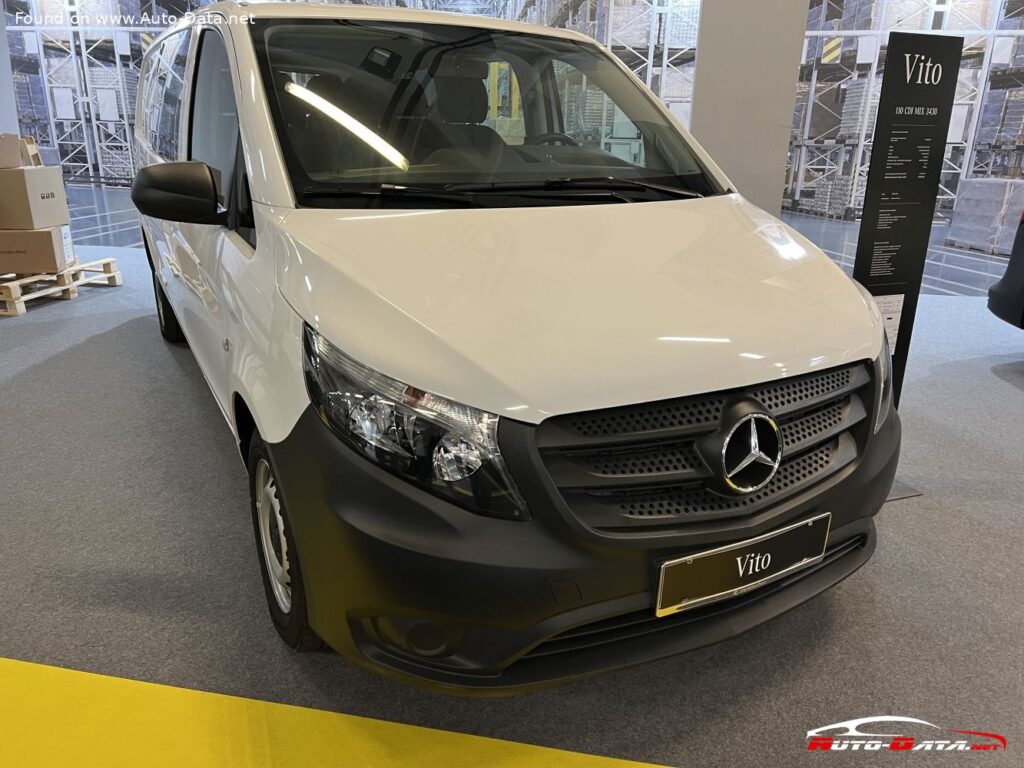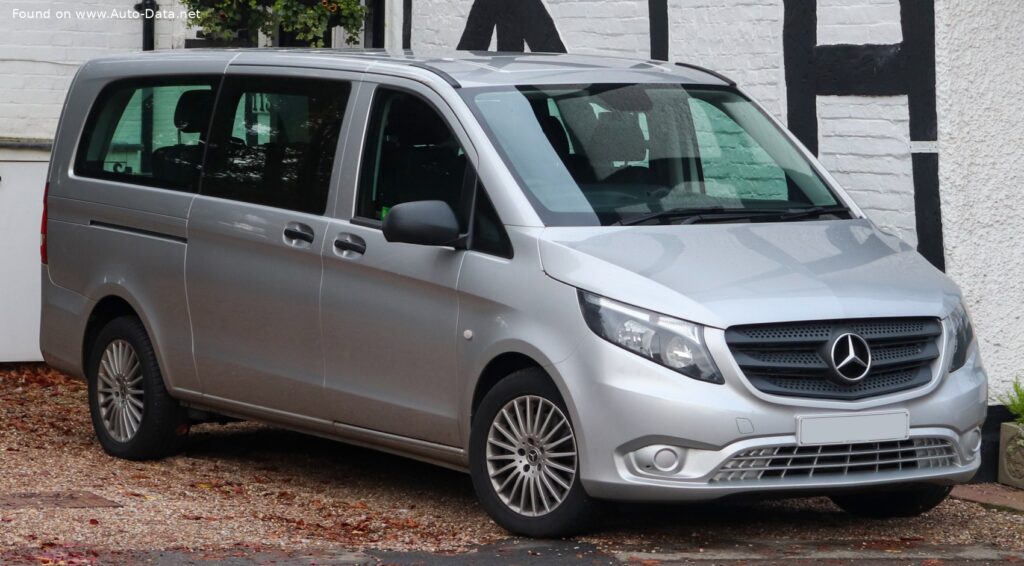
The Mercedes-Benz Vito (W447) Tourer Extra Long 119 CDI (190 Hp) Automatic represents a highly versatile and robust offering within the European light commercial vehicle segment, serving primarily as a passenger shuttle or a configurable van for various business needs. Introduced in October 2014 and produced until February 2019, this particular iteration of the W447 generation, known for its extended wheelbase and increased passenger capacity, solidified Mercedes-Benz’s reputation for combining practicality with premium engineering. Unlike many of its counterparts, the Vito Tourer emphasizes comfort and refinement, making it a popular choice for airport transfers, hotel shuttles, and large families across Europe and other global markets where it was sold. While not a common sight on American roads, the Vito’s engineering principles and design ethos are deeply rooted in Mercedes-Benz’s global commitment to quality, efficiency, and durability, translating its commercial vehicle expertise into a compelling package. The Tourer Extra Long variant, specifically designed to accommodate up to nine occupants, showcases the brand’s ability to maximize interior space and passenger comfort without compromising on driving dynamics or fuel efficiency.
Engine and Performance of the Mercedes-Benz Vito (W447) Tourer Extra Long 119 CDI (190 Hp) Automatic
At the heart of the Mercedes-Benz Vito (W447) Tourer Extra Long 119 CDI (190 Hp) Automatic lies a sophisticated powertrain meticulously engineered for both power and efficiency. This model is equipped with Mercedes-Benz’s renowned OM651 DE22LA engine, a 2.1-liter (specifically, 2143 cubic centimeters or 130.77 cubic inches) inline four-cylinder diesel unit. This engine configuration, positioned longitudinally at the front, is a testament to modern diesel technology, featuring a common rail fuel injection system and an advanced turbocharger with an intercooler. These technologies work in concert to deliver a robust output of 190 horsepower at 3800 revolutions per minute, providing ample power for hauling a full complement of passengers or significant cargo loads.
Crucially for a vehicle of its intended purpose, the engine also produces a substantial 324.53 pound-feet of torque, available across a broad and usable range from 1400 to 2400 rpm. This wide torque band is instrumental in ensuring strong acceleration from a standstill, effortless highway cruising, and confident towing capabilities, even when the vehicle is fully loaded. The power is efficiently managed by a 7-speed G-TRONIC PLUS automatic transmission, a sophisticated unit that provides smooth and precise gear changes, optimizing both performance and fuel economy. The drivetrain architecture is traditional for such a vehicle, with the internal combustion engine driving the rear wheels, a configuration known for its durability, superior traction under load, and balanced handling characteristics, particularly when carrying heavy loads.
Despite its considerable size and passenger capacity, the Vito 119 CDI demonstrates impressive fuel efficiency for its class. The combined fuel consumption is rated at 35.6 US miles per gallon, a remarkable figure for a large van. In urban driving, it achieves approximately 35.1 US mpg, while extra-urban conditions see it reach 36.2 US mpg. These figures underscore Mercedes-Benz’s commitment to economical operation, a key factor for commercial operators and private owners alike. The vehicle also adheres to the stringent Euro 6c emission standard, with CO2 emissions of 174 grams per kilometer, reflecting its environmental consciousness. The engine’s design includes a particulate filter as standard, further reducing harmful emissions. With an engine oil capacity of 11.1 US quarts and a coolant capacity of 10.99 US quarts, the OM651 DE22LA is designed for longevity and ease of maintenance, crucial aspects for vehicles that often operate under demanding conditions. The weight-to-power ratio of 10.1 kilograms per horsepower and a weight-to-torque ratio of 4.4 kilograms per Newton-meter further highlight the engine’s capability to move the substantial curb weight of the extra-long Vito with authority.
Design and Features
The Mercedes-Benz Vito (W447) Tourer Extra Long is characterized by its functional yet elegant design, a hallmark of Mercedes-Benz vehicles. As a van body type, its primary focus is on maximizing interior space and utility, a goal it achieves with its extended dimensions. Measuring 211.42 inches in length, 75.91 inches in width, and standing between 74.41 and 75.2 inches tall, the Tourer Extra Long variant offers a capacious interior capable of comfortably seating nine individuals across multiple rows. The generous 135.04-inch wheelbase not only contributes to the expansive cabin but also provides a stable and composed ride, essential for passenger comfort over long journeys.
Access to the interior is facilitated by 4 or 5 doors, typically including a large sliding side door on at least one side for easy entry and exit for rear passengers, complemented by conventional front doors and either a tailgate or barn-style rear doors for cargo access. Even with all nine seats in place, the Vito Tourer Extra Long offers a minimum trunk (boot) space of 49.09 cubic feet (1390 liters), demonstrating its practicality for carrying luggage or equipment alongside passengers. This flexibility makes it an ideal choice for a wide array of uses, from executive shuttles to large family vehicles.
Beyond its spaciousness, the Vito Tourer incorporates a range of features designed to enhance safety, convenience, and driving dynamics. The vehicle is equipped with disc brakes on both the front and rear axles, ensuring strong and consistent stopping power. An Anti-lock Braking System (ABS) is standard, providing critical stability during emergency braking situations. The front suspension system features an independent McPherson strut design with coil springs and an anti-roll bar, delivering a comfortable ride and precise handling. The rear suspension, while designed for load-bearing, also contributes to the vehicle’s overall stability and passenger comfort.
The Vito Tourer rides on 17-inch wheels, shod with 225/55 R17 tires, specified to handle the vehicle’s weight and performance capabilities. These tire and wheel combinations are carefully selected to provide a balance of grip, ride comfort, and durability. Practical considerations are also evident in its utility specifications: a fuel tank capacity of 15.06 US gallons, an AdBlue tank of 3.04 US gallons for emissions control, and impressive towing capacities of 4409.25 pounds with brakes and 1653.47 pounds without brakes. A maximum roof load of 330.69 pounds adds to its versatility, allowing for additional cargo carrying options. The minimum turning circle of 44.95 feet, while substantial for a vehicle of this size, is manageable for urban maneuvering, reflecting thoughtful design for its operating environment.
Technical Specifications
| Brand | Mercedes-Benz |
| Model | Vito |
| Generation | Vito (W447) Tourer Extra Long |
| Type (Engine) | 119 CDI (190 Hp) Automatic |
| Start of production | October, 2014 year |
| End of production | February, 2019 year |
| Powertrain Architecture | Internal Combustion engine |
| Body type | Van |
| Seats | 9 |
| Doors | 4/5 |
| Fuel consumption (economy) – urban | 35.1 US mpg (6.7 l/100 km) |
| Fuel consumption (economy) – extra urban | 36.2 US mpg (6.5 l/100 km) |
| Fuel consumption (economy) – combined | 35.6 US mpg (6.6 l/100 km) |
| CO2 emissions | 174 g/km |
| Fuel Type | Diesel |
| Emission standard | Euro 6c |
| Weight-to-power ratio | 10.1 kg/Hp |
| Weight-to-torque ratio | 4.4 kg/Nm |
| Power | 190 Hp @ 3800 rpm |
| Power per liter | 88.7 Hp/l |
| Torque | 324.53 lb.-ft. @ 1400-2400 rpm (440 Nm) |
| Engine layout | Front, Longitudinal |
| Engine Model/Code | OM651 DE22LA |
| Engine displacement | 130.77 cu. in. (2143 cm3) |
| Number of cylinders | 4 |
| Engine configuration | Inline |
| Cylinder Bore | 3.27 in. (83 mm) |
| Piston Stroke | 3.9 in. (99 mm) |
| Compression ratio | 16.2:1 |
| Number of valves per cylinder | 4 |
| Fuel injection system | Diesel Commonrail |
| Engine aspiration | Turbocharger, Intercooler |
| Engine oil capacity | 11.1 US qt (10.5 l) |
| Coolant | 10.99 US qt (10.4 l) |
| Engine systems | Particulate filter |
| Kerb Weight | 4232.88 – 4292.4 lbs. (1920-1947 kg) |
| Max. weight | 7054.79 lbs. (3200 kg) |
| Max load | 2762.39 – 2821.92 lbs. (1253-1280 kg) |
| Trunk (boot) space – minimum | 49.09 cu. ft. (1390 l) |
| Fuel tank capacity | 15.06 US gal (57 l) |
| AdBlue tank | 3.04 US gal (11.5 l) |
| Max. roof load | 330.69 lbs. (150 kg) |
| Permitted trailer load with brakes (12%) | 4409.25 lbs. (2000 kg) |
| Permitted trailer load without brakes | 1653.47 lbs. (750 kg) |
| Length | 211.42 in. (5370 mm) |
| Width | 75.91 in. (1928 mm) |
| Height | 74.41 – 75.2 in. (1890-1910 mm) |
| Wheelbase | 135.04 in. (3430 mm) |
| Minimum turning circle (turning diameter) | 44.95 ft. (13.7 m) |
| Drivetrain Architecture | The Internal combustion engine (ICE) drives the rear wheels of the vehicle. |
| Drive wheel | Rear wheel drive |
| Number of gears and type of gearbox | 7 gears, automatic transmission G-TRONIC PLUS |
| Front suspension | Independent, type McPherson with coil spring and anti-roll bar |
| Front brakes | Disc |
| Rear brakes | Disc |
| Assisting systems | ABS (Anti-lock braking system) |
| Tires size | 225/55 R17 104/102 H |
| Wheel rims size | 6.5J x 17; 7J x 17 |