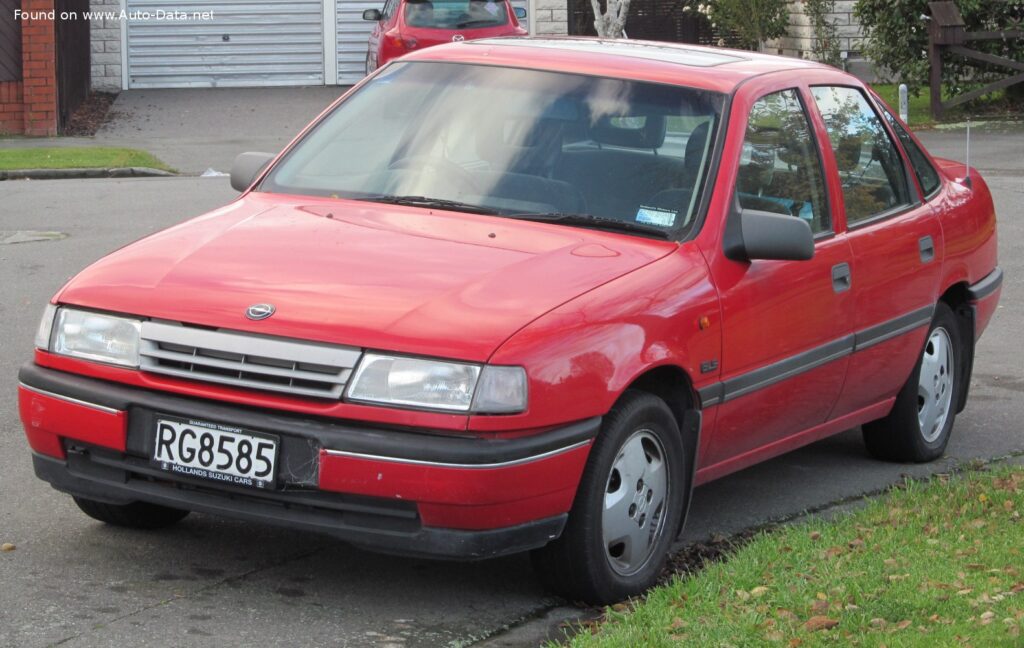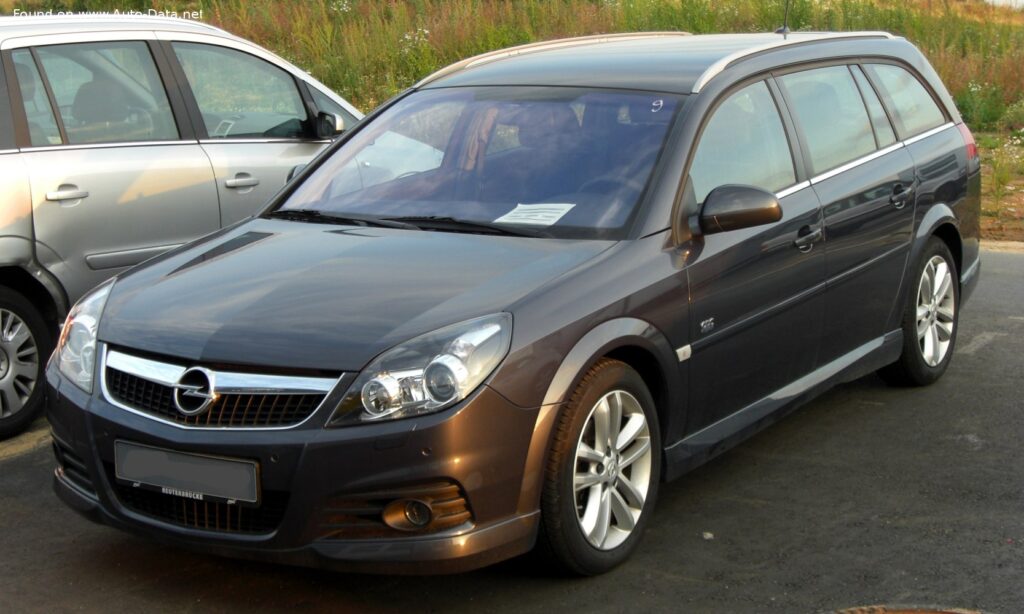
The Opel Vectra C Caravan (facelift 2005) 2.2i 16V DIRECT (155 Hp) represents a significant offering within the European D-segment, a market segment characterized by its focus on family-oriented mid-size vehicles that balance comfort, practicality, and driving dynamics. As a product of Opel, a German automotive manufacturer traditionally strong in its home market and across Europe, the Vectra C Caravan was designed to compete with established rivals by providing a compelling combination of space, efficiency, and contemporary technology for its time. This particular variant, introduced as part of the 2005 facelift, showcased Opel’s commitment to refining its successful third-generation Vectra lineup, which had been in production since 2002. The “Caravan” designation in Opel’s nomenclature traditionally denotes a station wagon or estate body style, emphasizing its utility and cargo-carrying capabilities. The 2.2i 16V DIRECT engine, a highlight of this model, utilized advanced direct injection technology, a relatively sophisticated feature for a mainstream family car in the mid-2000s, promising improved fuel economy and performance. Positioned as a versatile workhorse for families and business users alike, the Vectra C Caravan aimed to deliver a comfortable and capable driving experience, cementing its role as a practical and reliable choice in its primary European and other international markets where Opel (or its Vauxhall counterpart in the UK) operated.
Engine & Performance of the Opel Vectra C Caravan (facelift 2005)
At the heart of the Opel Vectra C Caravan (facelift 2005) 2.2i 16V DIRECT (155 Hp) lies a meticulously engineered powertrain designed for a blend of responsiveness and efficiency. This specific model is equipped with the Z22YH engine, a 2.2-liter (2198 cm3 or 134.13 cu. in.) inline four-cylinder unit. This engine configuration, with its DOHC (Double Overhead Camshaft) valvetrain and four valves per cylinder, was a testament to modern engineering practices, ensuring optimal airflow for combustion. A key technological differentiator for this engine was its “DIRECT” designation, indicating a direct fuel injection system. Unlike conventional multi-point injection systems that spray fuel into the intake manifold, direct injection delivers fuel directly into the combustion chamber, allowing for more precise control over the air-fuel mixture. This typically results in better fuel atomization, leading to improved combustion efficiency, increased power output, and reduced emissions, especially under varying load conditions.
The engine generates a respectable 155 horsepower at 5600 rpm, translating to a power-per-liter output of 70.5 horsepower per liter, which was competitive for a naturally aspirated engine of its era. Torque figures are equally impressive for a family wagon, producing 220 Nm (162.26 lb.-ft.) at a relatively accessible 3800 rpm. This broad torque band ensures ample pulling power across a range of driving scenarios, from city commuting to highway cruising with a full load. The engine’s high compression ratio of 12:1 further underscores its efficiency-focused design, maximizing the energy extracted from each liter of gasoline. Power is delivered to the front wheels via a smooth-shifting 5-speed manual transmission, a common and reliable choice for this segment, offering direct driver engagement and control. The vehicle’s performance figures reflect this balanced approach: an acceleration time from 0 to 60 mph in a brisk 9.6 seconds and a maximum speed of 131.73 mph (212 km/h). These numbers indicate that the Vectra C Caravan was more than capable of handling typical European highway speeds and providing confident overtaking maneuvers. Fuel economy was also a strong suit, with a combined rating of 29 US mpg (8.1 l/100 km), demonstrating the effectiveness of the direct injection system in managing fuel consumption for a vehicle of its size and power.
Design & Features: Practicality and Refinement
The Opel Vectra C Caravan (facelift 2005) embodies the quintessential European station wagon, prioritizing generous interior space, cargo versatility, and a refined driving experience. Its body type, a 5-door station wagon (estate), was designed from the outset to offer maximum utility without compromising on aesthetics. The facelift introduced in 2005 brought subtle yet effective updates to the exterior styling, including revised front fascias, lighting clusters, and potentially interior trim enhancements, keeping the Vectra C fresh and competitive. With a length of 190.51 inches (4839 mm), a width of 70.79 inches (1798 mm), and a height of 59.06 inches (1500 mm), the Caravan possessed a substantial footprint, contributing to its commanding road presence and, more importantly, its expansive interior volume. The long wheelbase of 111.42 inches (2830 mm) was particularly beneficial, maximizing passenger legroom for all five occupants and ensuring a stable ride quality.
Cargo capacity is a standout feature, crucial for any station wagon. The Vectra C Caravan offered an impressive minimum trunk space of 18.72 cubic feet (530 liters) with all seats in place. When the rear seats were folded down, this expanded dramatically to a cavernous 65.33 cubic feet (1850 liters), making it exceptionally practical for carrying large items, luggage for extended trips, or even serving as a light commercial vehicle. The kerb weight of 3417.17 pounds (1550 kg) and a maximum permissible weight of 4596.64 pounds (2085 kg) highlight its robust construction and significant load-carrying capability, with a maximum payload of 1179.47 pounds (535 kg). The chassis was engineered for comfort and predictable handling, featuring a spring strut front suspension and a multi-link rear suspension system (“several levers and rods”), which was advanced for its time and contributed to both ride composure and agile dynamics. Safety features, paramount in a family vehicle, included ventilated disc brakes at the front and disc brakes at the rear, complemented by an Anti-lock Braking System (ABS) as standard, providing confident stopping power. The steering system utilized a rack and pinion setup, offering precise control. The vehicle rode on 215/55 R16 tires mounted on 6.5J X 16 wheel rims, providing a good balance between comfort, grip, and aesthetic appeal. The 60-liter (15.85 US gal) fuel tank capacity ensured a practical cruising range, aligning with its role as a capable long-distance family transporter.
Technical Specifications
| Brand | Opel |
| Model | Vectra |
| Generation | Vectra C Caravan (facelift 2005) |
| Type (Engine) | 2.2i 16V DIRECT (155 Hp) |
| Start of production | 2005 year |
| End of production | August, 2008 year |
| Powertrain Architecture | Internal Combustion engine |
| Body type | Station wagon (estate) |
| Seats | 5 |
| Doors | 5 |
| Fuel consumption (economy) – urban | 10.6 l/100 km (22.2 US mpg) |
| Fuel consumption (economy) – extra urban | 6.6 l/100 km (35.6 US mpg) |
| Fuel consumption (economy) – combined | 8.1 l/100 km (29 US mpg) |
| Fuel Type | Petrol (Gasoline) |
| Acceleration 0 – 60 mph | 9.6 sec |
| Maximum speed | 212 km/h (131.73 mph) |
| Weight-to-power ratio | 10 kg/Hp, 100 Hp/tonne |
| Weight-to-torque ratio | 7 kg/Nm, 141.9 Nm/tonne |
| Power | 155 Hp @ 5600 rpm |
| Power per liter | 70.5 Hp/l |
| Torque | 220 Nm @ 3800 rpm (162.26 lb.-ft. @ 3800 rpm) |
| Engine layout | Front, Transverse |
| Engine Model/Code | Z22YH |
| Engine displacement | 2198 cm3 (2.2 l, 134.13 cu. in.) |
| Number of cylinders | 4 |
| Engine configuration | Inline |
| Cylinder Bore | 86 mm (3.39 in.) |
| Piston Stroke | 94.6 mm (3.72 in.) |
| Compression ratio | 12:1 |
| Number of valves per cylinder | 4 |
| Fuel injection system | Direct injection |
| Engine aspiration | Naturally aspirated engine |
| Valvetrain | DOHC |
| Engine oil capacity | 5 l (5.28 US qt) |
| Coolant | 7.1 l (7.5 US qt) |
| Kerb Weight | 1550 kg (3417.17 lbs) |
| Max. weight | 2085 kg (4596.64 lbs) |
| Max load | 535 kg (1179.47 lbs) |
| Trunk (boot) space – minimum | 530 l (18.72 cu. ft.) |
| Trunk (boot) space – maximum | 1850 l (65.33 cu. ft.) |
| Fuel tank capacity | 60 l (15.85 US gal) |
| Length | 4839 mm (190.51 in.) |
| Width | 1798 mm (70.79 in.) |
| Height | 1500 mm (59.06 in.) |
| Wheelbase | 2830 mm (111.42 in.) |
| Front track | 1536 mm (60.47 in.) |
| Rear (Back) track | 1525 mm (60.04 in.) |
| Drivetrain Architecture | The Internal combustion engine (ICE) drives the front wheels of the vehicle. |
| Drive wheel | Front wheel drive |
| Number of gears and type of gearbox | 5 gears, manual transmission |
| Front suspension | Spring Strut |
| Rear suspension | Several levers and rods |
| Front brakes | Ventilated discs |
| Rear brakes | Disc |
| Assisting systems | ABS (Anti-lock braking system) |
| Steering type | Steering rack and pinion |
| Tires size | 215/55 R16 |
| Wheel rims size | 6.5J X 16 |