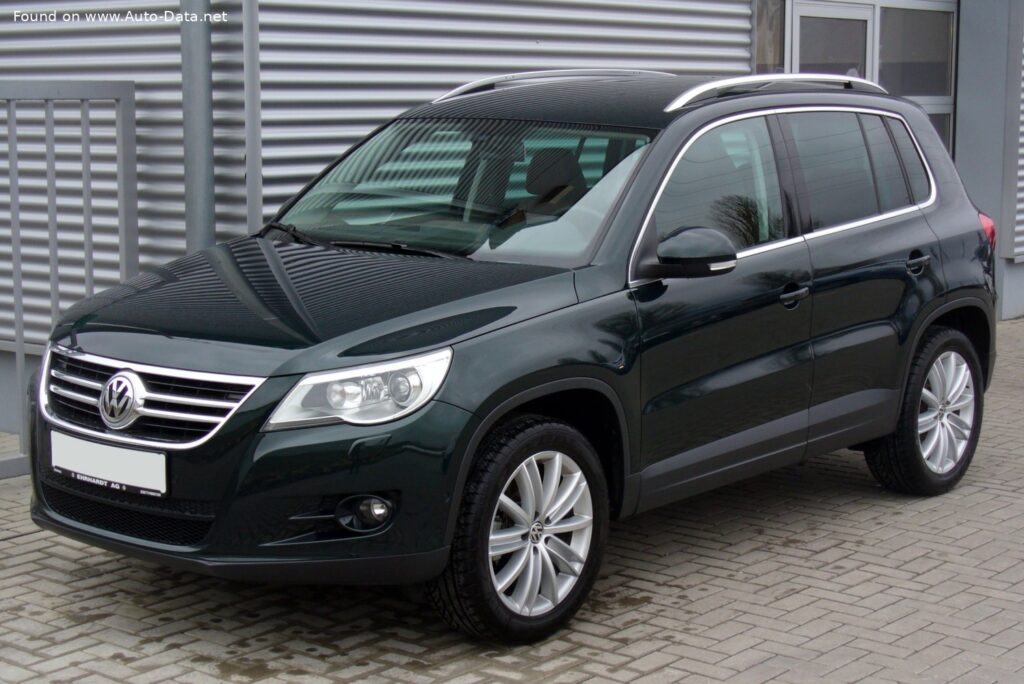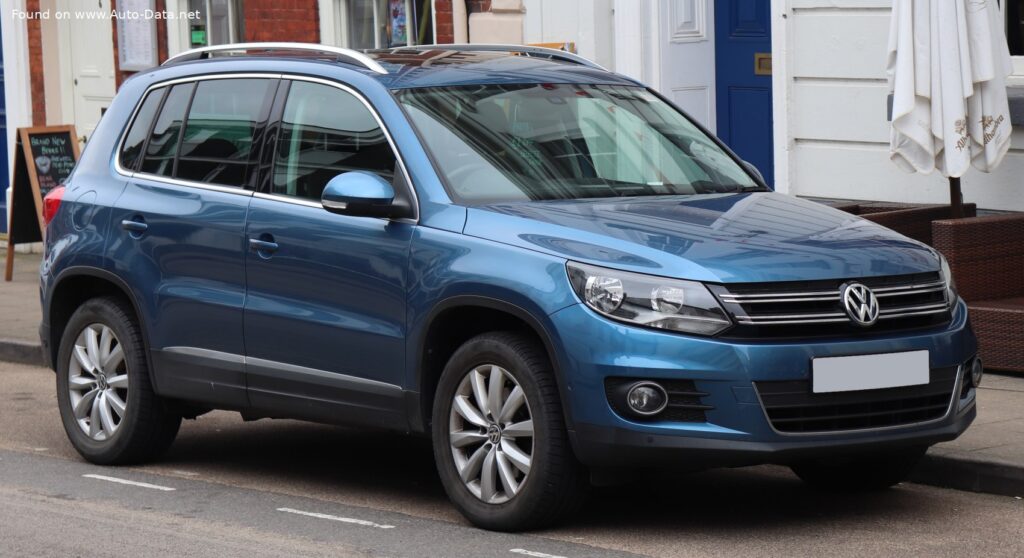
The Volkswagen Tiguan I (facelift 2011) 2.0 TDI BMT (150 Hp) represents a compelling chapter in the evolution of the compact SUV segment, particularly within the European market. As part of the first-generation Tiguan lineup, which debuted globally in 2007, this specific variant showcases Volkswagen’s commitment to combining practical utility with advanced diesel powertrain technology and efficiency. The 2011 facelift brought subtle yet significant refinements to the Tiguan, enhancing its aesthetic appeal, interior quality, and technological offerings, aligning it with Volkswagen’s contemporary design language and engineering advancements. Positioned as a versatile five-seater SUV, the Tiguan I successfully carved out a niche for itself, offering a more refined and car-like driving experience compared to many of its rugged competitors, while still providing ample space and capability for urban families and outdoor enthusiasts alike. This 2.0 TDI BMT (BlueMotion Technology) model, produced briefly in 2015 at the very end of the first generation’s lifecycle, was a prime example of Volkswagen’s focus on fuel economy and reduced emissions, particularly relevant in markets with a strong preference for diesel engines.
Powertrain and Performance of the Volkswagen Tiguan I (facelift 2011) 2.0 TDI BMT (150 Hp)
At the heart of this particular Tiguan model lies a sophisticated 2.0-liter TDI (Turbocharged Direct Injection) diesel engine, designated with the internal code CUVC, delivering a robust 150 horsepower (Hp) at 3500-4000 rpm. This inline four-cylinder engine is transversely mounted at the front, driving the front wheels through a precise 6-speed manual transmission, a configuration known for its efficiency and direct driver engagement. The engine’s displacement of 1968 cubic centimeters (approximately 120.09 cu. in.) is optimized for a blend of power and fuel economy, a hallmark of Volkswagen’s diesel engineering. Torque output is particularly impressive for its class, peaking at 340 Newton-meters (250.77 lb.-ft.) across a broad range of 1750-3000 rpm. This substantial torque ensures strong acceleration and effortless cruising, whether navigating city streets or tackling highway stretches, and contributes to its commendable towing capabilities.
Performance figures underscore the engine’s capability. The Volkswagen Tiguan I (facelift 2011) 2.0 TDI BMT (150 Hp) accelerates from 0 to 60 mph in a swift 9.3 seconds (0-100 km/h in 9.8 seconds), making it agile enough for most driving scenarios. Its maximum speed is rated at 123.03 mph (198 km/h). Beyond raw power, the BlueMotion Technology (BMT) integration is crucial to this model’s appeal. BMT encompasses a suite of efficiency-enhancing features, including a Start & Stop System that automatically shuts off the engine when the vehicle is stationary and restarts it upon clutch engagement, significantly reducing fuel consumption and emissions in urban traffic. The presence of a particulate filter further ensures compliance with stringent Euro 6 emission standards, minimizing harmful exhaust gases. The engine’s design features a DOHC (Double Overhead Camshaft) valvetrain and a common rail fuel injection system, which precisely controls fuel delivery for optimal combustion, efficiency, and reduced noise levels. A turbocharger with an intercooler ensures dense, cool air enters the engine, maximizing power output and efficiency across the rev range.
Fuel economy is a standout attribute of this 2.0 TDI BMT variant. Under the NEDC (New European Driving Cycle) testing protocol, the Tiguan achieves an impressive combined fuel consumption of 5.0 liters per 100 kilometers, translating to approximately 47 US mpg (56.5 UK mpg). Urban driving yields 5.8 l/100 km (40.6 US mpg), while extra-urban conditions see consumption drop to just 4.5 l/100 km (52.3 US mpg). These figures highlight the economic benefits of advanced diesel technology, particularly for drivers covering significant mileage. The CO2 emissions are kept to a respectable 130 g/km, further emphasizing its environmentally conscious design for its era.
Design and Features of the Tiguan I (facelift 2011)
The Volkswagen Tiguan I (facelift 2011) 2.0 TDI BMT (150 Hp) maintains the practical and understated design language characteristic of Volkswagen. As a five-door SUV with seating for five occupants, it prioritizes functionality and comfort. The 2011 facelift introduced a refreshed front fascia, including new headlights that echoed the design of other contemporary Volkswagen models like the Golf and Passat, along with a revised grille and bumper. These updates gave the Tiguan a sharper, more modern appearance while retaining its familiar, robust stance. The body type, an SUV, naturally offers a commanding driving position and enhanced visibility, attributes highly valued by consumers in this segment.
Inside, the Tiguan provides a well-appointed and ergonomically designed cabin. While specific luxury features are not detailed in the provided data, Volkswagen interiors of this era were known for their high-quality materials, solid construction, and intuitive controls. Practicality is a strong suit, with a minimum trunk (boot) space of 470 liters (16.6 cu. ft.), which expands to an impressive 1510 liters (53.33 cu. ft.) with the rear seats folded down, offering ample cargo capacity for luggage, groceries, or sports equipment. This flexibility makes the Tiguan a suitable choice for various lifestyles, from daily commuting to weekend adventures. The vehicle’s dimensions, including a length of 4426 mm (174.25 in.), width of 1809 mm (71.22 in.), and height of 1703 mm (67.05 in.), contribute to its maneuverable yet spacious character. A generous wheelbase of 2604 mm (102.52 in.) ensures stable handling and a comfortable ride for all passengers.
Safety and convenience features are integral to the Tiguan’s design. The inclusion of an Anti-lock Braking System (ABS) provides crucial stopping power and control in emergency situations. The electric power steering system offers light steering at low speeds for easy parking and adds more weight and precision at higher speeds for enhanced stability. The vehicle also boasts a respectable ground clearance of 200 mm (7.87 in.), along with approach, departure, and ramp-over angles of 18°, 25°, and 20° respectively, suggesting a degree of capability beyond paved roads, albeit primarily designed for urban and light off-road duties. With a maximum roof load of 75 kg (165.35 lbs.) and substantial towing capacities (up to 2100 kg / 4629.71 lbs. with brakes), the Tiguan is well-equipped for hauling extra gear or a small trailer, further extending its utility.
Chassis, Drivetrain, and Handling
The chassis and drivetrain architecture of the Volkswagen Tiguan I (facelift 2011) 2.0 TDI BMT (150 Hp) are engineered to deliver a balanced driving experience, combining comfort with confident handling. This specific variant features a front-wheel-drive (FWD) setup, where the internal combustion engine powers the front wheels, a common configuration for compact SUVs that prioritizes fuel efficiency and provides predictable handling characteristics. The FWD system, coupled with the 6-speed manual transmission, offers a direct and engaging driving feel, allowing the driver precise control over gear selection and power delivery.
The suspension system is designed to provide a comfortable ride while maintaining composure through corners. The front suspension utilizes an independent McPherson strut design, a widely adopted and effective setup known for its compact packaging and ability to absorb road imperfections. It is complemented by a transverse stabilizer bar, which helps reduce body roll during cornering, enhancing stability and handling. At the rear, an independent multi-link suspension system is employed, also featuring a transverse stabilizer. The multi-link design allows for greater control over wheel alignment and movement, contributing to improved ride quality, better traction, and more refined handling dynamics, especially over uneven surfaces. This combination of independent suspension systems at both ends ensures that the Tiguan offers a sophisticated and compliant ride, characteristic of Volkswagen vehicles.
Braking performance is handled by a robust system comprising ventilated discs at the front and solid discs at the rear. Ventilated discs are particularly effective at dissipating heat, reducing brake fade during repeated heavy braking, which is a crucial safety feature. The Anti-lock Braking System (ABS) is a standard assisting system, preventing wheel lock-up during hard braking and allowing the driver to maintain steering control. Steering is managed by a rack and pinion system, enhanced with electric power steering. This setup provides variable assistance, making steering lighter and easier at low speeds for parking and maneuvering, and firmer at higher speeds for greater stability and feedback. The vehicle rides on 215/65 R16 tires mounted on 6.5J x 16 wheel rims, a practical size that offers a good balance between ride comfort, grip, and tire availability. The minimum turning circle of 12 meters (39.37 ft.) indicates decent maneuverability for an SUV of its size, aiding in urban environments.
Technical Specifications
| Brand | Volkswagen |
| Model | Tiguan |
| Generation | Tiguan I (facelift 2011) |
| Engine Type | 2.0 TDI BMT (150 Hp) |
| Production Start | 2015 year |
| Production End | 2015 year |
| Powertrain Architecture | Internal Combustion engine |
| Body type | SUV |
| Seats | 5 |
| Doors | 5 |
| Fuel consumption (urban NEDC) | 5.8 l/100 km (40.6 US mpg) |
| Fuel consumption (extra urban NEDC) | 4.5 l/100 km (52.3 US mpg) |
| Fuel consumption (combined NEDC) | 5.0 l/100 km (47 US mpg) |
| CO2 emissions (NEDC) | 130 g/km |
| Fuel Type | Diesel |
| Acceleration 0 – 60 mph | 9.3 sec |
| Acceleration 0 – 100 km/h | 9.8 sec |
| Maximum speed | 198 km/h (123.03 mph) |
| Emission standard | Euro 6 |
| Weight-to-power ratio | 10.1 kg/Hp |
| Weight-to-torque ratio | 4.5 kg/Nm |
| Power | 150 Hp @ 3500-4000 rpm |
| Power per liter | 76.2 Hp/l |
| Torque | 340 Nm @ 1750-3000 rpm (250.77 lb.-ft.) |
| Engine layout | Front, Transverse |
| Engine Model/Code | CUVC |
| Engine displacement | 1968 cm3 (120.09 cu. in.) |
| Number of cylinders | 4 |
| Engine configuration | Inline |
| Cylinder Bore | 81 mm (3.19 in.) |
| Piston Stroke | 95.5 mm (3.76 in.) |
| Number of valves per cylinder | 4 |
| Fuel injection system | Diesel Commonrail |
| Engine aspiration | Turbocharger, Intercooler |
| Valvetrain | DOHC |
| Engine oil capacity | 4.7 l (4.97 US qt) |
| Engine systems | Start & Stop System, Particulate filter |
| Kerb Weight | 1522 kg (3355.44 lbs.) |
| Max. weight | 2150 kg (4739.94 lbs.) |
| Max load | 628 kg (1384.5 lbs.) |
| Trunk (boot) space – minimum | 470 l (16.6 cu. ft.) |
| Trunk (boot) space – maximum |