
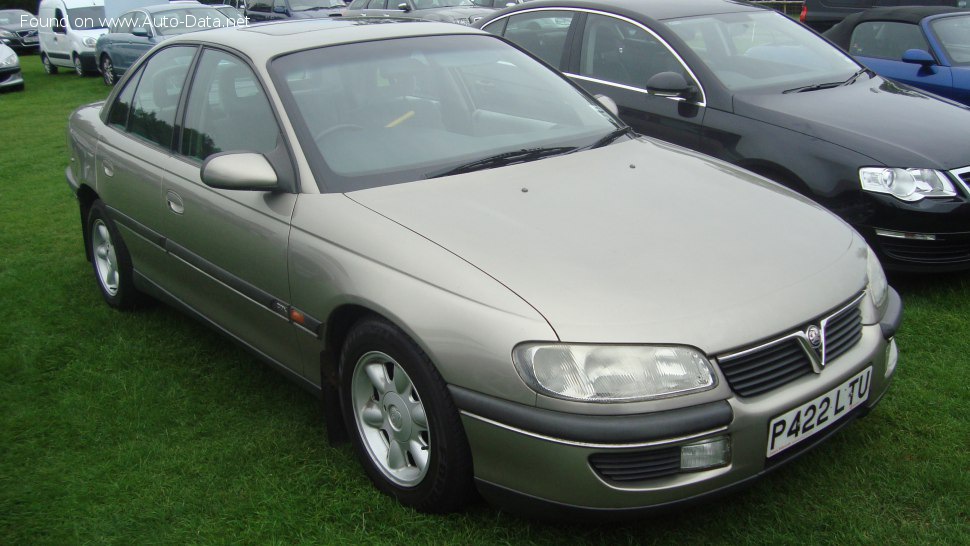
The Vauxhall Omega B 5.7 V8 (310 Hp) Automatic represents a fascinating, albeit short-lived, chapter in the history of European executive sedans, particularly for the UK market where the Vauxhall brand operates as part of General Motors. Introduced in 2000 and ceasing production in 2001, this particular variant of the Omega B generation was a rare and potent offering, transforming a capable, comfortable large sedan into a genuine performance sleeper. While the Omega itself was a well-regarded executive car in Europe, known for its spacious interior and refined ride, the decision to shoehorn a powerful 5.7-liter V8 engine from General Motors’ LS family (specifically, a variant of the Gen III Small Block, often found in Australian Holden Commodores and American Chevrolet models) elevated its status considerably. This high-performance iteration of the Vauxhall Omega B 5.7 V8 (310 Hp) Automatic was not officially offered in the United States, making it a unique example of transatlantic engineering collaboration within the GM global network, tailored for specific regional markets.
Engine & Performance of the Vauxhall Omega B 5.7 V8 (310 Hp) Automatic
At the heart of the Vauxhall Omega B 5.7 V8 (310 Hp) Automatic lies its formidable 5.7-liter V8 engine, an internal combustion powerplant that dramatically reshaped the car’s character. Bearing the engine code Y57XE, this naturally aspirated V-engine delivered a robust 310 horsepower (Hp) and a substantial 331.9 lb.-ft. (450 Nm) of torque, peaking at 4400 rpm. With an engine displacement of 5665 cubic centimeters (345.7 cu. in.), the power output per liter stood at a respectable 54.7 Hp/l, showcasing its efficiency for a naturally aspirated unit of its era. The engine featured a classic V8 configuration with 8 cylinders, a bore of 3.9 inches (99 mm), and a piston stroke of 3.62 inches (92 mm), yielding a compression ratio of 10.1:1. Each cylinder utilized two valves, and fuel delivery was managed by a multi-port manifold injection system, ensuring precise fuel metering and combustion.
Power was delivered to the rear wheels via a 4-speed automatic transmission, a choice that emphasized smooth, effortless cruising and a relaxed driving experience, despite the underlying performance potential. This rear-wheel-drive architecture, combined with the longitudinal engine layout, provided a balanced chassis dynamics characteristic of premium executive sedans. The performance figures were impressive for a car of its class and time, with a maximum speed of 155.34 mph (250 km/h), a testament to the V8’s capabilities. While specific acceleration times were not provided, the generous torque output at moderate RPMs suggests strong, linear acceleration from a standstill and potent in-gear flexibility. Fuel consumption, as expected for a large V8 sedan, registered at an urban economy of 13.1 US mpg (18 l/100 km), reflecting the performance-oriented nature of the powertrain. The engine oil capacity was 6.34 US quarts (6 liters), highlighting the lubrication requirements of such a powerful unit.
Design & Features of the Vauxhall Omega B
The Vauxhall Omega B, in its 5.7 V8 guise, retained the elegant and understated design language of the standard Omega B, a model that underwent a significant facelift in 1999, introducing updated styling cues and interior enhancements. As a traditional sedan, it offered a classic four-door, five-seat configuration, prioritizing passenger comfort and practicality. Its dimensions were substantial, measuring 188.46 inches (4787 mm) in length, 70.31 inches (1786 mm) in width (or 77.17 inches / 1960 mm including mirrors), and 57.28 inches (1455 mm) in height. A generous wheelbase of 107.48 inches (2730 mm) contributed significantly to the Omega’s renowned stable ride and expansive interior space, particularly for rear-seat passengers. The rear overhang measured 44.88 inches (1140 mm), contributing to the car’s balanced proportions.
Despite its size, the Omega B boasted a respectable drag coefficient (Cd) of 0.29, indicating a degree of aerodynamic refinement that contributed to both fuel efficiency and reduced wind noise at higher speeds. The chassis was engineered for comfort and control, featuring an independent McPherson strut front suspension with coil springs and an anti-roll bar, paired with an independent multi-link suspension at the rear. This sophisticated setup provided a compliant ride while maintaining composure during more spirited driving. Stopping power was ensured by ventilated disc brakes on both the front and rear axles, complemented by an Anti-lock Braking System (ABS) for enhanced safety during emergency braking maneuvers. The minimum turning circle of 33.46 feet (10.2 meters) allowed for decent maneuverability in urban environments, despite the car’s overall length.
Inside, the Omega B offered a spacious and well-appointed cabin. The trunk (boot) space was generous, providing up to 18.72 cubic feet (530 liters) of cargo capacity, making it suitable for long journeys or family use. A fuel tank capacity of 19.81 US gallons (75 liters) ensured a reasonable cruising range, albeit one that would be tested by the V8 engine’s thirst. For its time, the Omega B represented a blend of traditional executive comfort with advanced engineering, and the V8 variant stood as a unique performance flagship, offering a distinctive driving experience not commonly found in its European segment.
Technical Specifications
| Brand | Vauxhall |
| Model | Omega |
| Generation | Omega B |
| Type (Engine) | 5.7 V8 (310 Hp) Automatic |
| Start of production | 2000 year |
| End of production | 2001 year |
| Powertrain Architecture | Internal Combustion engine |
| Body type | Sedan |
| Seats | 5 |
| Doors | 4 |
| Fuel consumption (economy) – urban | 18 l/100 km (13.1 US mpg) |
| Fuel Type | Petrol (Gasoline) |
| Maximum speed | 250 km/h (155.34 mph) |
| Power | 310 Hp |
| Power per litre | 54.7 Hp/l |
| Torque | 450 Nm @ 4400 rpm (331.9 lb.-ft. @ 4400 rpm) |
| Engine layout | Front, Longitudinal |
| Engine Model/Code | Y57XE |
| Engine displacement | 5665 cm3 (345.7 cu. in.) |
| Number of cylinders | 8 |
| Engine configuration | V-engine |
| Cylinder Bore | 99 mm (3.9 in.) |
| Piston Stroke | 92 mm (3.62 in.) |
| Compression ratio | 10.1:1 |
| Number of valves per cylinder | 2 |
| Fuel injection system | Multi-port manifold injection |
| Engine aspiration | Naturally aspirated engine |
| Engine oil capacity | 6 l (6.34 US qt) |
| Trunk (boot) space – maximum | 530 l (18.72 cu. ft.) |
| Fuel tank capacity | 75 l (19.81 US gal) |
| Length | 4787 mm (188.46 in.) |
| Width | 1786 mm (70.31 in.) |
| Width including mirrors | 1960 mm (77.17 in.) |
| Height | 1455 mm (57.28 in.) |
| Wheelbase | 2730 mm (107.48 in.) |
| Rear overhang | 1140 mm (44.88 in.) |
| Drag coefficient (Cd) | 0.29 |
| Minimum turning circle (turning diameter) | 10.2 m (33.46 ft.) |
| Drivetrain Architecture | The Internal combustion engine (ICE) drives the rear wheels of the vehicle. |
| Drive wheel | Rear wheel drive |
| Number of gears and type of gearbox | 4 gears, automatic transmission |
| Front suspension | Independent, type McPherson with coil spring and anti-roll bar |
| Rear suspension | Independent multi-link suspension |
| Front brakes | Ventilated discs |
| Rear brakes | Ventilated discs |
| Assisting systems | ABS (Anti-lock braking system) |
