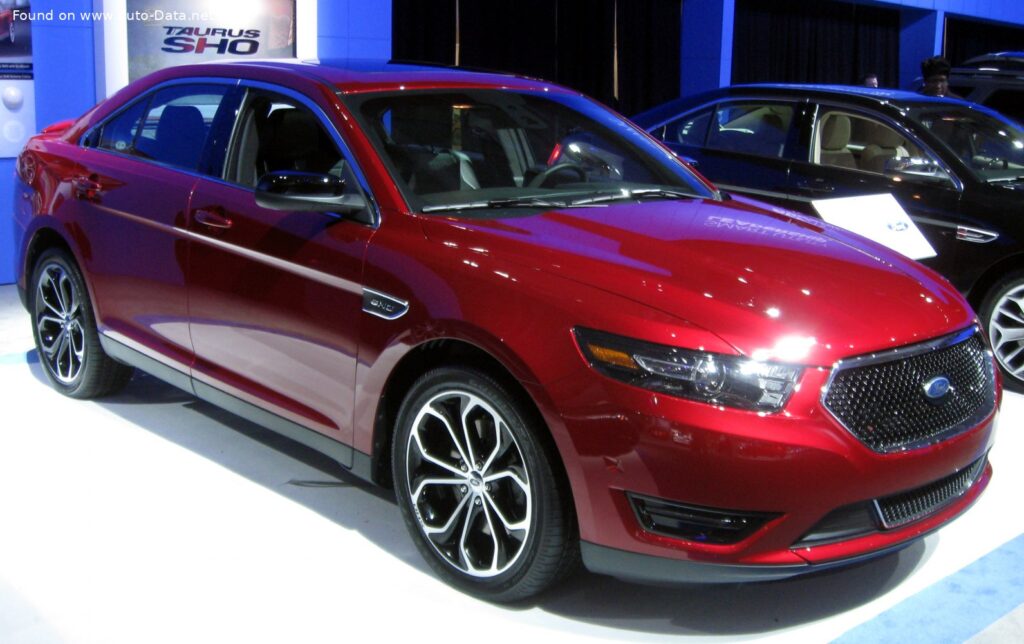
The Ford Taurus, a nameplate long synonymous with American sedans, underwent a significant evolution with its sixth generation, particularly with the comprehensive facelift introduced in 2013. This iteration, known as the Ford Taurus VI (facelift 2013), solidified its position in the full-size sedan segment, catering to a market that valued spaciousness, comfort, and a commanding road presence. Produced from 2013 until its eventual discontinuation in 2019, this particular model, equipped with the 3.5 V6 24V (288 Hp) AWD Automatic powertrain, represented a compelling blend of robust performance, all-weather capability, and a refined driving experience. Positioned as a flagship sedan in Ford’s North American lineup, it aimed to provide a premium feel without straying into luxury brand territory, offering a practical yet powerful option for discerning buyers. Its design language and engineering focus were distinctly American, emphasizing a strong, assertive stance and a comfortable, technology-rich interior.
Engine & Performance: The Power Within the Ford Taurus VI (facelift 2013)
At the heart of the Ford Taurus VI (facelift 2013) 3.5 V6 24V (288 Hp) AWD Automatic lies the formidable Duratec 35 engine, a naturally aspirated V6 powerplant renowned for its smooth operation and robust output. This specific engine, displacing 3.5 liters (3496 cm3 or 213.34 cubic inches), delivers a peak power of 288 horsepower at a relatively high 6500 revolutions per minute. Torque, a crucial factor for real-world drivability and acceleration, is equally impressive, reaching 253.72 pound-feet (344 Nm) at 4000 rpm, ensuring ample pulling power across a broad rev range. The engine’s architecture features a V-configuration with six cylinders, each benefiting from four valves, contributing to efficient breathing and combustion. The advanced DOHC (Double Overhead Camshaft) valvetrain, coupled with Ti-VCT (Twin Independent Variable Camshaft Timing), precisely controls valve operation, optimizing performance and fuel efficiency across various driving conditions. Fuel is delivered via a multi-port manifold injection system, a proven technology for reliable and consistent power delivery.
Power is seamlessly transferred to all four wheels through an intelligent All-Wheel Drive (AWD) system, providing enhanced traction and stability, particularly in adverse weather conditions or on challenging road surfaces. Mated to the engine is a 6-speed SelectShift automatic transmission, offering the convenience of an automatic with the option for manual gear selection, allowing drivers a more engaging experience when desired. This powertrain combination results in a weight-to-power ratio of 6.6 kilograms per horsepower (151.3 Hp per tonne) and a weight-to-torque ratio of 5.5 kg/Nm (180.8 Nm per tonne), indicating a well-balanced performance profile for a vehicle of its size and segment.
Despite its substantial power output, the Ford Taurus VI (facelift 2013) exhibits respectable fuel economy for a full-size, AWD sedan. According to official figures, urban fuel consumption stands at 13 liters per 100 kilometers (18.1 US mpg). On the extra-urban cycle, it improves significantly to 9 liters per 100 kilometers (26.1 US mpg), while the combined average is 11.2 liters per 100 kilometers (21 US mpg). These figures underscore Ford’s commitment to balancing performance with everyday usability, making the Taurus a practical choice for both city commuting and longer highway journeys. The engine’s robust design and advanced features ensure a smooth, confident, and responsive driving experience, characteristic of a contemporary American sedan.
Design & Features: The Commanding Presence of the Ford Taurus
The Ford Taurus VI (facelift 2013) presented a bold and assertive design, reflecting its position as a full-size American sedan. With a length of 202.91 inches (5154 mm), a width of 76.18 inches (1935 mm), and a height of 60.71 inches (1542 mm), it commanded a significant footprint on the road. The substantial wheelbase of 112.91 inches (2868 mm) contributed to both its spacious interior and stable ride quality. The facelift introduced a more aggressive front fascia, featuring a prominent grille and redesigned headlights, giving the Taurus a more modern and upscale appearance. Its sleek profile was further enhanced by a drag coefficient (Cd) of 0.3, a respectable figure for a vehicle of its size, aiding in both fuel efficiency and reduced wind noise at higher speeds.
As a four-door sedan designed to accommodate five occupants, the Taurus prioritized passenger comfort and cargo capacity. The interior offered a generous 20.09 cubic feet (569 liters) of trunk space, making it highly practical for family trips or daily errands. The cabin environment was designed with an emphasis on ergonomic layout and available technology. While specific infotainment features are not detailed in the provided data, a vehicle of this era and segment would typically include advanced audio systems, available navigation, and connectivity options, reflecting the growing demand for in-car technology. Safety was also a key consideration, with the inclusion of an Anti-lock Braking System (ABS) as standard, complementing the ventilated disc brakes at the front and solid disc brakes at the rear, ensuring confident stopping power. The steering system utilized a rack and pinion setup, providing precise and responsive control.
The vehicle’s stance was further accentuated by its 19-inch wheel rims, shod with 255/45 R19 tires, which not only contributed to its muscular aesthetic but also provided ample grip and handling stability. The robust suspension system, with a front track of 65.31 inches (1659 mm) and a rear track of 65.51 inches (1664 mm), was engineered to provide a comfortable ride while maintaining composure during dynamic maneuvers. The minimum turning circle of 39.7 feet (12.1 meters) was commendable for a vehicle of its size, aiding maneuverability in urban environments. Overall, the Ford Taurus VI (facelift 2013) embodied a design philosophy that blended traditional American sedan virtues with contemporary styling and practical features, making it a competitive offering in its segment.
Technical Specifications
| Brand | Ford |
| Model | Taurus |
| Generation | Taurus VI (facelift 2013) |
| Type (Engine) | 3.5 V6 24V (288 Hp) AWD Automatic |
| Start of production | 2013 year |
| End of production | 2019 year |
| Powertrain Architecture | Internal Combustion engine |
| Body type | Sedan |
| Seats | 5 |
| Doors | 4 |
| Fuel consumption (economy) – urban | 13 l/100 km (18.1 US mpg) |
| Fuel consumption (economy) – extra urban | 9 l/100 km (26.1 US mpg) |
| Fuel consumption (economy) – combined | 11.2 l/100 km (21 US mpg) |
| Fuel Type | Petrol (Gasoline) |
| Weight-to-power ratio | 6.6 kg/Hp (151.3 Hp/tonne) |
| Weight-to-torque ratio | 5.5 kg/Nm (180.8 Nm/tonne) |
| Power | 288 Hp @ 6500 rpm |
| Power per litre | 82.4 Hp/l |
| Torque | 344 Nm @ 4000 rpm (253.72 lb.-ft. @ 4000 rpm) |
| Engine Model/Code | Duratec 35 |
| Engine displacement | 3496 cm3 (213.34 cu. in.) |
| Number of cylinders | 6 |
| Engine configuration | V-engine |
| Cylinder Bore | 92.5 mm (3.64 in.) |
| Piston Stroke | 86.7 mm (3.41 in.) |
| Compression ratio | 10.8:1 |
| Number of valves per cylinder | 4 |
| Fuel injection system | Multi-port manifold injection |
| Engine aspiration | Naturally aspirated engine |
| Valvetrain | DOHC, Ti-VCT |
| Engine oil capacity | 5.7 l (6.02 US qt) |
| Coolant | 10.5 l (11.1 US qt) |
| Kerb Weight | 1903 kg (4195.4 lbs.) |
| Trunk (boot) space – minimum | 569 l (20.09 cu. ft.) |
| Fuel tank capacity | 72 l (19.02 US gal) |
| Length | 5154 mm (202.91 in.) |
| Width | 1935 mm (76.18 in.) |
| Width with mirrors folded | 1963 mm (77.28 in.) |
| Width including mirrors | 2177 mm (85.71 in.) |
| Height | 1542 mm (60.71 in.) |
| Wheelbase | 2868 mm (112.91 in.) |
| Front track | 1659 mm (65.31 in.) |
| Rear (Back) track | 1664 mm (65.51 in.) |
| Drag coefficient (Cd) | 0.3 |
| Minimum turning circle (turning diameter) | 12.1 m (39.7 ft.) |
| Drive wheel | All wheel drive (4×4) |
| Number of gears and type of gearbox | 6 gears, automatic transmission SelectShift |
| Front brakes | Ventilated discs |
| Rear brakes | Disc |
| Assisting systems | ABS (Anti-lock braking system) |
| Steering type | Steering rack and pinion |
| Tires size | 255/45 R19 |
| Wheel rims size | 19 |