
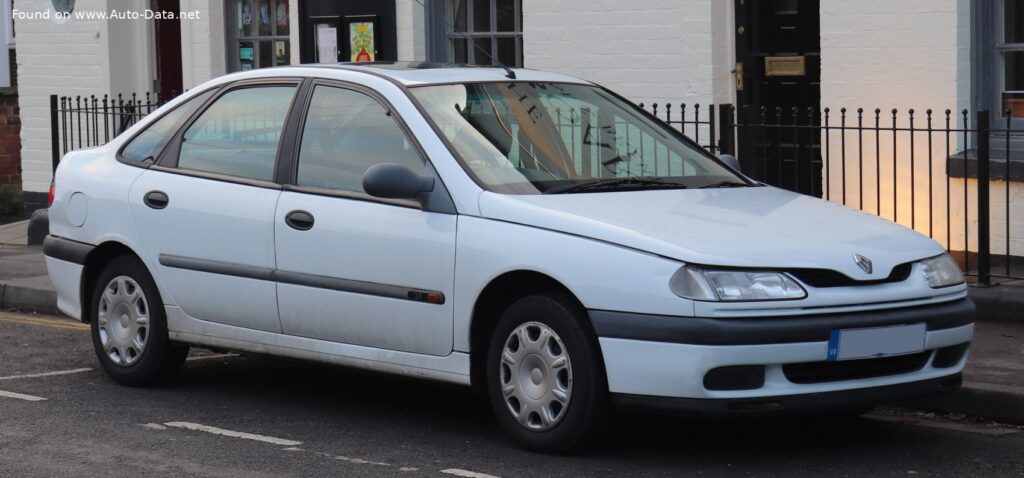
The Renault Laguna, a nameplate synonymous with family motoring in Europe during the 1990s and beyond, represented a significant step for the French automaker in the highly competitive D-segment. Specifically, the first-generation Renault Laguna 3.0 V6 RXE (170 Hp), produced from 1993 to 2000, stood as a testament to Renault’s ambition to offer a blend of comfort, safety, and performance in a practical package. Launched as a successor to the Renault 21, the Laguna quickly established itself as a popular choice for European families seeking a versatile and well-equipped vehicle. While never officially imported into the United States, this model played a crucial role in shaping Renault’s image in its primary markets, offering a compelling alternative to domestic and other European rivals through its distinctive styling and advanced features for its era. The RXE trim, in particular, denoted a higher specification level, often including more luxurious appointments and advanced technology, positioning it as a premium offering within the Laguna lineup.
The First-Generation Renault Laguna: A European D-Segment Contender
The first-generation Renault Laguna, with its production run spanning from 1993 to 2000, was strategically positioned to capture a significant share of the European D-segment market. This segment, characterized by family-sized sedans and hatchbacks, was fiercely contested by models such as the Ford Mondeo, Volkswagen Passat, and Opel Vectra. Renault’s approach with the Laguna was to emphasize safety, comfort, and a contemporary design that moved away from the more angular aesthetics of its predecessor, the Renault 21. The vehicle’s architecture was based on an internal combustion engine driving the front wheels, a common and efficient layout for family cars of the period.
The Laguna was offered in various body styles, but the 3.0 V6 RXE (170 Hp) variant was exclusively available as a practical 5-door hatchback. This configuration provided excellent versatility, catering to the diverse needs of European families, from daily commuting to long-distance holiday travel. The hatchback design offered a substantial and flexible cargo area, with a minimum trunk volume of 15.96 cubic feet, expandable to a generous 31.22 cubic feet with the rear seats folded. This adaptability was a key selling point in a market that valued practicality alongside performance and comfort. The Laguna’s design, characterized by smooth lines and a rounded silhouette, was considered quite modern and aerodynamic for its time, contributing to both its visual appeal and its efficiency.
Throughout its production, the first-generation Laguna underwent several updates and facelifts, continually refining its aesthetics, improving its safety features, and updating its powertrain options to remain competitive. The 3.0 V6 RXE variant, being a top-tier offering, benefited from these enhancements, ensuring it remained relevant and desirable among discerning buyers looking for a blend of executive-level comfort and family-car practicality. Its role was pivotal in establishing Renault as a leader in vehicle safety, a reputation that would grow stronger with subsequent generations of its models.
Engine and Performance: The 3.0 V6 RXE Heartbeat
At the core of the Renault Laguna 3.0 V6 RXE (170 Hp) was its robust Z7X engine, a naturally aspirated V-engine with a displacement of 2963 cubic centimeters, or approximately 180.81 cubic inches. This 3.0-liter V6 powerplant was engineered for a smooth and refined power delivery, a hallmark of premium European sedans and hatchbacks. The engine featured an Overhead Camshaft (OHC) valvetrain with two valves per cylinder, a configuration that balanced performance with reliability and maintenance ease for its time. Fuel delivery was managed by a multi-port manifold injection system, ensuring precise fuel metering and efficient combustion.
The engine produced a respectable 170 horsepower at 5500 revolutions per minute, providing ample power for both city driving and sustained highway speeds. Torque output was equally impressive for the era, peaking at 173.33 pound-feet at 4500 rpm. This healthy torque figure, delivered relatively low in the rev range, contributed to the car’s strong mid-range acceleration and effortless cruising capability. The power-to-weight ratio stood at 124.1 horsepower per tonne, while the torque-to-weight ratio was 171.5 Nm per tonne, indicating a well-balanced performance package for a vehicle of its size and class.
Mated to a 5-speed manual transmission, the 3.0 V6 RXE offered an engaging driving experience, allowing the driver direct control over the engine’s power band. This powertrain combination enabled the Laguna to achieve 0 to 60 mph in a brisk 8.2 seconds, a commendable figure for a family hatchback in the 1990s. Its maximum speed was rated at 136.7 mph, demonstrating its capability as a comfortable long-distance cruiser on European autobahns. Fuel economy, while not the primary focus of a V6 engine from this period, was rated at a combined 21.2 US miles per gallon, a reasonable figure considering the engine’s size and the vehicle’s performance. The engine’s oil capacity was 7 US quarts, and the cooling system held 10.57 US quarts, indicating robust engineering for thermal management.
Design and Features: Practicality and Comfort
The design philosophy behind the first-generation Renault Laguna prioritized a harmonious blend of practicality, comfort, and a visually appealing aesthetic that would stand the test of time. As a 5-door hatchback with seating for five occupants, the Laguna 3.0 V6 RXE was designed to be a highly functional family vehicle. Its exterior dimensions – a length of 177.48 inches, a width of 68.98 inches, and a height of 56.38 inches – contributed to a spacious interior without making the car overly cumbersome for urban environments. The generous 105.12-inch wheelbase further enhanced ride comfort and interior room, particularly for rear-seat passengers.
Suspension components were engineered to deliver a compliant and comfortable ride, characteristic of French automobiles. The front suspension utilized a spring strut design, while the rear featured a torsion beam setup, a cost-effective and space-efficient solution that also contributed to predictable handling. Braking performance was handled by ventilated discs at the front and solid discs at the rear, complemented by an Anti-lock Braking System (ABS) as a crucial safety feature for improved stopping power and control under emergency conditions. Steering was managed by a rack and pinion system with hydraulic power steering, providing a good balance of driver feedback and ease of maneuverability at lower speeds. The vehicle rode on 15-inch wheel rims fitted with 205/60 R15 tires, offering a comfortable ride and adequate grip.
With a kerb weight of 3020.33 pounds and a maximum permissible weight of 4265.94 pounds, the Laguna demonstrated a solid build quality and capacity for carrying passengers and cargo. The maximum load capacity was 1245.61 pounds, underscoring its utility as a family hauler. The fuel tank capacity of 17.44 US gallons provided a decent cruising range, reducing the frequency of fuel stops on longer journeys. The RXE trim, being a higher-end variant, would have typically included a range of comfort and convenience features standard for its era, such as power windows, central locking, and potentially climate control, further enhancing the driving and passenger experience. The overall design language emphasized soft curves and integrated bumpers, contributing to a refined and modern appearance that helped the Laguna stand out in its competitive segment.
Technical Specifications: Renault Laguna 3.0 V6 RXE (170 Hp)
| Brand | Renault |
| Model | Laguna |
| Generation | Laguna |
| Type (Engine) | 3.0 V6 RXE (170 Hp) |
| Start of production | 1993 year |
| End of production | 2000 year |
| Powertrain Architecture | Internal Combustion engine |
| Body type | Hatchback |
| Seats | 5 |
| Doors | 5 |
| Fuel consumption (economy) – combined | 21.2 US mpg (11.1 l/100 km) |
| Fuel Type | Petrol (Gasoline) |
| Acceleration 0 – 60 mph | 8.2 sec |
| Acceleration 0 – 100 km/h | 8.6 sec |
| Maximum speed | 136.7 mph (220 km/h) |
| Weight-to-power ratio | 8.1 kg/Hp, 124.1 Hp/tonne |
| Weight-to-torque ratio | 5.8 kg/Nm, 171.5 Nm/tonne |
| Power | 170 Hp @ 5500 rpm. |
| Power per litre | 57.4 Hp/l |
| Torque | 173.33 lb.-ft. @ 4500 rpm. (235 Nm @ 4500 rpm) |
| Engine layout | Front, Transverse |
| Engine Model/Code | Z7X |
| Engine displacement | 180.81 cu. in. (2963 cm3) |
| Number of cylinders | 6 |
| Engine configuration | V-engine |
| Cylinder Bore | 3.66 in. (93 mm) |
| Piston Stroke | 2.86 in. (72.7 mm) |
| Compression ratio | 9.6:1 |
| Number of valves per cylinder | 2 |
| Fuel injection system | Multi-port manifold injection |
| Engine aspiration | Naturally aspirated engine |
| Valvetrain | OHC |
| Engine oil capacity | 7.4 US qt (7 l) |
| Coolant | 10.57 US qt (10 l) |
| Kerb Weight | 3020.33 lbs. (1370 kg) |
| Max. weight | 4265.94 lbs. (1935 kg) |
| Max load | 1245.61 lbs. (565 kg) |
| Trunk (boot) space – minimum | 15.96 cu. ft. (452 l) |
| Trunk (boot) space – maximum | 31.22 cu. ft. (884 l) |
| Fuel tank capacity | 17.44 US gal (66 l) |
| Length | 177.48 in. (4508 mm) |
| Width | 68.98 in. (1752 mm) |
| Height | 56.38 in. (1432 mm) |
| Wheelbase | 105.12 in. (2670 mm) |
| Front track | 58.27 in. (1480 mm) |
| Rear (Back) track | 57.32 in. (1456 mm) |
| Drivetrain Architecture | The Internal combustion engine (ICE) drives the front wheels of the vehicle. |
| Drive wheel | Front wheel drive |
| Number of gears and type of gearbox | 5 gears, manual transmission |
| Front suspension | Spring Strut |
| Rear suspension | Torsion |
| Front brakes | Ventilated discs |
| Rear brakes | Disc |
| Assisting systems | ABS (Anti-lock braking system) |
| Steering type | Steering rack and pinion |
| Power steering | Hydraulic Steering |
| Tires size | 205/60 R15 |
| Wheel rims size | 15 |
