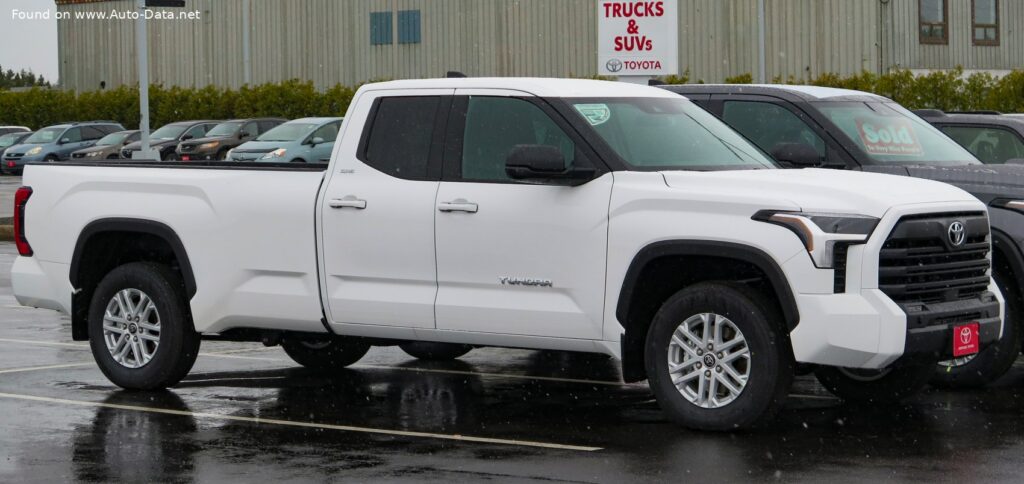
The Toyota Tundra III Double Cab Long Bed 3.5 V6 i-FORCE (348 Hp) 4×2 ECT-i represents a significant evolution in the full-size pickup truck segment, specifically tailored for the demanding North American market. Launched in September 2021, this third-generation Tundra builds upon a legacy of rugged durability and capability, while embracing modern powertrain technology and advanced features. Positioned to compete fiercely against established domestic rivals, this iteration of the Tundra aims to offer a compelling blend of strength, efficiency, and comfort. The Double Cab Long Bed configuration emphasizes utility, providing ample passenger space combined with an extended cargo bed, making it a versatile choice for both work and personal use. This particular variant, equipped with the potent 3.5-liter V6 i-FORCE engine and a sophisticated 10-speed automatic transmission, exemplifies Toyota’s commitment to innovation in a segment where performance and reliability are paramount.
Engine and Performance: The i-FORCE V6 Powerhouse
At the heart of the Toyota Tundra III Double Cab Long Bed 3.5 V6 i-FORCE (348 Hp) 4×2 ECT-i lies a meticulously engineered powertrain designed to deliver robust performance without compromising on modern efficiency standards. The V35A-FTS engine is a 3.5-liter (3445 cm³ or 210.23 cu. in.) V6 unit, featuring a cutting-edge twin-turbo, intercooled setup. This advanced forced induction system, combined with a sophisticated fuel injection strategy that incorporates both direct injection and multi-port manifold injection, allows the engine to produce an impressive 348 horsepower at 5200 rpm. The power per liter stands at a respectable 101 Hp/l, showcasing its efficient design.
Equally critical for a truck of this caliber is torque, and the i-FORCE V6 delivers generously, peaking at 549 Nm (404.92 lb.-ft.) at a low 2000 rpm. This broad and accessible torque band is crucial for towing, hauling, and off-road excursions, providing immediate pulling power when needed. The engine’s configuration is a V-engine with six cylinders, each featuring four valves, summing up to a DOHC (Double Overhead Camshaft) valvetrain with Dual VVT-i (Variable Valve Timing with intelligence). This technology optimizes valve timing for improved performance and fuel economy across the rev range. With a compression ratio of 10.4:1, the engine is optimized for gasoline fuel, meeting stringent LEV-III emission standards.
Power is channeled through a state-of-the-art 10-speed ECT-i automatic transmission. This electronically controlled transmission is designed for seamless gear changes, enhancing both acceleration and highway fuel efficiency. The 4×2 drivetrain architecture sends power exclusively to the rear wheels, a common configuration for full-size pickups focused on on-road capability and maximum towing capacity, while offering a lighter curb weight compared to 4×4 variants. The engine’s front, longitudinal layout contributes to balanced weight distribution and allows for the robust drivetrain components necessary for a truck of this size.
Despite its significant power output, the Tundra III 3.5 V6 i-FORCE demonstrates commendable fuel economy for its class. The combined fuel consumption is rated at 11.8 l/100 km, which translates to approximately 19.9 US mpg. Urban driving yields about 13.1 l/100 km (18 US mpg), while extra-urban cruising improves to 9.8 l/100 km (24 US mpg). With a fuel tank capacity of 85 liters (22.45 US gallons), the Tundra offers a practical cruising range. Its weight-to-power ratio is 6.9 kg/Hp (145 Hp/tonne), and the weight-to-torque ratio is 4.4 kg/Nm (228.8 Nm/tonne), indicating a well-balanced power-to-weight characteristic for a vehicle designed for heavy-duty applications.
Design and Features: A Purpose-Built Giant
The Toyota Tundra III Double Cab Long Bed 3.5 V6 i-FORCE (348 Hp) 4×2 ECT-i is an imposing and functional vehicle, reflecting its design brief as a versatile and capable full-size pickup. Its body type is a traditional pickup, featuring four doors and seating for five occupants, a configuration that blends passenger comfort with cargo utility. The “Long Bed” designation signifies its extended cargo area, catering to users who require maximum hauling capability for equipment, materials, or recreational gear.
Dimensionally, this Tundra variant is substantial. It measures an impressive 6414 mm (252.52 inches) in length, ensuring a commanding road presence and generous cargo volume. Its width stands at 2037 mm (80.2 inches), and its height is 1981 mm (77.99 inches). The substantial wheelbase of 4181 mm (164.61 inches) contributes to its stable ride quality, especially when towing or carrying heavy loads. A ground clearance of 236 mm (9.29 inches) provides ample capability for navigating unpaved roads or light off-road conditions, complemented by approach and departure angles of 21° and 24°, respectively. Despite its size, the Tundra maintains a respectable drag coefficient (Cd) of 0.36, indicating efforts to optimize aerodynamic efficiency for a truck of its stature.
The Tundra’s chassis and suspension systems are engineered for both durability and comfort. The front suspension employs a double wishbone setup, coupled with a transverse stabilizer, which provides precise steering response and good wheel articulation. At the rear, a rigid axle suspension with coil springs replaces the leaf springs found in previous generations, contributing to a more refined ride, especially when unladen, and improved handling. Braking is handled by large ventilated discs on both the front (353 mm) and rear (345 mm) axles, ensuring confident stopping power, further enhanced by an Anti-lock Braking System (ABS) for optimal control under hard braking. Steering is managed by an electric power-assisted rack and pinion system, offering ease of maneuverability despite the truck’s size, with a minimum turning circle of 15.8 meters (51.84 feet).
The vehicle rides on 245/75 R18 tires mounted on 8J x 18-inch wheel rims, a practical size chosen for a balance of load capacity, ride comfort, and all-terrain capability. The Tundra’s robust construction is evident in its weight specifications: a curb weight of 2400 kg (5291.09 lbs.) and a maximum permissible gross weight ranging from 3191 kg (7034.95 lbs.) to 3345 kg (7374.46 lbs.). It boasts a significant maximum payload capacity of 791-945 kg (1743.86 – 2083.37 lbs.) and an impressive permitted trailer load with brakes of 3765 kg (8300.4 lbs.), supported by a substantial towbar download capacity of 544 kg (1199.31 lbs.). These figures underscore its credentials as a serious work truck and a capable companion for adventures.
Toyota Tundra III Double Cab Long Bed 3.5 V6 i-FORCE (348 Hp) 4×2 ECT-i: Technical Specifications
| General information | |
| Brand | Toyota |
| Model | Tundra |
| Generation | Tundra III Double Cab Long Bed |
| Type (Engine) | 3.5 V6 i-FORCE (348 Hp) 4×2 ECT-i |
| Start of production | September, 2021 year |
| Powertrain Architecture | Internal Combustion engine |
| Body type | Pick-up |
| Seats | 5 |
| Doors | 4 |
| Performance specs | |
| Fuel consumption (economy) – urban | 13.1 l/100 km (18 US mpg / 21.6 UK mpg / 7.6 km/l) |
| Fuel consumption (economy) – extra urban | 9.8 l/100 km (24 US mpg / 28.8 UK mpg / 10.2 km/l) |
| Fuel consumption (economy) – combined | 11.8 l/100 km (19.9 US mpg / 23.9 UK mpg / 8.5 km/l) |
| Fuel Type | Petrol (Gasoline) |
| Emission standard | LEV-III |
| Weight-to-power ratio | 6.9 kg/Hp, 145 Hp/tonne |
| Weight-to-torque ratio | 4.4 kg/Nm, 228.8 Nm/tonne |
| Engine specs | |
| Power | 348 Hp @ 5200 rpm. |
| Power per litre | 101 Hp/l |
| Torque | 549 Nm @ 2000 rpm (404.92 lb.-ft. @ 2000 rpm) |
| Engine layout | Front, Longitudinal |
| Engine Model/Code | V35A-FTS |
| Engine displacement | 3445 cm³ (210.23 cu. in.) |
| Number of cylinders | 6 |
| Engine configuration | V-engine |
| Cylinder Bore | 85.5 mm (3.37 in.) |
| Piston Stroke | 100 mm (3.94 in.) |
| Compression ratio | 10.4:1 |
| Number of valves per cylinder | 4 |
| Fuel injection system | Direct injection and Multi-port manifold injection |
| Engine aspiration | Twin-Turbo, Intercooler |
| Valvetrain | DOHC, Dual VVT-i |
| Engine oil capacity | 7.3 l (7.71 US qt | 6.42 UK qt) |
| Coolant | 12.4 l (13.1 US qt | 10.91 UK qt) |
| Engine systems | Particulate filter |
| Space, Volume and weights | |
| Kerb Weight | 2400 kg (5291.09 lbs.) |
| Max. weight | 3191-3345 kg (7034.95 – 7374.46 lbs.) |
| Max load | 791-945 kg (1743.86 – 2083.37 lbs.) |
| Fuel tank capacity | 85 l (22.45 US gal | 18.7 UK gal) |
| Permitted trailer load with brakes (12%) | 3765 kg (8300.4 lbs.) |
| Permitted towbar download | 544 kg (1199.31 lbs.) |
| Dimensions | |
| Length | 6414 mm (252.52 in.) |
| Width | 2037 mm (80.2 in.) |
| Height | 1981 mm (77.99 in.) |
| Wheelbase | 4181 mm (164.61 in.) |
| Front track | 1737 mm (68.39 in.) |
| Rear (Back) track | 1737 mm (68.39 in.) |
| Ride height (ground clearance) | 236 mm (9.29 in.) |
| Drag coefficient (Cd) | 0.36 |
| Minimum turning circle (turning diameter) | 15.8 m (51.84 ft.) |
| Approach angle | 21° |
| Departure angle | 24° |
| Drivetrain, brakes and suspension specs | |
| Drivetrain Architecture | The Internal combustion engine (ICE) drives the rear wheels of the vehicle. |
| Drive wheel | Rear wheel drive |
| Number of gears and type of gearbox | 10 gears, automatic transmission ECT-i |
| Front suspension | Double wishbone, Transverse stabilizer |
| Rear suspension | Rigid axle suspension, Coil spring |
| Front brakes | Ventilated discs, 353 mm |
| Rear brakes | Ventilated discs, 345 mm |
| Assisting systems | ABS (Anti-lock braking system) |
| Steering type | Steering rack and pinion |
| Power steering | Electric Steering |
| Tires size | 245/75 R18 |
| Wheel rims size | 8J x 18 |