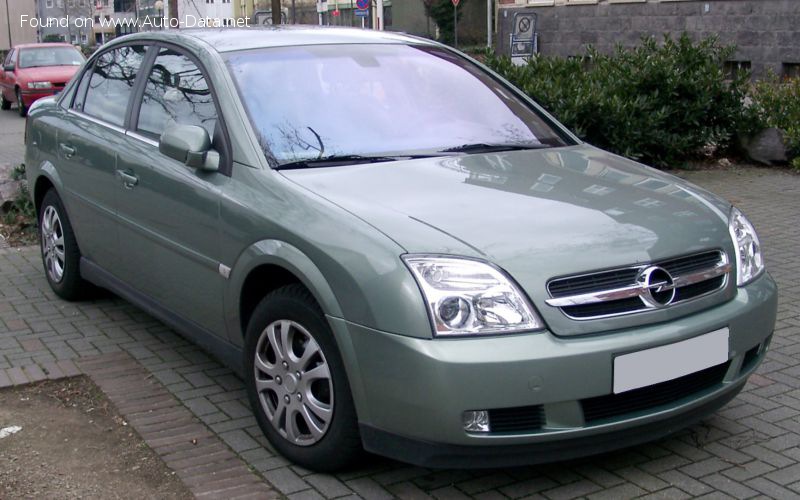
The Opel Vectra C CC 1.9 CDTI (120 Hp) represents a significant chapter in the history of Opel’s mid-size vehicle offerings, serving as a cornerstone of the brand’s presence in the highly competitive European D-segment during the mid-2000s. Introduced in January 2004, this particular variant of the third-generation Vectra, known internally as the Vectra C, was produced for a relatively brief period, concluding its run in 2005. The “CC” designation, often interpreted as a “Compact Coupe” or a variant of a hatchback, truly defines its body style as a practical and versatile 5-door hatchback. As a key model for Opel, then part of General Motors’ global portfolio, the Vectra C was engineered primarily for the European market, where it excelled in offering a compelling blend of spaciousness, comfort, and, crucially, the efficiency inherent in its diesel powertrain. While never officially sold in the United States, understanding its technical specifications and market role provides insight into the engineering priorities and consumer demands of its primary operating environment.
The Opel Vectra C CC 1.9 CDTI (120 Hp): A European Mainstay
The Opel Vectra C generation, launched in 2002, succeeded the Vectra B and aimed to elevate Opel’s standing in the executive and family car segments. The Vectra C was praised for its significantly improved chassis, offering a more refined ride and better handling dynamics compared to its predecessors. The introduction of the 5-door hatchback variant, often referred to as the Vectra C CC, broadened the model’s appeal, providing a more versatile alternative to the traditional sedan and wagon (Caravan) body styles. This particular variant, equipped with the 1.9 CDTI engine, was strategically positioned to capture a substantial share of the European fleet market and appeal to private buyers seeking a cost-effective yet capable family vehicle.
Opel, a German manufacturer with a long-standing reputation for engineering robust and practical cars, leveraged the Vectra C to showcase its commitment to modern diesel technology. The 1.9 CDTI engine, a product of a collaborative effort between General Motors and Fiat, became a ubiquitous and highly regarded powerplant across various GM Europe models. Its inclusion in the Vectra C CC underscored the growing importance of fuel efficiency and reduced emissions in the European automotive landscape. The Vectra C CC, with its blend of practicality, comfortable interior, and efficient diesel engine, carved out a strong niche for itself, competing against formidable rivals like the Volkswagen Passat, Ford Mondeo, and Renault Laguna.
Powertrain and Performance Dynamics
At the heart of the Opel Vectra C CC 1.9 CDTI (120 Hp) lies a robust and efficient 1.9-liter Common Rail Diesel Injection (CDTI) engine, designated by the code Z19DT. This inline four-cylinder engine, with its front transverse layout, was a testament to the advancements in diesel technology during the early 2000s. Featuring an Overhead Camshaft (OHC) valvetrain with two valves per cylinder, the engine prioritizes durability and torque delivery, which are essential characteristics for a family-oriented vehicle designed for both urban commuting and long-distance cruising.
The engine’s displacement of 1910 cubic centimeters (116.56 cu. in.) is paired with a sophisticated fuel injection system that utilizes common rail technology, allowing for precise fuel delivery and improved combustion efficiency. This system, combined with a turbocharger and an intercooler, enables the engine to produce a respectable 120 horsepower at 3500 rpm. The power per liter stands at 62.8 Hp/l, indicating a well-optimized design for its time. More significantly for real-world driving, the engine delivers a substantial 280 Newton-meters (206.52 lb.-ft.) of torque, available across a broad and usable rev range from 2000 to 2750 rpm. This wide torque band ensures strong acceleration from low speeds and excellent flexibility, reducing the need for frequent gear changes and making the car particularly well-suited for highway driving and overtaking maneuvers.
The Vectra C CC 1.9 CDTI channels its power to the front wheels via a smooth-shifting 6-speed manual transmission. This gearbox was a crucial component in maximizing both performance and fuel economy. The additional gear ratio, compared to older 5-speed units, allowed for closer ratios in the lower gears for better acceleration, while providing a taller sixth gear for relaxed and fuel-efficient highway cruising. This combination results in a respectable acceleration time from 0 to 60 mph in approximately 10.9 seconds, with a top speed of 124.27 mph (200 km/h). These figures, while not setting any performance records, were more than adequate for a family hatchback of its class and era, ensuring confident performance in diverse driving conditions.
Fuel efficiency was a major selling point for this diesel variant, reflecting European market demands. The combined fuel consumption is rated at an impressive 5.7 liters per 100 kilometers, translating to approximately 41.3 US mpg. Urban driving yields around 31.8 US mpg (7.4 l/100 km), while extra-urban conditions see figures as high as 50 US mpg (4.7 l/100 km). These economy figures, coupled with a generous 16.11 US gallon (61 liter) fuel tank, provide a substantial cruising range, making the Vectra C CC an economical choice for long-distance travel. The vehicle’s weight-to-power ratio of 12.7 kg/Hp and weight-to-torque ratio of 5.4 kg/Nm further underscore its balanced engineering, delivering a pragmatic blend of performance and efficiency.
Design, Features, and Practicality
The Opel Vectra C CC’s design language was characterized by its clean lines and functional aesthetic, typical of European mid-size cars of the early 2000s. As a 5-door hatchback, it offered a sleek profile that blended the practicality of a wagon with the sportier appeal of a sedan. The body type, with its five seats, was designed to comfortably accommodate a family, offering ample legroom and headroom for both front and rear passengers. Its overall dimensions – a length of 180.94 inches (4596 mm), a width of 70.79 inches (1798 mm), and a height of 57.48 inches (1460 mm) – contributed to a substantial road presence and a stable ride. The wheelbase of 106.3 inches (2700 mm) played a crucial role in enhancing interior space and ride comfort, minimizing pitching motions over uneven surfaces.
Practicality was a cornerstone of the Vectra C CC’s appeal. The hatchback body style provided exceptional cargo flexibility. The trunk (boot) space offered a generous minimum of 500 liters (17.66 cu. ft.), which could be expanded dramatically to a cavernous 1360 liters (48.03 cu. ft.) by folding down the rear seats. This made it an ideal vehicle for everything from weekly grocery runs to hauling luggage for family vacations or larger items for home improvement projects. The kerb weight of 3357.64 lbs. (1523 kg) and a maximum permissible weight of 4464.36 lbs. (2025 kg) indicate a robust construction capable of carrying a significant payload of 1106.72 lbs. (502 kg).
In terms of chassis and safety features, the Vectra C CC was equipped with a sophisticated suspension system for its class. The front utilized a Spring Strut arrangement, known for its balance of comfort and handling precision. The rear suspension featured a multi-link design, incorporating several levers and rods, which further contributed to the car’s stable road holding and refined ride quality, particularly important for a vehicle often used for long journeys. Stopping power was provided by a combination of ventilated disc brakes at the front and solid disc brakes at the rear, ensuring effective and consistent braking performance. An Anti-lock Braking System (ABS) was a standard assisting system, enhancing safety by preventing wheel lock-up during hard braking and maintaining steering control.
The steering system was a rack and pinion type, offering direct and predictable feedback to the driver. The vehicle rode on 215/55 R16 tires, mounted on 6.5J x 16-inch wheel rims, a common specification that balanced ride comfort, grip, and replacement cost. While modern cars boast an array of advanced driver-assistance systems, the Vectra C CC, for its time, delivered a competent and safe driving experience with its fundamental engineering and standard safety features, making it a reliable and practical choice for the European market.
Technical Specifications: Opel Vectra C CC 1.9 CDTI (120 Hp)
| Brand | Opel |
| Model | Vectra |
| Generation | Vectra C CC |
| Type (Engine) | 1.9 CDTI (120 Hp) |
| Start of production | January, 2004 year |
| End of production | 2005 year |
| Powertrain Architecture | Internal Combustion engine |
| Body type | Hatchback |
| Seats | 5 |
| Doors | 5 |
| Fuel consumption (economy) – urban | 7.4 l/100 km (31.8 US mpg) |
| Fuel consumption (economy) – extra urban | 4.7 l/100 km (50 US mpg) |
| Fuel consumption (economy) – combined | 5.7 l/100 km (41.3 US mpg) |
| Fuel Type | Diesel |
| Acceleration 0 – 60 mph | 10.9 sec |
| Acceleration 0 – 100 km/h | 11.5 sec |
| Maximum speed | 200 km/h (124.27 mph) |
| Weight-to-power ratio | 12.7 kg/Hp (78.8 Hp/tonne) |
| Weight-to-torque ratio | 5.4 kg/Nm (183.8 Nm/tonne) |
| Power | 120 Hp @ 3500 rpm |
| Power per liter | 62.8 Hp/l |
| Torque | 280 Nm @ 2000-2750 rpm (206.52 lb.-ft. @ 2000-2750 rpm) |
| Engine layout | Front, Transverse |
| Engine Model/Code | Z19DT |
| Engine displacement | 1910 cm3 (116.56 cu. in.) |
| Number of cylinders | 4 |
| Engine configuration | Inline |
| Cylinder Bore | 82 mm (3.23 in.) |
| Piston Stroke | 90.4 mm (3.56 in.) |
| Compression ratio | 18:1 |
| Number of valves per cylinder | 2 |
| Fuel injection system | Diesel Commonrail |
| Engine aspiration | Turbocharger, Intercooler |
| Valvetrain | OHC |
| Engine oil capacity | 4.3 l (4.54 US qt) |
| Coolant | 7 l (7.4 US qt) |
| Kerb Weight | 1523 kg (3357.64 lbs.) |
| Max. weight | 2025 kg (4464.36 lbs.) |
| Max load | 502 kg (1106.72 lbs.) |
| Trunk (boot) space – minimum | 500 l (17.66 cu. ft.) |
| Trunk (boot) space – maximum | 1360 l (48.03 cu. ft.) |
| Fuel tank capacity | 61 l (16.11 US gal) |
| Length | 4596 mm (180.94 in.) |
| Width | 1798 mm (70.79 in.) |
| Width including mirrors | 2036 mm (80.16 in.) |
| Height | 1460 mm (57.48 in.) |
| Wheelbase | 2700 mm (106.3 in.) |
| Front track | 1523 mm (59.96 in.) |
| Rear (Back) track | 1513 mm (59.57 in.) |
| Front overhang | 905 mm (35.63 in.) |
| Rear overhang | 991 mm (39.02 in.) |
| Drivetrain Architecture | The Internal combustion engine (ICE) drives the front wheels of the vehicle. |
| Drive wheel | Front wheel drive |
| Number of gears and type of gearbox | 6 gears, manual transmission |
| Front suspension | Spring Strut |
| Rear suspension | Several levers and rods (Multi-link) |
| Front brakes | Ventilated discs |
| Rear brakes | Disc |
| Assisting systems | ABS (Anti-lock braking system) |
| Steering type | Steering rack and pinion |
| Tires size | 215/55 R16 |
| Wheel rims size | 6.5J x 16 |