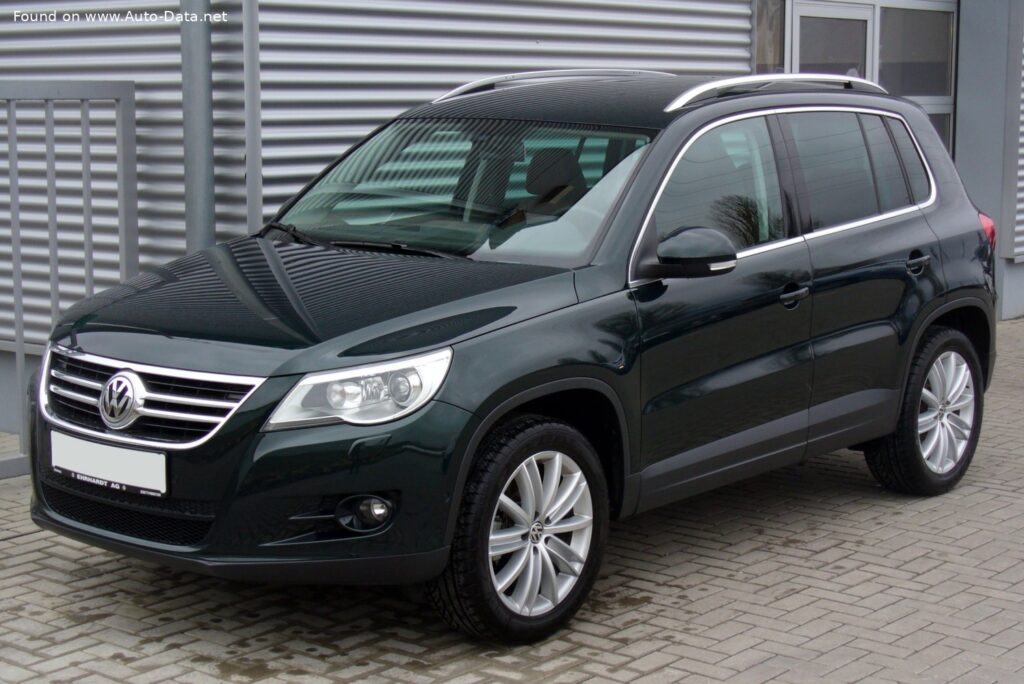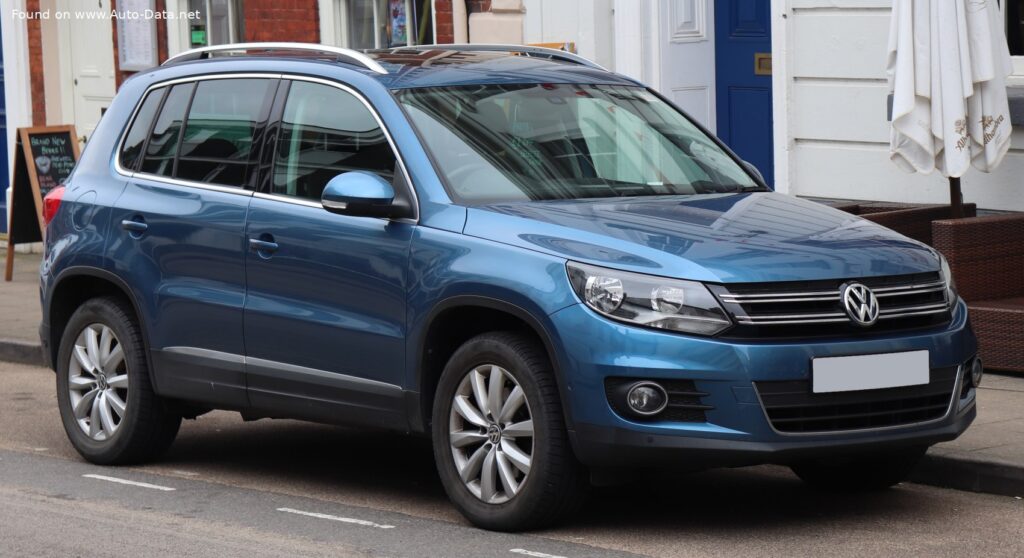
The Volkswagen Tiguan I (facelift 2011) 2.0 TSI (180 Hp) 4MOTION represents a significant iteration of Volkswagen’s foray into the compact SUV segment, a market increasingly vital for global automotive manufacturers. Introduced in 2011 as a refreshed version of the first-generation Tiguan, this model aimed to solidify its position as a sophisticated and capable contender, bridging the gap between utilitarian SUVs and premium crossovers. Designed to appeal to a broad demographic, from young families to urban adventurers, the Tiguan combined Volkswagen’s renowned engineering prowess with a practical, refined package. This particular variant, featuring the potent 2.0-liter TSI engine and the advanced 4MOTION all-wheel-drive system, highlighted its commitment to both dynamic performance and all-weather capability, making it a compelling choice in both European and North American markets during its production run from 2011 to 2015.
The Volkswagen Tiguan I (facelift 2011): A Refined Compact SUV
The 2011 facelift of the Tiguan I brought a series of aesthetic and technical updates that aligned its design language with Volkswagen’s contemporary models, such as the Golf VI and Passat B7. This refresh was more than skin deep, enhancing the vehicle’s appeal and functionality. As a compact SUV, it offered a versatile blend of urban maneuverability and surprising off-road aptitude, a characteristic bolstered by its intelligent 4MOTION all-wheel-drive system. With a body type defined as an SUV, featuring five doors and comfortable seating for five occupants, the Tiguan was engineered for practicality without compromising on the driving experience expected from a Volkswagen.
Its market positioning was strategic, offering a more premium alternative to some competitors while remaining accessible. The Tiguan’s success lay in its ability to deliver a well-rounded package: a comfortable ride, a high-quality interior, and reliable performance. The facelifted model introduced subtle yet impactful changes, including redesigned headlights with optional LED daytime running lights, a revised front grille, and updated bumpers, giving it a sharper, more modern appearance. These changes were crucial in maintaining its competitive edge in a rapidly evolving segment.
Powertrain and Performance Dynamics
At the heart of this particular Tiguan variant is the formidable 2.0-liter TSI (Turbocharged Stratified Injection) engine, a testament to Volkswagen’s engineering philosophy of delivering strong performance alongside reasonable efficiency. This inline four-cylinder engine, designated with the model code CCZD, is transversely mounted at the front of the vehicle. It features a DOHC (Double Overhead Camshaft) valvetrain with four valves per cylinder, direct fuel injection, and is boosted by a turbocharger with an intercooler, optimizing air intake and combustion efficiency. With an engine displacement of 1984 cubic centimeters (121.07 cubic inches), it generates a robust 180 horsepower, available across a wide rev range from 4500 to 6200 rpm. Torque output is equally impressive, peaking at 280 Newton-meters (206.52 lb.-ft.) from a low 1700 rpm and maintaining through 4500 rpm, ensuring strong acceleration and flexible power delivery.
The performance figures underscore the engine’s capability: the Tiguan 2.0 TSI (180 Hp) 4MOTION can accelerate from 0 to 60 mph in a swift 7.9 seconds, with a maximum speed of 126.76 mph. This level of performance is highly competitive for its class, offering drivers a dynamic experience whether navigating city streets or cruising on the highway. Power is transmitted through a precise 6-speed manual transmission, providing engaging control for the driver. The vehicle’s powertrain architecture incorporates Volkswagen’s renowned 4MOTION all-wheel-drive system. This intelligent system primarily drives the front wheels but can instantaneously engage the rear wheels via an electrically or mechanically operated clutch when slip is detected, ensuring optimal traction and stability in varying road conditions, from wet pavement to light off-road trails. This system, combined with a kerb weight of 3463.46 lbs., results in a favorable weight-to-power ratio of 8.7 kg/Hp, contributing to its responsive handling.
Despite its performance orientation, the 2.0 TSI engine also demonstrated commendable fuel economy for an all-wheel-drive SUV of its era. According to NEDC standards, combined fuel consumption was rated at 8.5 liters per 100 kilometers, translating to approximately 27.7 US miles per gallon. Urban driving yielded around 20.3 US mpg, while extra-urban conditions saw efficiency climb to 35.1 US mpg. CO2 emissions were rated at 198 g/km, adhering to the Euro 5 emission standard, reflecting Volkswagen’s commitment to environmental considerations at the time.
Design, Utility, and Safety Features
The Volkswagen Tiguan I (facelift 2011) distinguished itself with a design that exuded understated elegance and robust capability. Its dimensions – a length of 174.25 inches, a width of 71.22 inches (80.35 inches including mirrors), and a height of 67.05 inches – contributed to its balanced proportions, making it agile enough for urban environments yet substantial enough for longer journeys. The wheelbase of 102.52 inches provided a stable platform, enhancing ride comfort and handling dynamics. With a respectable ground clearance of 7.87 inches, coupled with approach, departure, and ramp-over angles of 18°, 25°, and 20° respectively, the Tiguan possessed a degree of off-road capability that surpassed many of its crossover rivals, making it suitable for unpaved roads and light trail driving.
Inside, the Tiguan offered a cabin characterized by Volkswagen’s hallmark quality and ergonomic design. High-quality materials, precise fit and finish, and intuitive controls created an inviting and functional environment. The five-seat configuration provided ample space for occupants, while the cargo area demonstrated excellent versatility. With the rear seats in place, the trunk offered a minimum of 470 liters (16.6 cubic feet) of storage, expandable to an impressive 1510 liters (53.33 cubic feet) with the rear seats folded down, accommodating everything from groceries to luggage for a family vacation. The fuel tank capacity of 16.91 US gallons ensured a decent cruising range.
Safety was a paramount concern for Volkswagen, and the Tiguan I was equipped with a comprehensive suite of features. Standard safety systems included ABS (Anti-lock Braking System) for controlled stopping. The suspension setup, featuring independent McPherson struts with a transverse stabilizer at the front and an independent multi-link system with a transverse stabilizer at the rear, ensured composed handling and a comfortable ride. Braking performance was strong, with ventilated discs at the front and solid discs at the rear. The steering system utilized electric power steering with a rack and pinion setup, providing precise feedback and effortless maneuverability, especially at lower speeds. The vehicle rode on 215/60 R17 tires mounted on 6.5J x 17 wheel rims, a combination chosen for optimal grip and ride comfort. Furthermore, its robust construction and high maximum weight rating of 4850.17 lbs., along with a generous permitted trailer load of 4850.17 lbs. with brakes, underscored its capability as a versatile utility vehicle.
Comprehensive Technical Specifications
| Brand | Volkswagen |
| Model | Tiguan |
| Generation | Tiguan I (facelift 2011) |
| Type (Engine) | 2.0 TSI (180 Hp) 4MOTION |
| Start of production | 2011 year |
| End of production | 2015 year |
| Powertrain Architecture | Internal Combustion engine |
| Body type | SUV |
| Seats | 5 |
| Doors | 5 |
| Fuel consumption (economy) – urban (NEDC) | 11.6 l/100 km (20.3 US mpg) |
| Fuel consumption (economy) – extra urban (NEDC) | 6.7 l/100 km (35.1 US mpg) |
| Fuel consumption (economy) – combined (NEDC) | 8.5 l/100 km (27.7 US mpg) |
| CO2 emissions (NEDC) | 198 g/km |
| Fuel Type | Petrol (Gasoline) |
| Acceleration 0 – 100 km/h | 8.3 sec |
| Acceleration 0 – 62 mph | 8.3 sec |
| Acceleration 0 – 60 mph (Calculated) | 7.9 sec |
| Maximum speed | 204 km/h (126.76 mph) |
| Emission standard | Euro 5 |
| Weight-to-power ratio | 8.7 kg/Hp (114.6 Hp/tonne) |
| Weight-to-torque ratio | 5.6 kg/Nm (178.2 Nm/tonne) |
| Power | 180 Hp @ 4500-6200 rpm. |
| Power per litre | 90.7 Hp/l |
| Torque | 280 Nm @ 1700-4500 rpm. (206.52 lb.-ft.) |
| Engine layout | Front, Transverse |
| Engine Model/Code | CCZD |
| Engine displacement | 1984 cm3 (121.07 cu. in.) |
| Number of cylinders | 4 |
| Engine configuration | Inline |
| Cylinder Bore | 82.5 mm (3.25 in.) |
| Piston Stroke | 92.8 mm (3.65 in.) |
| Compression ratio | 9.6:1 |
| Number of valves per cylinder | 4 |
| Fuel injection system | Direct injection |
| Engine aspiration | Turbocharger, Intercooler |
| Valvetrain | DOHC |
| Engine oil capacity | 4.7 l (4.97 US qt) |
| Kerb Weight | 1571 kg (3463.46 lbs.) |
| Max. weight | 2200 kg (4850.17 lbs.) |
| Max load | 629 kg (1386.71 lbs.) |
| Trunk (boot) space – minimum | 470 l (16.6 cu. ft.) |
| Trunk (boot) space – maximum | 1510 l (53.33 cu. ft.) |
| Fuel tank capacity | 64 l (16.91 US gal) |
| Max. roof load | 75 kg (165.35 lbs.) |
| Permitted trailer load with brakes (8%) | 2200 kg (4850.17 lbs.) |
| Permitted trailer load with brakes (12%) | 2200 kg (4850.17 lbs.) |
| Permitted trailer load without brakes | 750 kg (1653.47 lbs.) |
| Permitted towbar download | 100 kg (220.46 lbs.) |
| Length | 4426 mm (174.25 in.) |
| Width | 1809 mm (71.22 in.) |
| Width including mirrors | 2041 mm (80.35 in.) |
| Height | 1703 mm (67.05 in.) |
| Wheelbase | 2604 mm (102.52 in.) |
| Front track | 1569 mm (61.77 in.) |
| Rear (Back) track | 1571 mm (61.85 in.) |
| Ride height (ground clearance) | 200 mm (7.87 in.) |
| Minimum turning circle (turning diameter) | 12 m (39.37 ft.) |
| Approach angle | 18° |
| Departure angle | 25° |
| Ramp-over (brakeover) angle | 20° |
| Drivetrain Architecture | The Internal combustion engine (ICE) drives the front wheels permanently, and the rear wheels are driven through an electrically or mechanically operated clutch if necessary. |
| Drive wheel | All wheel drive (4×4) |
| Number of gears and type of gearbox | 6 gears, manual transmission |
| Front suspension | Independent type McPherson, Transverse stabilizer |
| Rear suspension | Independent multi-link suspension, Transverse stabilizer |
| Front brakes | Ventilated discs |
| Rear brakes | Disc |
| Assisting systems | ABS (Anti-lock braking system) |
| Steering type | Steering rack and pinion |
| Power steering | Electric Steering |
| Tires size | 215/60 R17 |
| Wheel rims size | 6.5J x 17 |