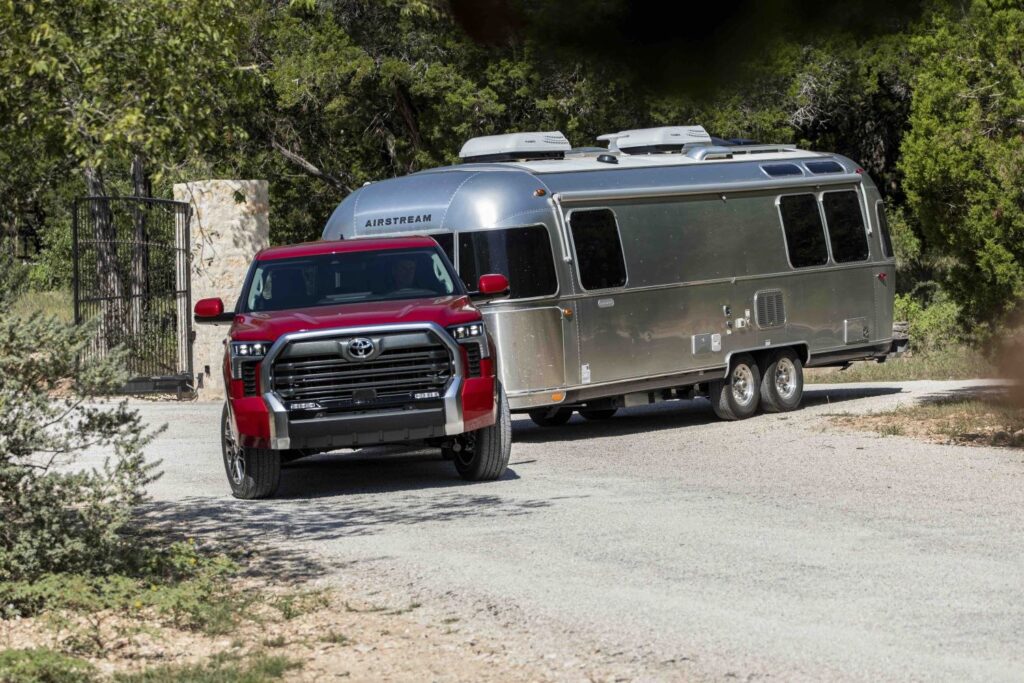
The Toyota Tundra III Double Cab Standard Bed 3.5 V6 i-FORCE (348 Hp) 4×2 ECT-i represents a significant evolution in the full-size pickup truck segment, marking the third generation of Toyota’s formidable entry into this highly competitive market. Launched in September 2021, this iteration of the Tundra was engineered from the ground up to challenge established domestic rivals by offering a compelling blend of robust performance, advanced technology, and enhanced efficiency. Designed specifically for the North American market, where full-size pickups are a cornerstone of both commercial and personal transportation, the Tundra III aims to redefine expectations with its powerful i-FORCE V6 engine, sophisticated drivetrain, and a host of modern features tailored for demanding users. This particular configuration, featuring the Double Cab with a Standard Bed and a 4×2 rear-wheel-drive setup, targets consumers who prioritize towing capability, payload capacity, and a comfortable ride for everyday use, while still benefiting from the inherent ruggedness and reliability synonymous with the Toyota brand. Its introduction underscored Toyota’s commitment to innovation in a segment that increasingly demands both brute strength and refined engineering.
Engineering Prowess: The Toyota Tundra III Double Cab Standard Bed Powertrain and Performance
At the heart of the Toyota Tundra III Double Cab Standard Bed 3.5 V6 i-FORCE (348 Hp) 4×2 ECT-i lies a meticulously engineered powertrain designed to deliver a potent combination of power and efficiency. The venerable 3.5-liter V6 i-FORCE engine, identified by its V35A-FTS code, is a twin-turbocharged unit, a departure from the previous generation’s naturally aspirated V8. This advanced engine configuration generates a substantial 348 horsepower at 5200 rpm, providing ample thrust for any task. More critically for a pickup truck, it produces an impressive 404.92 lb.-ft. (549 Nm) of torque, peaking at a remarkably low 2000 rpm. This broad and accessible torque band ensures strong acceleration from a standstill and confident towing capability, crucial attributes for a vehicle in this class.
The engine’s technical sophistication is evident in its design. It features a DOHC (Dual Overhead Camshaft) valvetrain with Dual VVT-i (Variable Valve Timing with intelligence), optimizing valve overlap for improved performance and fuel economy across the rev range. Fuel delivery is handled by a sophisticated system combining direct injection and multi-port manifold injection, a strategy that maximizes combustion efficiency and reduces emissions. The twin-turbo setup, coupled with an intercooler, not only boosts power output but also ensures consistent performance under various operating conditions. With a compression ratio of 10.4:1 and four valves per cylinder, the engine is optimized for high output and durability. Its power per liter stands at 101 Hp/l, reflecting its high-performance design.
Mated to this powerful engine is a highly advanced 10-speed automatic transmission with ECT-i (Electronically Controlled Transmission with intelligence). This gearbox is integral to the Tundra’s performance and efficiency, offering a wide range of gear ratios that allow the engine to operate in its most efficient or most powerful band, depending on driving conditions. The numerous gears contribute to smoother shifts and improved fuel economy, particularly during highway cruising. The Tundra III Double Cab Standard Bed 3.5 V6 i-FORCE (348 Hp) 4×2 ECT-i employs a rear-wheel-drive (4×2) drivetrain architecture, where the internal combustion engine exclusively drives the rear wheels. This configuration is often favored for its efficiency, simplicity, and superior towing characteristics, as weight over the rear axle improves traction when hauling heavy loads.
Fuel economy figures for this configuration are competitive within the segment, with an urban rating of 18 US mpg (13.1 l/100 km), an extra-urban rating of 24 US mpg (9.8 l/100 km), and a combined rating of 19.9 US mpg (11.8 l/100 km). These figures underscore the effectiveness of the twin-turbo V6 and 10-speed transmission in balancing power with responsible fuel consumption. The vehicle meets the stringent LEV-III emission standard, reflecting Toyota’s commitment to environmental responsibility. Furthermore, its impressive weight-to-power ratio of 6.6 kg/Hp (150.6 Hp/tonne) and weight-to-torque ratio of 4.2 kg/Nm (237.6 Nm/tonne) highlight its robust capabilities for hauling and towing, with a permitted trailer load with brakes reaching 8300.4 lbs (3765 kg) and a maximum payload of up to 2160.53 lbs (980 kg).
Design, Features, and Robust Chassis of the Toyota Tundra III Double Cab Standard Bed
The design of the Toyota Tundra III Double Cab Standard Bed is a bold statement, reflecting its capability and modern aesthetic. As a full-size pickup, it boasts imposing dimensions, with a length of 233.58 inches (5933 mm), a width of 80.2 inches (2037 mm), and a height of 77.99 inches (1981 mm). These measurements contribute to a commanding road presence and provide ample interior space for five occupants across its four doors. The Double Cab configuration strikes a balance between passenger comfort and bed utility, making it a versatile choice for both family duties and work-related tasks.
Underneath its muscular exterior, the Tundra III is built on a new, fully boxed frame, significantly enhancing rigidity and durability, which are critical for a truck intended for heavy-duty use. The chassis architecture is designed for both ruggedness and ride comfort. The front suspension employs a double wishbone setup with a transverse stabilizer, providing precise steering, improved handling dynamics, and effective absorption of road imperfections. At the rear, the Tundra departs from traditional leaf springs, opting for a modern rigid axle suspension with coil springs. This innovative choice significantly improves ride quality, especially when unladen, while still maintaining impressive payload and towing capacities. The coil springs offer more compliant suspension travel, reducing harshness and enhancing occupant comfort, a crucial factor in modern pickup truck design.
Braking performance is assured by a robust system featuring large ventilated discs at both the front and rear. The front brakes measure 353 mm, while the rear brakes are 345 mm, providing powerful and consistent stopping power even under heavy loads or during demanding towing scenarios. This system is complemented by an Anti-lock Braking System (ABS) as a standard assisting system, ensuring stability and control during emergency braking. Steering is managed by a rack and pinion system with electric power steering, which offers light effort at low speeds for easy maneuverability and more precise feedback at higher speeds. With a minimum turning circle of 48.56 feet (14.8 m), the Tundra remains surprisingly agile for its size.
The Tundra III Double Cab Standard Bed is equipped with 245/75 R18 tires mounted on 8J x 18 wheel rims, a practical choice that balances on-road comfort with off-road capability. The ground clearance of 9.29 inches (236 mm), combined with an approach angle of 21° and a departure angle of 24°, gives it respectable capability for navigating uneven terrain or tackling construction sites, even in its 4×2 configuration. The drag coefficient (Cd) of 0.36 indicates a design that, while prioritizing utility, also considers aerodynamic efficiency to some extent, contributing to its overall fuel economy. The vehicle’s kerb weight ranges from 5094.88 to 5213.93 lbs (2311-2365 kg), and its maximum gross weight is between 7034.95 and 7374.46 lbs (3191-3345 kg), underscoring its sturdy construction and capacity for heavy loads. The 22.45 US gallon (85 liter) fuel tank provides a generous cruising range, making it suitable for long hauls without frequent stops.
Technical Specifications
| Brand | Toyota |
| Model | Tundra |
| Generation | Tundra III Double Cab Standard Bed |
| Type (Engine) | 3.5 V6 i-FORCE (348 Hp) 4×2 ECT-i |
| Start of production | September, 2021 year |
| Powertrain Architecture | Internal Combustion engine |
| Body type | Pick-up |
| Seats | 5 |
| Doors | 4 |
| Fuel consumption (economy) – urban | 13.1 l/100 km (18 US mpg) |
| Fuel consumption (economy) – extra urban | 9.8 l/100 km (24 US mpg) |
| Fuel consumption (economy) – combined | 11.8 l/100 km (19.9 US mpg) |
| Fuel Type | Petrol (Gasoline) |
| Emission standard | LEV-III |
| Weight-to-power ratio | 6.6 kg/Hp (150.6 Hp/tonne) |
| Weight-to-torque ratio | 4.2 kg/Nm (237.6 Nm/tonne) |
| Power | 348 Hp @ 5200 rpm |
| Power per litre | 101 Hp/l |
| Torque | 549 Nm @ 2000 rpm (404.92 lb.-ft. @ 2000 rpm) |
| Engine layout | Front, Longitudinal |
| Engine Model/Code | V35A-FTS |
| Engine displacement | 3445 cm3 (210.23 cu. in.) |
| Number of cylinders | 6 |
| Engine configuration | V-engine |
| Cylinder Bore | 85.5 mm (3.37 in.) |
| Piston Stroke | 100 mm (3.94 in.) |
| Compression ratio | 10.4:1 |
| Number of valves per cylinder | 4 |
| Fuel injection system | Direct injection and Multi-port manifold injection |
| Engine aspiration | Twin-Turbo, Intercooler |
| Valvetrain | DOHC, Dual VVT-i |
| Engine oil capacity | 7.3 l (7.71 US qt) |
| Coolant | 12.4 l (13.1 US qt) |
| Particulate filter | Yes |
| Kerb Weight | 2311-2365 kg (5094.88 – 5213.93 lbs) |
| Max. weight | 3191-3345 kg (7034.95 – 7374.46 lbs) |
| Max load | 880-980 kg (1940.07 – 2160.53 lbs) |
| Fuel tank capacity | 85 l (22.45 US gal) |
| Permitted trailer load with brakes (12%) | 3765 kg (8300.4 lbs) |
| Permitted towbar download | 544 kg (1199.31 lbs) |
| Length | 5933 mm (233.58 in.) |
| Width | 2037 mm (80.2 in.) |
| Height | 1981 mm (77.99 in.) |
| Wheelbase | 3701 mm (145.71 in.) |
| Front track | 1737 mm (68.39 in.) |
| Rear (Back) track | 1737 mm (68.39 in.) |
| Ride height (ground clearance) | 236 mm (9.29 in.) |
| Drag coefficient (Cd) | 0.36 |
| Minimum turning circle (turning diameter) | 14.8 m (48.56 ft) |
| Approach angle | 21° |
| Departure angle | 24° |
| Drivetrain Architecture | Internal combustion engine (ICE) drives the rear wheels |
| Drive wheel | Rear wheel drive |
| Number of gears and type of gearbox | 10 gears, automatic transmission ECT-i |
| Front suspension | Double wishbone, Transverse stabilizer |
| Rear suspension | Rigid axle suspension, Coil spring |
| Front brakes | Ventilated discs, 353 mm |
| Rear brakes | Ventilated discs, 345 mm |
| Assisting systems | ABS (Anti-lock braking system) |
| Steering type | Steering rack and pinion |
| Power steering | Electric Steering |
| Tires size | 245/75 R18 |
| Wheel rims size | 8J x 18 |