
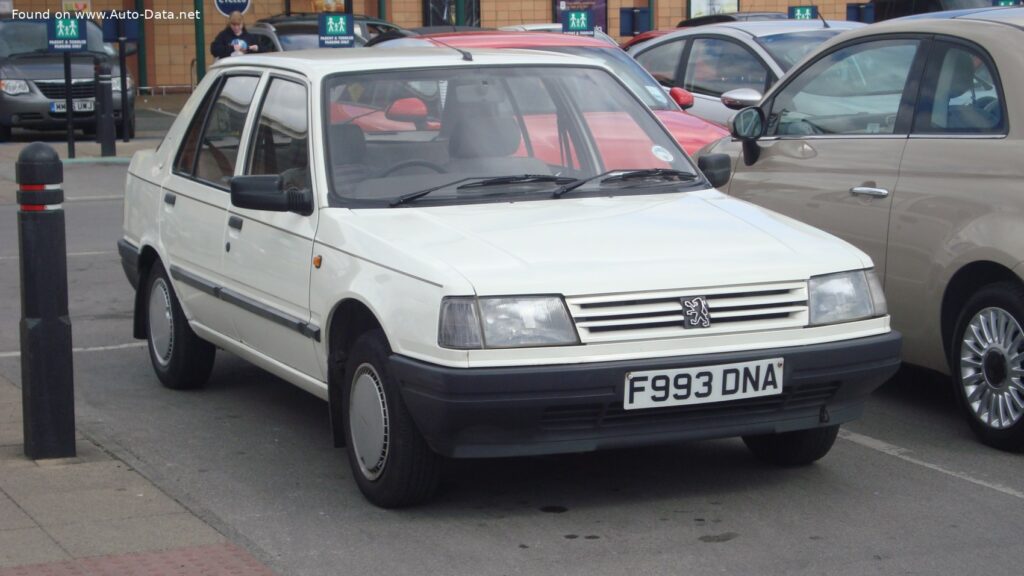
The Peugeot 309 (10C,10A) 1.6 (80 Hp) Automatic represents a significant chapter in the European automotive landscape of the late 1980s. Launched in 1987, this particular variant, distinguished by its 1.6-liter engine and automatic transmission, was a key offering in Peugeot’s compact car lineup, primarily targeting the discerning European market. While not officially sold in the United States, the 309 succeeded the Peugeot 305 and was positioned as a robust and practical family hatchback, bridging the gap between the smaller 205 and the larger 405. Its production run for this specific configuration spanned from 1987 to 1989, making it a quintessential example of automotive engineering from that era, prioritizing durability, functional design, and accessible performance for daily driving. The 309 was notable for being the first Peugeot to be built at the former Talbot factory in Ryton, England, a legacy of Peugeot’s acquisition of Chrysler Europe, later Talbot. This model played a crucial role in consolidating Peugeot’s market share in the competitive C-segment in Europe, offering a blend of traditional French comfort and a straightforward mechanical package that resonated with a broad customer base seeking reliability and ease of use.
The Peugeot 309 (10C,10A): A European Mainstay
The Peugeot 309 (10C,10A) emerged during a period of intense competition and innovation within the European automotive industry. Its design, while sharing some visual cues with its stablemates, was distinctly its own, moving away from the more angular styling of its predecessors towards a smoother, more aerodynamic profile. Classified as a 5-door hatchback, it offered a practical solution for families and individuals alike, balancing compact exterior dimensions with a surprisingly spacious interior. The vehicle’s architecture, an internal combustion engine driving the front wheels, was a common and effective setup for its class, contributing to predictable handling and efficient packaging. The 309’s tenure on the market, particularly this 1.6-liter automatic variant, highlighted Peugeot’s commitment to providing a range of options to cater to diverse consumer preferences, from manual transmission enthusiasts to those preferring the convenience of an automatic for urban commutes and longer journeys across the continent. Its role in the European market was one of a reliable workhorse, a car that could comfortably serve as a primary family vehicle, offering a blend of economy, practicality, and a touch of Peugeot’s signature ride comfort.
Powertrain and Performance: The Peugeot 309 (10C,10A) 1.6 (80 Hp) Automatic Experience
Engine Architecture and Output
At the heart of the Peugeot 309 (10C,10A) 1.6 (80 Hp) Automatic lies a dependable 1.6-liter (1580 cm³ or 96.42 cu. in.) inline four-cylinder engine, designated by the code XU51C. This naturally aspirated power plant featured a front, transverse layout, typical for front-wheel-drive vehicles of its time, which optimized interior space and simplified the drivetrain. Employing a single overhead camshaft (OHC) valvetrain with two valves per cylinder, the engine was designed for robustness and ease of maintenance, characteristic of Peugeot’s engineering philosophy for its volume sellers. Fuel delivery was managed by a carburettor system, a common technology in the late 1980s before the widespread adoption of electronic fuel injection. The engine produced a respectable 80 horsepower at 5600 rpm, translating to a power-per-liter output of 50.6 Hp/l. Torque figures stood at 132 Nm (97.36 lb.-ft.) delivered at a relatively low 2800 rpm, indicating a focus on usable mid-range power for everyday driving rather than outright high-rev performance. This combination ensured a smooth and tractable power delivery, especially when paired with the automatic transmission, making it a comfortable companion for varied driving conditions.
Performance Metrics
The performance characteristics of the 1987-1989 Peugeot 309 (10C,10A) 1.6 (80 Hp) Automatic were aligned with its role as a practical family car. With an acceleration time from 0 to 60 mph calculated at 15.2 seconds (0-100 km/h in 16 seconds), it offered adequate pace for navigating city traffic and merging onto highways without being overtly sporty. The top speed was rated at 102.53 mph (165 km/h), a competent figure for a compact car of its era and engine size. The vehicle’s curb weight of 1986.36 lbs (901 kg) contributed to a weight-to-power ratio of 11.3 kg/Hp, or 88.8 Hp per tonne, which, combined with the 4-speed automatic transmission, provided a balanced driving experience. Fuel efficiency was also a key consideration for European buyers. The urban fuel economy was reported at 8.5 l/100 km (27.7 US mpg), while extra-urban consumption improved to 5.8 l/100 km (40.6 US mpg). These figures underscore the vehicle’s economical nature, a vital attribute in markets with higher fuel prices, allowing for reasonable running costs over its lifespan. The 55-liter (14.53 US gallon) fuel tank capacity provided a decent cruising range, reducing the frequency of fuel stops.
Design, Features, and Practicality
Exterior and Interior Design
The Peugeot 309 (10C,10A) embodied the pragmatic design language prevalent in the late 1980s, characterized by clean lines and functional aesthetics. Its 5-door hatchback body type was inherently practical, offering easy access to both the passenger compartment and the cargo area. With a length of 159.49 inches (4051 mm), a width of 64.09 inches (1628 mm), and a height of 54.33 inches (1380 mm), the 309 was sized perfectly for European urban environments, allowing for nimble maneuverability and easier parking. The wheelbase measured 97.2 inches (2469 mm), contributing to a stable ride quality. The drag coefficient (Cd) of 0.33 was commendable for its time, indicating a thoughtful approach to aerodynamics, which positively impacted both fuel efficiency and high-speed stability. Inside, the 309 was designed to comfortably accommodate five occupants, with a focus on ergonomics and straightforward controls. The trunk space was a strong point, offering a minimum of 14.02 cu. ft. (397 liters), expandable to a generous 45.17 cu. ft. (1279 liters) with the rear seats folded, making it highly versatile for carrying luggage, groceries, or larger items. This emphasis on practicality and space utilization was a hallmark of Peugeot’s approach to compact family cars.
Chassis, Drivetrain, and Safety
The chassis and drivetrain architecture of the Peugeot 309 (10C,10A) 1.6 (80 Hp) Automatic were engineered for a balance of comfort and predictable handling. The front suspension featured an independent McPherson strut setup with coil springs and an anti-roll bar, providing good wheel control and absorbing road imperfections effectively. At the rear, a torsion beam suspension system was employed, a compact and robust design that allowed for a flatter load floor and maximized interior space. The drivetrain was a classic front-wheel-drive configuration, with the internal combustion engine driving the front wheels, known for its efficiency and stability. Steering was managed by a rack and pinion system, offering direct feedback and ease of control. Braking duties were handled by disc brakes at the front and drum brakes at the rear, a common and effective setup for vehicles in this class during the late 1980s, providing reliable stopping power. The vehicle rode on 165/70 R13 tires mounted on 13-inch wheel rims, a specification that prioritized ride comfort and economical tire replacement. While advanced active safety features common in modern vehicles were absent, the 309’s fundamental design, including its sturdy body structure and predictable dynamics, offered a foundational level of occupant protection. The maximum load capacity of 945.78 lbs (429 kg) and a permitted trailer load with brakes of 1763.7 lbs (800 kg) further underscored its utility and robust construction.
