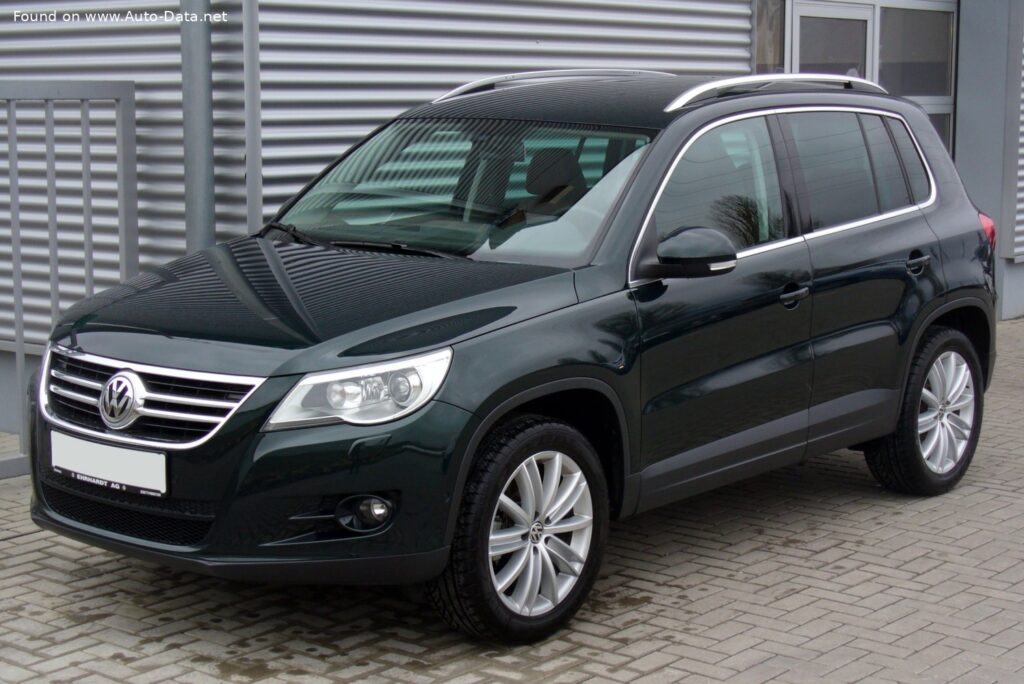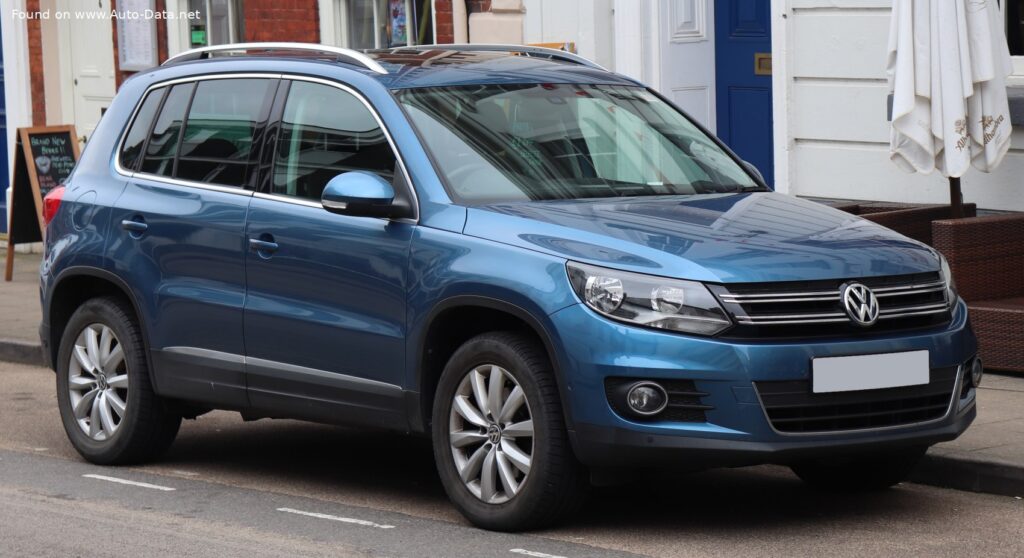
The Volkswagen Tiguan I (facelift 2011) 2.0 TSI (180 Hp) 4MOTION Tiptronic represents a significant iteration of Volkswagen’s foray into the highly competitive compact SUV segment. Introduced in 2011 as a refreshed version of the first-generation Tiguan, this model aimed to solidify its position as a premium, versatile, and capable vehicle for families and individuals seeking a blend of urban practicality and light off-road capability. While primarily a European market success, the Tiguan, including this generation, found a strong following globally, particularly in North America, where its blend of German engineering, sophisticated powertrain, and comfortable interior resonated with consumers. This specific variant, featuring the potent 2.0-liter TSI engine paired with Volkswagen’s renowned 4MOTION all-wheel-drive system and a Tiptronic automatic transmission, offered a compelling package of performance, efficiency, and safety features for its time, cementing its reputation as a well-rounded contender in its class.
The Volkswagen Tiguan I (facelift 2011): A Refined Compact SUV Offering
The 2011 facelift of the first-generation Tiguan brought a host of updates that enhanced its aesthetic appeal and technological offerings, aligning its design language more closely with Volkswagen’s contemporary models like the Touareg and Golf VI. This refresh, produced from 2011 to 2012 for this particular powertrain, was more than just a cosmetic upgrade; it represented Volkswagen’s commitment to continuous improvement in a segment that was rapidly expanding. The Tiguan I, in its facelifted form, maintained its core identity as a compact SUV designed for both on-road comfort and occasional off-road excursions, a characteristic amplified by the 4MOTION all-wheel-drive system. Its market positioning was clear: a more premium alternative to many Japanese and Korean rivals, offering a driving experience often associated with larger, more expensive SUVs, yet in a more manageable and fuel-efficient package. The Tiguan’s global appeal was undeniable, offering a practical solution for diverse climates and driving conditions, from snowy European winters to the varied terrains of the Americas.
Engine and Performance: The 2.0 TSI Powerplant
At the heart of the Volkswagen Tiguan I (facelift 2011) 2.0 TSI (180 Hp) 4MOTION Tiptronic lies a sophisticated 2.0-liter turbocharged, direct-injection gasoline engine, designated with the internal code CCZD. This inline four-cylinder powerplant is a testament to Volkswagen’s engineering prowess, delivering a robust 180 horsepower at a broad range of 4500-6200 rpm. More impressively, it produces a substantial 206.52 lb.-ft. (280 Nm) of torque, available from a remarkably low 1700 rpm and sustained up to 4500 rpm. This wide torque band ensures responsive acceleration and strong pulling power across various driving scenarios, whether navigating city streets or cruising on the highway. The engine’s advanced features, including a turbocharger with an intercooler and DOHC valvetrain with four valves per cylinder, contribute to its impressive power output and efficiency. With a compression ratio of 9.6:1 and precise direct fuel injection, the 2.0 TSI balances performance with optimized fuel combustion.
Performance figures for this Tiguan variant are quite respectable for a compact SUV. It accelerates from 0 to 60 mph in an estimated 9.1 seconds, with a 0-62 mph (0-100 km/h) sprint time of 9.6 seconds. The maximum speed is rated at 124.9 mph (201 km/h), demonstrating its capability for sustained highway speeds. Power is efficiently managed by a 6-speed Tiptronic automatic transmission, known for its smooth shifts and the option for manual gear selection, giving drivers greater control. The vehicle’s powertrain architecture incorporates Volkswagen’s 4MOTION all-wheel-drive system. This intelligent system primarily drives the front wheels but can instantaneously engage the rear wheels via an electrically or mechanically operated clutch when slippage is detected, or proactively in anticipation of challenging conditions. This setup provides enhanced traction and stability, particularly beneficial in adverse weather or light off-road situations, without the fuel economy penalty of a permanent all-wheel-drive system. Fuel economy is rated at a combined 27 US mpg (8.7 l/100 km) under the NEDC cycle, with urban consumption at 20.3 US mpg and extra-urban at 33.6 US mpg. Emissions are rated at 203 g/km CO2, meeting the Euro 5 emission standard for its production years.
Design and Features: Practicality Meets Volkswagen Sophistication
The Volkswagen Tiguan I (facelift 2011) embodied a design philosophy centered on understated elegance and functional practicality. As a 5-door SUV with seating for five, its dimensions were optimized for maneuverability in urban environments while offering ample interior space. With a length of 174.25 inches (4426 mm), a width of 71.22 inches (1809 mm), and a height of 67.05 inches (1703 mm), the Tiguan struck a balance between a commanding road presence and ease of parking. The wheelbase of 102.52 inches (2604 mm) contributed to a stable ride, while a minimum turning circle of 39.37 feet (12 m) aided in tight urban navigation.
Inside, the Tiguan offered a cabin characterized by high-quality materials and thoughtful ergonomics, typical of Volkswagen. The standard trunk space of 16.6 cubic feet (470 liters) was generous for its class, expandable to an impressive 53.33 cubic feet (1510 liters) with the rear seats folded, making it highly versatile for cargo. The vehicle’s kerb weight of 3443.62 lbs (1562 kg) and a maximum load capacity of 1428.6 lbs (648 kg) underscore its robust construction. Furthermore, its towing capabilities were substantial, with a permitted trailer load of 4850.17 lbs (2200 kg) with brakes, highlighting its utility for adventurous owners. For those venturing off the beaten path, the Tiguan offered a ground clearance of 7.87 inches (200 mm) and respectable approach, departure, and ramp-over angles of 18°, 25°, and 20° respectively, making it competent for light trail use.
Underneath, the Tiguan featured an independent McPherson strut front suspension with a transverse stabilizer and an independent multi-link rear suspension, also with a transverse stabilizer. This setup provided a comfortable ride while maintaining composed handling. Stopping power was ensured by ventilated disc brakes at the front and disc brakes at the rear, complemented by an Anti-lock Braking System (ABS) for enhanced safety. The electric power steering system offered precise control and varied assistance based on speed, contributing to a refined driving experience. Standard tire size was 215/65 R16 on 6.5J x 16 wheel rims, providing a good balance of comfort and grip.
Market Context and Legacy
The Volkswagen Tiguan I (facelift 2011), with its 2.0 TSI (180 Hp) 4MOTION Tiptronic variant, played a crucial role in Volkswagen’s global strategy. During its production run from 2011 to 2012, it competed against a growing field of compact SUVs, including the Honda CR-V, Toyota RAV4, and Ford Escape. What set the Tiguan apart was its distinctly European driving feel, characterized by firm yet compliant suspension, precise steering, and the refined performance of its turbocharged engine. It appealed to buyers who valued driving dynamics and a more upscale interior over sheer ruggedness or maximum cargo capacity. The 4MOTION all-wheel-drive system further broadened its appeal, offering peace of mind in adverse conditions without compromising on fuel efficiency as significantly as some older AWD systems.
This facelifted first-generation Tiguan helped establish the model as a credible and desirable option in the compact SUV segment, known for its solid build quality and sophisticated engineering. Its legacy is evident in the continued success of subsequent Tiguan generations, which have built upon the foundation of versatility, performance, and premium feel established by this early model. Even today, the 2011-2012 Tiguan remains a testament to Volkswagen’s ability to blend practicality with an enjoyable driving experience, offering a compelling package that continues to be a reliable and capable choice for many.
Technical Specifications
| Brand | Volkswagen |
| Model | Tiguan |
| Generation | Tiguan I (facelift 2011) |
| Type (Engine) | 2.0 TSI (180 Hp) 4MOTION Tiptronic |
| Start of production | 2011 year |
| End of production | 2012 year |
| Powertrain Architecture | Internal Combustion engine |
| Body type | SUV |
| Seats | 5 |
| Doors | 5 |
| Fuel consumption (economy) – urban (NEDC) | 11.6 l/100 km (20.3 US mpg / 24.4 UK mpg) |
| Fuel consumption (economy) – extra urban (NEDC) | 7 l/100 km (33.6 US mpg / 40.4 UK mpg) |
| Fuel consumption (economy) – combined (NEDC) | 8.7 l/100 km (27 US mpg / 32.5 UK mpg) |
| CO2 emissions (NEDC) | 203 g/km |
| Fuel Type | Petrol (Gasoline) |
| Acceleration 0 – 60 mph | 9.1 sec |
| Acceleration 0 – 62 mph (0 – 100 km/h) | 9.6 sec |
| Maximum speed | 201 km/h (124.9 mph) |
| Emission standard | Euro 5 |
| Weight-to-power ratio | 8.7 kg/Hp (115.2 Hp/tonne) |
| Weight-to-torque ratio | 5.6 kg/Nm (179.3 Nm/tonne) |
| Power | 180 Hp @ 4500-6200 rpm |
| Power per liter | 90.7 Hp/l |
| Torque | 280 Nm @ 1700-4500 rpm (206.52 lb.-ft.) |
| Engine layout | Front, Transverse |
| Engine Model/Code | CCZD |
| Engine displacement | 1984 cm3 (121.07 cu. in.) |
| Number of cylinders | 4 |
| Engine configuration | Inline |
| Cylinder Bore | 82.5 mm (3.25 in.) |
| Piston Stroke | 92.8 mm (3.65 in.) |
| Compression ratio | 9.6:1 |
| Number of valves per cylinder | 4 |
| Fuel injection system | Direct injection |
| Engine aspiration | Turbocharger, Intercooler |
| Valvetrain | DOHC |
| Engine oil capacity | 4.7 l (4.97 US qt / 4.14 UK qt) |
| Kerb Weight | 1562 kg (3443.62 lbs) |
| Max. weight | 2210 kg (4872.22 lbs) |
| Max load | 648 kg (1428.6 lbs) |
| Trunk (boot) space – minimum | 470 l (16.6 cu. ft.) |
| Trunk (boot) space – maximum | 1510 l (53.33 cu. ft.) |
| Fuel tank capacity | 64 l (16.91 US gal / 14.08 UK gal) |
| Max. roof load | 75 kg (165.35 lbs) |
| Permitted trailer load with brakes (8%) | 2200 kg (4850.17 lbs) |
| Permitted trailer load with brakes (12%) | 2200 kg (4850.17 lbs) |
| Permitted trailer load without brakes | 750 kg (1653.47 lbs) |
| Permitted towbar download | 100 kg (220.46 lbs) |
| Length | 4426 mm (174.25 in.) |
| Width | 1809 mm (71.22 in.) |
| Width including mirrors | 2041 mm (80.35 in.) |
| Height | 1703 mm (67.05 in.) |
| Wheelbase | 2604 mm (102.52 in.) |
| Front track | 1569 mm (61.77 in.) |
| Rear (Back) track | 1571 mm (61.85 in.) |
| Ride height (ground clearance) | 200 mm (7.87 in.) |
| Minimum turning circle (turning diameter) | 12 m (39.37 ft.) |
| Approach angle | 18° |
| Departure angle | 25° |
| Ramp-over (brakeover) angle | 20° |
| Drivetrain Architecture | ICE drives front wheels permanently, rear wheels driven via clutch if necessary. |
| Drive wheel | All wheel drive (4×4) |
| Number of gears and type of gearbox | 6 gears, automatic transmission Tiptronic |
| Front suspension | Independent type McPherson, Transverse stabilizer |
| Rear suspension | Independent multi-link suspension, Transverse stabilizer |
| Front brakes | Ventilated discs |
| Rear brakes | Disc |
| Assisting systems | ABS (Anti-lock braking system) |
| Steering type | Steering rack and pinion |
| Power steering | Electric Steering |
| Tires size | 215/65 R16 |
| Wheel rims size | 6.5J x 16 |