
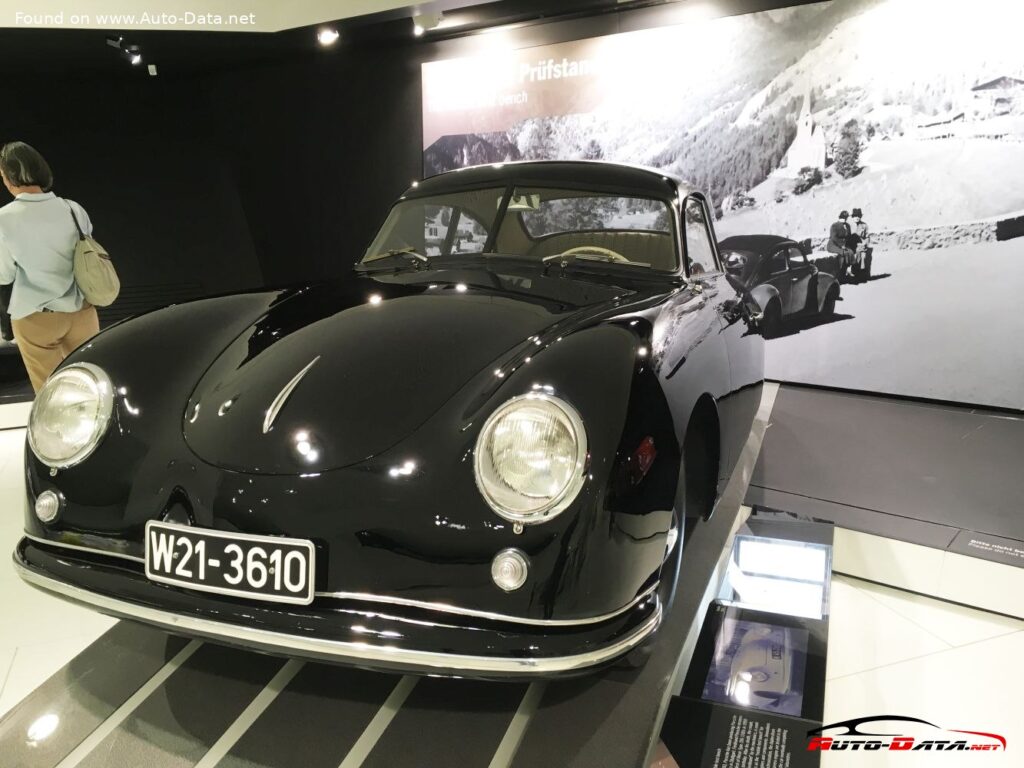
The Porsche 356 Coupe 1100 (40 Hp) stands as a monumental vehicle in automotive history, marking the true genesis of the Porsche brand as a manufacturer of sports cars. Produced from 1948 to 1955, this specific generation, known simply as the 356 Coupe, was the very first series production car from the nascent German automaker. It emerged from the vision of Ferry Porsche, who sought to create a lightweight, agile sports car that leveraged the engineering principles of his father, Ferdinand Porsche, particularly those found in the Volkswagen Beetle. Although not initially designed for the American market, its inherent qualities quickly garnered international attention, laying the groundwork for Porsche’s enduring legacy as a purveyor of performance and precision. The 356 Coupe 1100 (40 Hp) represented a foundational step, embodying the core philosophies of lightweight construction, rear-engine configuration, and aerodynamic efficiency that would define Porsche for decades to come, establishing a benchmark for driver-focused vehicles in the post-war era.
Engineering and Performance of the Porsche 356 Coupe 1100 (40 Hp)
At the heart of the 1948-1955 Porsche 356 Coupe 1100 (40 Hp) was a meticulously engineered powertrain, a testament to Porsche’s philosophy of maximizing efficiency and performance from a modest displacement. This particular variant featured a rear, longitudinally mounted internal combustion engine with a displacement of 1086 cubic centimeters, or approximately 1.1 liters (66.27 cu. in.). This four-cylinder boxer engine, a configuration that would become synonymous with Porsche, produced a respectable 40 horsepower at 4000-4200 revolutions per minute. The boxer layout, characterized by horizontally opposed cylinders, allowed for a lower center of gravity, contributing significantly to the car’s balanced handling and stability—a crucial factor in its early sporting successes.
The engine was naturally aspirated and fed by a carburetor, a common fuel injection system for its time, employing an overhead valve (OHV) valvetrain with two valves per cylinder. This straightforward yet effective design contributed to its reliability and ease of maintenance. With a compression ratio of 7:1, the engine was designed for robust operation. The power output translated to a power per liter figure of 36.8 Hp/l, showcasing an impressive specific output for a production vehicle of its era. Engine oil capacity stood at 3.5 liters (3.7 US qt).
Power was delivered to the rear wheels via a four-speed manual transmission, a setup that provided direct driver engagement and control. This drivetrain architecture, where the internal combustion engine drives the rear wheels, was fundamental to the 356’s sporting character. The car’s performance figures, while modest by today’s standards, were quite competitive for the late 1940s and early 1950s. The Porsche 356 Coupe 1100 (40 Hp) could reach a maximum speed of 86.99 mph (140 km/h), making it a surprisingly capable performer on the nascent highway networks. Its fuel economy was also noteworthy, with a combined consumption rate of 7-8 liters per 100 kilometers, equating to an impressive 33.6 to 29.4 US miles per gallon. This blend of performance and efficiency made the 356 a practical sports car for daily use, not just for weekend escapades.
The lightweight construction of the 356 was pivotal to its dynamic abilities. With a kerb weight of just 1642.44 pounds (745 kg), the car boasted an excellent weight-to-power ratio of 18.6 kg/Hp (53.7 Hp/tonne). This low mass meant that even with 40 horsepower, the car felt nimble and responsive, offering an engaging driving experience. The maximum gross weight was 2425.08 pounds (1100 kg), allowing for a maximum load of 782.64 pounds (355 kg), which included occupants and luggage. The 50-liter (13.21 US gallon) fuel tank provided a decent cruising range, further enhancing its usability.
Design, Features, and Legacy
The design of the Porsche 356 Coupe was revolutionary and instantly recognizable, laying down aesthetic principles that would influence Porsche’s styling for generations. It featured a sleek, aerodynamic coupe body, characterized by its flowing lines and curvaceous silhouette—often affectionately referred to as the “bathtub” shape. This two-door, two-seat configuration emphasized its role as a dedicated sports car, prioritizing driver and passenger experience over utility. The body’s elegant simplicity was not merely for aesthetics; its low drag coefficient significantly contributed to the car’s performance and fuel efficiency.
In terms of dimensions, the 356 Coupe 1100 (40 Hp) was remarkably compact, measuring 152.36 inches (3870 mm) in length, 65.16 inches (1655 mm) in width, and 51.18 inches (1300 mm) in height. Its short wheelbase of 82.68 inches (2100 mm) contributed to its agility and nimble handling. The front track was 49.21 inches (1250 mm), and the rear track was slightly wider at 50.79 inches (1290 mm), providing a stable footprint. A ground clearance of 6.89 inches (175 mm) offered practical usability on varied road surfaces. The minimum turning circle of 34.45 feet (10.5 meters) made it surprisingly maneuverable in urban environments.
Underneath its graceful exterior, the 356 featured an innovative suspension system for its time, employing torsion bars at both the front and rear. This setup, derived from Volkswagen technology but refined by Porsche, provided a comfortable yet sporting ride, allowing the car to handle with precision and predictability. Braking was managed by 280 mm drum brakes on all four wheels, a standard but effective system for a car of its weight and performance capabilities in that era. The steering system utilized a worm-reduction unit, offering direct feedback to the driver, enhancing the visceral connection between man and machine.
The interior of the 356 Coupe was spartan but functional, designed with the driver in mind. Instrumentation was clear and concise, providing all necessary information without distraction. The emphasis was on lightweight materials and straightforward controls, reflecting the car’s sporting intent. While modern safety features like airbags or anti-lock brakes were decades away, the 356’s inherent structural rigidity and predictable handling characteristics offered a degree of passive safety for its era.
The Porsche 356 Coupe 1100 (40 Hp) cemented Porsche’s reputation for building robust, high-quality sports cars that were not only thrilling to drive but also remarkably durable. Its design, performance, and engineering set the template for future Porsche models, including the iconic 911. Today, the 356 Coupe is revered as a classic, cherished for its historical significance, elegant design, and the pure, unadulterated driving experience it offers, embodying the very essence of Porsche’s founding principles.
Technical Specifications
| Brand | Porsche |
| Model | 356 |
| Generation | 356 Coupe |
| Type (Engine) | 1100 (40 Hp) |
| Start of production | 1948 year |
| End of production | 1955 year |
| Powertrain Architecture | Internal Combustion engine |
| Body type | Coupe |
| Seats | 2 |
| Doors | 2 |
| Fuel consumption (combined) | 7-8 l/100 km (33.6 – 29.4 US mpg) |
| Fuel Type | Petrol (Gasoline) |
| Maximum speed | 140 km/h (86.99 mph) |
| Weight-to-power ratio | 18.6 kg/Hp (53.7 Hp/tonne) |
| Power | 40 Hp @ 4000-4200 rpm |
| Power per liter | 36.8 Hp/l |
| Engine layout | Rear, Longitudinal |
| Engine displacement | 1086 cm3 (66.27 cu. in.) |
| Number of cylinders | 4 |
| Engine configuration | Boxer |
| Cylinder Bore | 73.5 mm (2.89 in.) |
| Piston Stroke | 64 mm (2.52 in.) |
| Compression ratio | 7:1 |
| Number of valves per cylinder | 2 |
| Fuel injection system | Carburetor |
| Engine aspiration | Naturally aspirated engine |
| Valvetrain | OHV |
| Engine oil capacity | 3.5 l (3.7 US qt) |
| Kerb Weight | 745 kg (1642.44 lbs.) |
| Max. weight | 1100 kg (2425.08 lbs.) |
| Max load | 355 kg (782.64 lbs.) |
| Fuel tank capacity | 50 l (13.21 US gal) |
| Length | 3870 mm (152.36 in.) |
| Width | 1655 mm (65.16 in.) |
| Height | 1300 mm (51.18 in.) |
| Wheelbase | 2100 mm (82.68 in.) |
| Front track | 1250 mm (49.21 in.) |
| Rear (Back) track | 1290 mm (50.79 in.) |
| Ride height (ground clearance) | 175 mm (6.89 in.) |
| Minimum turning circle | 10.5 m (34.45 ft.) |
| Drivetrain Architecture | ICE drives rear wheels |
| Drive wheel | Rear wheel drive |
| Number of gears and type | 4 gears, manual transmission |
| Front suspension | Torsion |
| Rear suspension | Torsion |
| Front brakes | Drum, 280 mm |
| Rear brakes | Drum, 280 mm |
| Steering type | Worm-reduction unit |
