
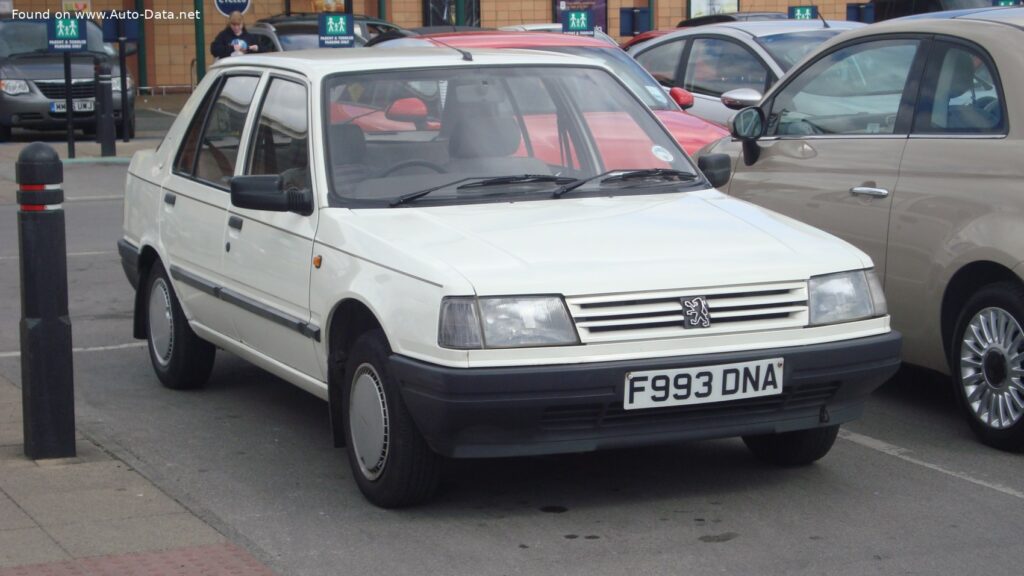
The Peugeot 309 (10C,10A) 1.9 (109 Hp) represents a significant chapter in the history of the French automaker, serving as a robust and practical compact family car primarily for the European market during its production run. Launched in 1988, this particular variant, distinguished by its 1.9-liter engine, quickly established itself as a capable performer within its class. The 309 generation, denoted by the internal codes 10C and 10A for its hatchback iterations, was a crucial model for Peugeot, bridging the gap between the smaller 205 and the larger 405. While never officially imported to the United States, its engineering and design principles reflect the prevailing automotive trends and consumer demands of late 1980s Europe, emphasizing a blend of economy, reliability, and spirited driving dynamics. The 1.9 (109 Hp) model, produced for a brief but impactful period between 1988 and 1989, offered a compelling package for buyers seeking a versatile hatchback with a respectable power output.
The Peugeot 309 (10C,10A) 1.9 (109 Hp): A European Compact Legacy
The Peugeot 309 holds a unique position in the brand’s history, having originally been conceived under the Talbot marque before its rebadging as a Peugeot. This lineage is a testament to the complex automotive landscape of the 1980s, where corporate mergers and strategic platform sharing were common. The 309 was intended to replace the aging Talbot Horizon and was built on a modified version of the highly successful Peugeot 205 platform, inheriting much of its acclaimed handling characteristics. Its introduction marked a strategic move for Peugeot, aiming to solidify its presence in the competitive C-segment of the European market. The 309 was positioned as a more spacious and practical alternative to the 205, yet more compact and accessible than the 405 sedan. Its production from 1988 to 1989 for this specific 1.9 (109 Hp) variant highlights a period when Peugeot was refining its offerings, delivering a vehicle that combined everyday usability with a touch of performance appeal. As a car not directly marketed in North America, its significance is best understood within the context of the bustling European automotive scene, where it competed fiercely against rivals from Volkswagen, Ford, and Renault.
Powertrain and Performance Characteristics
At the heart of the Peugeot 309 (10C,10A) 1.9 (109 Hp) lies the venerable DDZ XU9M engine, a 1.9-liter, naturally aspirated gasoline power plant that delivered a robust 109 horsepower. This engine was part of Peugeot’s highly regarded XU series, known for its durability, relative simplicity, and performance potential. The XU9M, specifically, was a fuel-injected unit, a significant advancement over carbureted engines and indicative of the era’s push towards greater efficiency and cleaner emissions. Its naturally aspirated design meant power delivery was linear and predictable, providing a direct connection between the driver’s input and the engine’s response, a characteristic often cherished by driving enthusiasts. With 109 Hp, the 309 1.9 was a lively performer for its class, offering ample power for both urban commuting and sustained highway speeds. This power output, coupled with the 309’s relatively light hatchback body, ensured that the driving experience was engaging, reflecting Peugeot’s reputation for producing cars with excellent chassis dynamics.
The powertrain architecture, centered around an internal combustion engine, adhered to conventional front-engine, front-wheel-drive layouts that were standard for compact cars of the period. This configuration provided a good balance of interior space, traction, and manufacturing simplicity, contributing to the 309’s reputation as a reliable and easy-to-manage vehicle. The engine’s oil capacity of 4 liters (4.23 US quarts) and a coolant capacity of 7.5 liters (7.93 US quarts) indicate its design for reliable operation under various conditions, essential for a car destined for diverse European climates. The use of gasoline as fuel was standard, and the engine’s design focused on providing a blend of everyday usability and a hint of sportiness, making the 309 1.9 (109 Hp) a versatile option for a wide range of buyers, from families to individuals seeking a capable and enjoyable compact car. Its strong mechanical foundation and respectable performance cemented its status as a mechanically sound and engaging vehicle for its time.
Design Philosophy and Practical Features
The Peugeot 309 (10C,10A) adopted a classic hatchback body type, a configuration highly popular in Europe for its versatility and practicality. Its design, while sharing some visual cues with the groundbreaking 205, presented a more mature and angular aesthetic, reflecting a late 1980s sensibility. The exterior styling was characterized by clean lines, a relatively upright windshield, and a distinctive rear-end treatment that provided generous cargo space. This functional design was a hallmark of Peugeot during this period, prioritizing utility without sacrificing an understated elegance. The body structure was designed to be robust, offering a solid feel on the road and a degree of passive safety protection, which was a growing concern for consumers in the late 1980s.
Inside, the 309 offered a straightforward and ergonomic cabin. While not luxurious by modern standards, the interior was well-appointed for its time, featuring durable materials and a logical layout of controls. Comfort was a key consideration, with supportive seating designed for longer journeys, a testament to Peugeot’s understanding of European driving habits which often involved extensive highway travel. As a family-oriented compact car, the 309 excelled in practicality. The hatchback configuration meant easy access to a flexible cargo area, which could be expanded by folding down the rear seats, making it suitable for everything from weekly grocery runs to hauling luggage for vacation. Features, typical of the late 1980s, would have included a basic heating and ventilation system, manual windows in standard trims, and a simple radio. Power steering might have been an option on higher trims or with larger engines, enhancing maneuverability in urban environments. Safety, while not featuring the array of electronic aids found in modern vehicles, relied on a robust body structure and essential features like seatbelts for all occupants, representing the prevailing standards of the era. The 309’s design was a practical response to the demands of the European market, where compact dimensions, fuel efficiency, and interior flexibility were highly valued. Its role as a successor to the Talbot Horizon and a complement to the 205 and 405 cemented its place in Peugeot’s strategic lineup. The 1.9 (109 Hp) variant, in particular, offered a desirable balance of performance and practicality, making it a compelling choice for consumers who appreciated a spirited drive without compromising on everyday usability. Today, the Peugeot 309 (10C,10A) stands as a testament to Peugeot’s engineering prowess during a pivotal decade, embodying the robust, no-nonsense approach to car design that defined many European classics.
Technical Specifications
| Brand | Peugeot |
| Model | 309 |
| Generation | 309 (10C,10A) |
| Type (Engine) | 1.9 (109 Hp) |
| Start of production | 1988 year |
| End of production | 1989 year |
| Powertrain Architecture | Internal Combustion engine |
| Body type | Hatchback |
| Fuel Type | Petrol (Gasoline) |
| Power | 109 Hp |
| Engine Model/Code | DDZ XU9M |
| Engine aspiration | Naturally aspirated engine |
| Engine oil capacity | 4 l (4.23 US qt) |
| Coolant | 7.5 l (7.93 US qt) |
