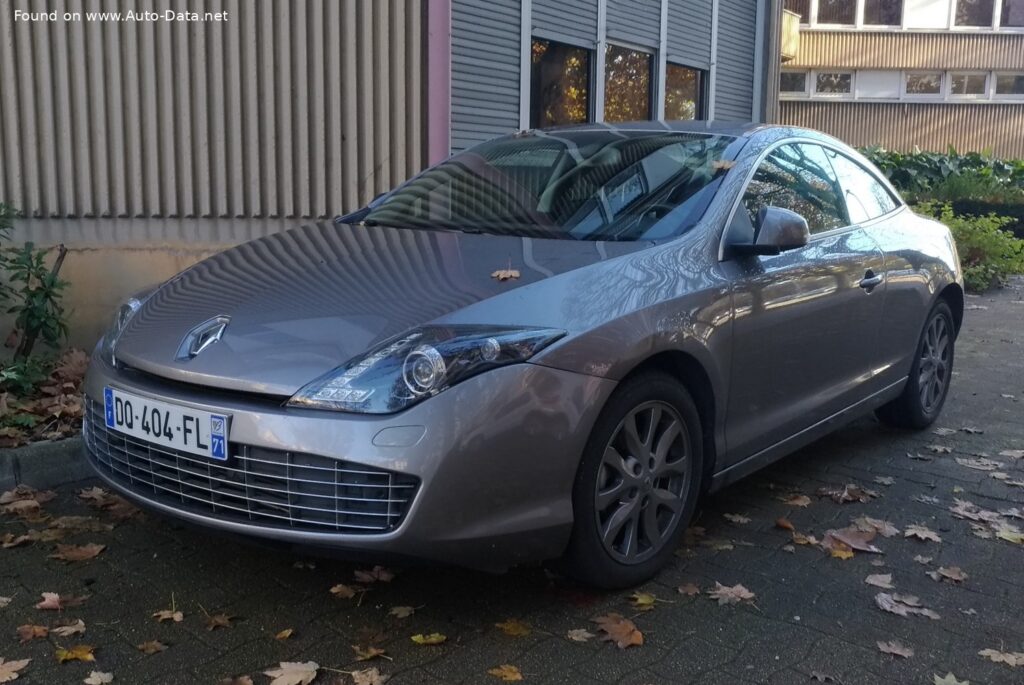
The Renault Laguna Coupe (Phase II) stands as a testament to European automotive design and engineering from the early 2010s, a refined grand tourer that carved out its niche in a competitive segment primarily across Europe. Produced between 2012 and 2015, this two-door, four-seat coupe represented the more elegant and performance-oriented iteration of Renault’s third-generation Laguna lineup. While not officially imported to the United States, its presence in its home market offered a compelling blend of style, comfort, and efficient diesel performance, particularly in the 2.0 dCi (150 Hp) Automatic variant. This model was designed to appeal to buyers seeking a sophisticated and distinctive vehicle with a strong emphasis on long-distance cruising capability and a premium feel, distinguishing itself from its more utilitarian sedan and wagon counterparts.
Engine and Performance: The Heart of the Renault Laguna Coupe (Phase II)
At the core of the Renault Laguna Coupe (Phase II) 2.0 dCi (150 Hp) Automatic lies a robust and efficient powertrain, engineered to deliver a balanced blend of performance and fuel economy characteristic of modern European diesel vehicles. The engine, designated by Renault as the M9R, is a 2.0-liter (1995 cm3 or 121.74 cu. in.) inline four-cylinder turbodiesel unit. This powerplant employs a common-rail direct fuel injection system, coupled with a turbocharger and intercooler, ensuring optimal air-fuel mixture and enhanced power delivery across the rev range. It produces a respectable 150 horsepower at 4000 rpm, translating to a power-per-liter output of 75.2 horsepower per liter, an impressive figure for a diesel engine of its era.
More crucial for a diesel of this nature, especially in a grand touring coupe, is its torque output. The engine generates a substantial 340 Newton-meters (250.77 lb.-ft.) of torque, available at a low 2000 rpm. This ample torque at lower engine speeds contributes significantly to the car’s effortless acceleration and flexible driving characteristics, particularly valuable for highway overtaking and relaxed cruising. Power is delivered to the front wheels via a smooth-shifting 6-speed automatic transmission, which complements the engine’s characteristics by providing seamless gear changes and contributing to overall driving refinement.
Performance figures for the Renault Laguna Coupe (Phase II) 2.0 dCi (150 Hp) Automatic reflect its grand tourer aspirations rather than outright sportiness. The vehicle accelerates from 0 to 60 mph in a calculated 9.3 seconds (0-100 km/h in 9.8 seconds), which is competitive for a diesel coupe of its size and power output. Its maximum speed is rated at 130.49 mph (210 km/h), allowing for comfortable and sustained high-speed travel on European autobahns. Despite its performance capabilities, the Laguna Coupe maintains a strong focus on efficiency. Its combined fuel economy is an estimated 7 liters per 100 kilometers, translating to approximately 33.6 US miles per gallon. Urban consumption stands at 9.6 l/100 km (24.5 US mpg), while extra-urban driving yields an impressive 5.6 l/100 km (42 US mpg). These figures highlight the inherent efficiency benefits of its diesel powertrain. Furthermore, with CO2 emissions rated at 185 g/km, the vehicle met the Euro 4 emission standard, demonstrating Renault’s commitment to environmental responsibility at the time of its production.
The engine’s layout is a front, transverse configuration, driving the front wheels, a common and effective setup for optimizing interior space and manufacturing efficiency. With a compression ratio of 16:1, a bore of 3.31 inches (84 mm), and a stroke of 3.54 inches (90 mm), the M9R engine is designed for durability and consistent performance. The weight-to-power ratio of 10.3 kg/Hp (97.5 Hp/tonne) and a weight-to-torque ratio of 4.5 kg/Nm (220.9 Nm/tonne) further underscore the engine’s capability to move the 3392.91-pound (1539 kg) curb weight of the coupe with authority, providing a confident and stable driving experience.
Design and Features: Elegance and Practicality in the Renault Laguna Coupe (Phase II)
The design of the Renault Laguna Coupe (Phase II) is arguably its most compelling attribute, setting it apart with its sleek, flowing lines and sophisticated profile. As a two-door coupe, it exudes a sense of sportiness and elegance that distinguishes it from its more common sedan and wagon siblings. The body type features a classic coupe silhouette, characterized by a long hood, a gracefully sloping roofline that tapers towards the rear, and a short rear deck. This design language contributes to a low drag coefficient (Cd) of 0.30, enhancing both aerodynamic efficiency and aesthetic appeal.
Despite its coupe designation, the Laguna Coupe offers practical seating for four occupants, making it suitable for couples or small families embarking on journeys. The two-door configuration emphasizes its personal luxury appeal, while the interior is crafted to provide a comfortable and refined environment. Dimensions for the vehicle are substantial, with an overall length of 182.8 inches (4643 mm), a width of 71.34 inches (1812 mm), and a height of 55.04 inches (1398 mm). The wheelbase measures 106.06 inches (2694 mm), contributing to a stable ride and generous interior volume. The front and rear tracks are 60.94 inches (1548 mm) and 60.71 inches (1542 mm) respectively, ensuring a confident stance on the road.
Practicality extends to its cargo capacity, with a trunk space of 423 liters (14.94 cu. ft.), which is quite respectable for a coupe and capable of accommodating luggage for weekend trips. The fuel tank capacity of 17.44 US gallons (66 liters) ensures a considerable driving range, further solidifying its grand touring credentials. The vehicle’s kerb weight is 3392.91 lbs (1539 kg), with a maximum permissible weight of 4446.72 lbs (2017 kg) and a maximum load capacity of 1053.81 lbs (478 kg).
Underpinning the elegant bodywork is a well-engineered chassis designed for comfort and predictable handling. The front suspension utilizes an independent McPherson type, known for its balance of ride comfort and responsiveness. The rear suspension features a semi-independent setup with coil springs, providing a compliant ride while maintaining stability. Braking is handled by ventilated discs at the front and solid discs at the rear, complemented by an Anti-lock Braking System (ABS) for enhanced safety during emergency stops. The steering system is a hydraulic rack and pinion setup, offering precise control and feedback to the driver. The vehicle offers a range of tire sizes, including 185/65 R16, 215/50 R17, and 225/45 R18, mounted on corresponding 16, 17, or 18-inch wheel rims, allowing for customization of both aesthetics and driving dynamics. The minimum turning circle ranges from 35.43 to 38.71 feet (10.8-11.8 meters), providing reasonable maneuverability for a vehicle of its size.
Technical Specifications
| Brand | Renault |
| Model | Laguna |
| Generation | Laguna Coupe (Phase II) |
| Type (Engine) | 2.0 dCi (150 Hp) Automatic |
| Start of production | 2012 year |
| End of production | 2015 year |
| Powertrain Architecture | Internal Combustion engine |
| Body type | Coupe |
| Seats | 4 |
| Doors | 2 |
| Fuel consumption (economy) – urban | 9.6 l/100 km (24.5 US mpg) |
| Fuel consumption (economy) – extra urban | 5.6 l/100 km (42 US mpg) |
| Fuel consumption (economy) – combined | 7 l/100 km (33.6 US mpg) |
| CO2 emissions | 185 g/km |
| Fuel Type | Diesel |
| Acceleration 0 – 60 mph | 9.3 sec |
| Acceleration 0 – 100 km/h | 9.8 sec |
| Maximum speed | 210 km/h (130.49 mph) |
| Emission standard | Euro 4 |
| Power | 150 Hp @ 4000 rpm |
| Power per liter | 75.2 Hp/l |
| Torque | 340 Nm @ 2000 rpm (250.77 lb.-ft. @ 2000 rpm) |
| Maximum engine speed | 5200 rpm |
| Engine layout | Front, Transverse |
| Engine Model/Code | M9R |
| Engine displacement | 1995 cm3 (121.74 cu. in.) |
| Number of cylinders | 4 |
| Engine configuration | Inline |
| Cylinder Bore | 84 mm (3.31 in.) |
| Piston Stroke | 90 mm (3.54 in.) |
| Compression ratio | 16:1 |
| Number of valves per cylinder | 4 |
| Fuel injection system | Diesel Commonrail |
| Engine aspiration | Turbocharger, Intercooler |
| Engine oil capacity | 6.6 l (6.97 US qt) |
| Engine oil specification | Not specified |
| Coolant | 7.8 l (8.24 US qt) |
| Kerb Weight | 1539 kg (3392.91 lbs) |
| Max. weight | 2017 kg (4446.72 lbs) |
| Max load | 478 kg (1053.81 lbs) |
| Trunk (boot) space – minimum | 423 l (14.94 cu. ft.) |
| Fuel tank capacity | 66 l (17.44 US gal) |
| Permitted trailer load with brakes (12%) | 1500 kg (3306.93 lbs) |
| Permitted trailer load without brakes | 650 kg (1433 lbs) |
| Length | 4643 mm (182.8 in.) |
| Width | 1812 mm (71.34 in.) |
| Width including mirrors | 2082 mm (81.97 in.) |
| Height | 1398 mm (55.04 in.) |
| Wheelbase | 2694 mm (106.06 in.) |
| Front track | 1548 mm (60.94 in.) |
| Rear (Back) track | 1542 mm (60.71 in.) |
| Front overhang | 1022 mm (40.24 in.) |
| Rear overhang | 927 mm (36.5 in.) |
| Ride height (ground clearance) | 120 mm (4.72 in.) |
| Drag coefficient (Cd) | 0.30 |
| Minimum turning circle (turning diameter) | 10.8-11.8 m (35.43 – 38.71 ft.) |
| Drivetrain Architecture | Front wheel drive. Internal Combustion engine. |
| Drive wheel | Front wheel drive |
| Number of gears and type of gearbox | 6 gears, automatic transmission |
| Front suspension | Independent type McPherson |
| Rear suspension | Semi-independent, coil spring |
| Front brakes | Ventilated discs |
| Rear brakes | Disc |
| Assisting systems | ABS (Anti-lock braking system) |
| Steering type | Steering rack and pinion |
| Power steering | Hydraulic Steering |
| Tires size | 185/65 R16; 215/50 R17; 225/45 R18 |
| Wheel rims size | 16; 17; 18 |