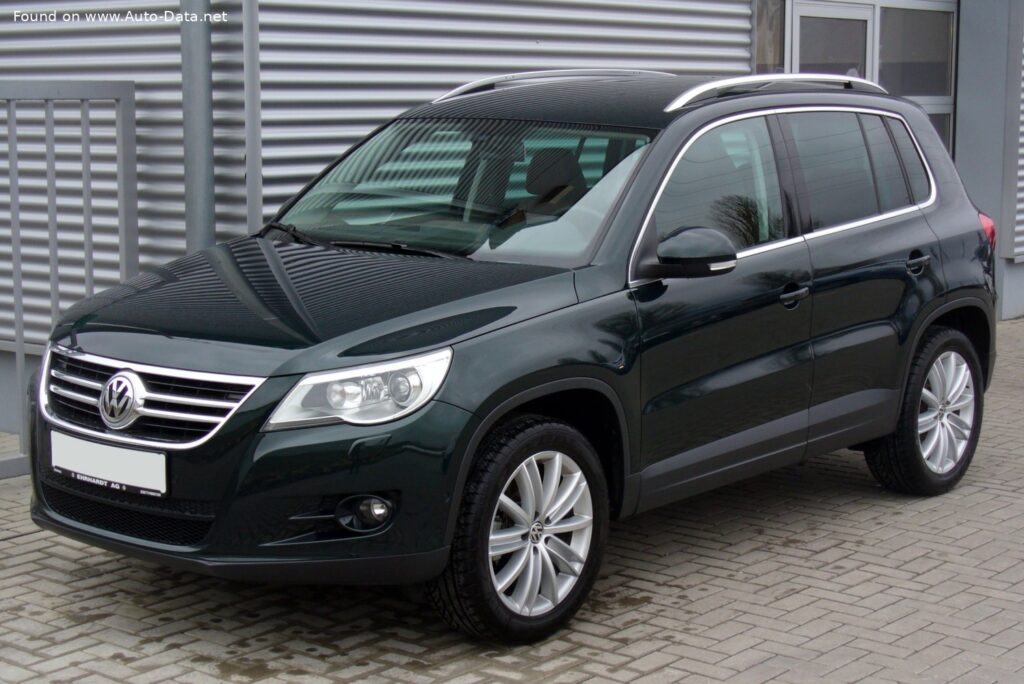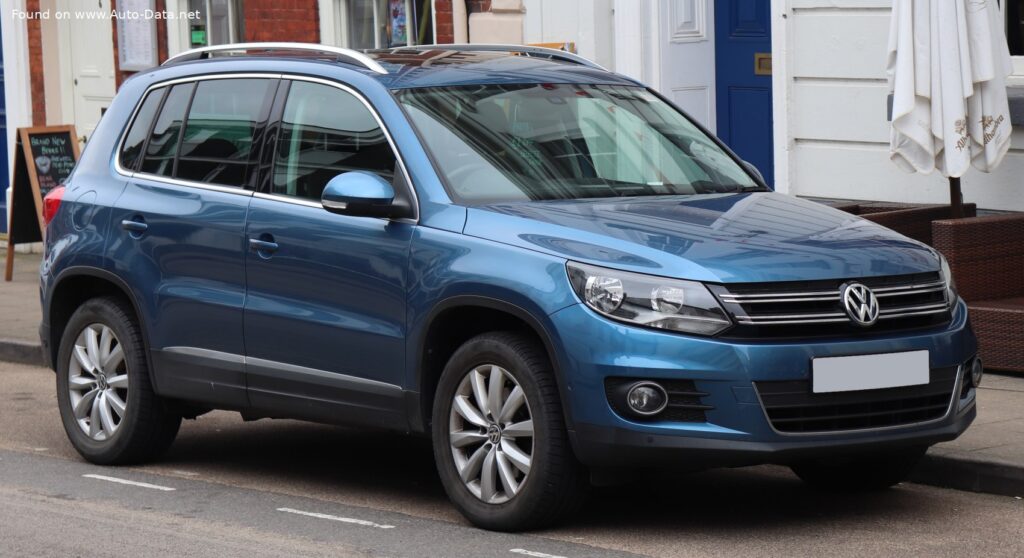
The Volkswagen Tiguan I, specifically the facelifted model introduced in 2011 and available through 2016, represented a crucial offering in the highly competitive compact SUV segment. This particular iteration, the 2.0 TSI (200 Hp) Tiptronic, positioned itself as a refined and capable choice for consumers seeking a blend of European engineering, practicality, and spirited performance. While the Tiguan found a strong foothold globally, including a significant presence in the North American market, this specific front-wheel-drive, 200-horsepower variant with the Tiptronic automatic transmission was particularly popular in markets where fuel efficiency and a balance of urban maneuverability with highway cruising comfort were paramount. The facelift brought subtle yet effective aesthetic updates and technological refinements, ensuring the Tiguan remained a compelling option against rivals, emphasizing Volkswagen’s commitment to quality and driving dynamics in a family-friendly package. Its robust construction and sophisticated powertrain made it a benchmark for compact SUVs of its era, appealing to buyers who appreciated a more upscale and engaging driving experience than many competitors offered.
Powertrain and Performance of the Volkswagen Tiguan I (facelift 2011) 2.0 TSI (200 Hp) Tiptronic
At the heart of the Volkswagen Tiguan I (facelift 2011) 2.0 TSI (200 Hp) Tiptronic lies a highly regarded 2.0-liter turbocharged inline-four gasoline engine, part of Volkswagen’s prolific EA888 family, specifically bearing the CCTA code. This engine, mounted transversely at the front, is a masterclass in modern internal combustion design, featuring direct fuel injection, a turbocharger, and an intercooler to optimize performance and efficiency. It generates a robust 200 horsepower at 5100 rpm, delivering a power output of 100.8 horsepower per liter, which is impressive for a vehicle in this class. More critically for daily driving, the engine produces a substantial 280 Nm (206.52 lb.-ft.) of torque across a broad and accessible rev range, from a low 1700 rpm up to 5000 rpm. This wide torque band ensures responsive acceleration and confident passing power without the need to constantly wind out the engine, contributing to a relaxed yet engaging driving experience.
The EA888 engine’s technical sophistication is further highlighted by its DOHC (Double Overhead Camshaft) valvetrain with four valves per cylinder, ensuring optimal airflow and combustion. A compression ratio of 9.6:1 further aids in efficiency and power delivery. The engine’s displacement of 1984 cubic centimeters (121.07 cu. in.) is achieved through a bore of 82.5 mm (3.25 in.) and a piston stroke of 92.8 mm (3.65 in.). Power is managed by a 6-speed Tiptronic automatic transmission, a conventional torque-converter automatic known for its smooth shifts and reliability. This transmission allows for manual gear selection, providing drivers with greater control over the power delivery, which can be particularly useful in varied driving conditions or when desiring a more dynamic feel. The combination of the potent 2.0 TSI engine and the Tiptronic gearbox results in a refined and capable powertrain architecture where the internal combustion engine drives the front wheels, offering a responsive and efficient driving experience.
Regarding fuel economy, the Volkswagen Tiguan I (facelift 2011) 2.0 TSI (200 Hp) Tiptronic demonstrates a balanced approach. In urban driving conditions, it achieves approximately 21 US mpg (11.2 l/100 km). On the highway, or “extra-urban” cycle, this improves significantly to 26.1 US mpg (9 l/100 km). The combined EPA estimate for this model stands at 23.1 US mpg (10.2 l/100 km), reflecting a practical level of efficiency for a turbocharged gasoline SUV of its size and power. The vehicle’s curb weight of 3403.94 lbs (1544 kg) contributes to a favorable power-to-weight ratio of 129.5 Hp/tonne (7.7 kg/Hp) and a torque-to-weight ratio of 181.3 Nm/tonne (5.5 kg/Nm), underlining its sprightly performance despite its SUV body type.
Design and Features of the Volkswagen Tiguan I (facelift 2011)
The Volkswagen Tiguan I (facelift 2011) maintained its identity as a compact SUV, offering a practical and visually appealing package. The facelift brought subtle but effective updates, aligning its aesthetics more closely with Volkswagen’s contemporary design language, seen in models like the Golf and Passat of the same era. It retained its five-door, five-seat configuration, making it a versatile choice for families and individuals alike. The exterior design was characterized by clean lines, a robust stance, and a purposeful, understated elegance that is typical of Volkswagen. The front fascia received a refreshed grille and headlight design, often incorporating LED daytime running lights, giving it a more modern and assertive look.
Dimensionally, the Tiguan was designed for urban maneuverability without compromising interior space. It measured 174.53 inches (4433 mm) in length, 71.22 inches (1809 mm) in width (80.35 inches or 2041 mm including mirrors), and 67.05 inches (1703 mm) in height. The wheelbase of 102.52 inches (2604 mm) provided a stable ride and contributed to a respectable interior volume. With a front track of 61.77 inches (1569 mm) and a rear track of 61.85 inches (1571 mm), the Tiguan maintained a solid footprint. Its ground clearance of 6.89 inches (175 mm), along with approach, departure, and ramp-over angles of 28°, 25°, and 21° respectively, hinted at its capability to handle light off-road excursions, though its primary domain remained paved roads.
Inside, the Tiguan offered a well-appointed and ergonomically sound cabin. The five-seat layout provided comfortable seating for adults, and the rear seats could often slide and recline, offering flexibility between passenger comfort and cargo capacity. Speaking of cargo, the trunk (boot) space was a practical 16.6 cubic feet (470 liters) with the rear seats in place, expanding significantly to 53.33 cubic feet (1510 liters) when the rear seats were folded down. This versatility made the Tiguan a capable hauler for luggage, groceries, or sports equipment. The fuel tank capacity of 16.91 US gallons (64 liters) provided a good cruising range.
Safety features for the 2011-2016 Tiguan included standard ABS (Anti-lock Braking System), multiple airbags, and a robust body structure designed to protect occupants. The vehicle also featured electric power steering, which provided a good balance of assist for low-speed maneuvering and feedback at higher speeds, contributing to the Tiguan’s reputation for refined driving dynamics. The minimum turning circle of 39.04 feet (11.9 meters) further enhanced its urban agility. Various wheel and tire options were available, ranging from 215/65 R16 to more aggressive 255/40 R19 setups, allowing for personalization and influencing both aesthetics and handling characteristics.
Chassis and Driving Dynamics
The driving dynamics of the Volkswagen Tiguan I (facelift 2011) 2.0 TSI (200 Hp) Tiptronic were a testament to Volkswagen’s engineering prowess, aiming for a car-like ride and handling despite its SUV stature. The chassis architecture was designed to offer a comfortable yet engaging experience, making it a standout in its class. The front suspension utilized an independent MacPherson strut setup with coil springs and an anti-roll bar. This configuration is renowned for its simplicity, effectiveness, and ability to provide precise steering response and good ride comfort. At the rear, an independent multi-link spring suspension with a stabilizer bar was employed. The multi-link design is more sophisticated than simpler beam axles, allowing for greater control over wheel alignment and movement, which translates to superior ride quality, improved handling, and enhanced stability, especially over uneven surfaces or during spirited driving.
Braking performance was assured with a comprehensive system. The front wheels were equipped with ventilated disc brakes, measuring 312×25 mm, providing excellent heat dissipation and consistent stopping power, crucial for a vehicle of its weight and performance capabilities. The rear wheels featured solid disc brakes, measuring 286×12 mm. The inclusion of ABS (Anti-lock Braking System) as a standard assisting system further enhanced safety by preventing wheel lock-up during hard braking, allowing the driver to maintain steering control. The steering system was a rack and pinion type, complemented by electric power steering. This electric system offered variable assistance, making it light and effortless for parking and low-speed maneuvers, while firming up at higher speeds to provide better road feel and stability, contributing to the Tiguan’s confident and predictable handling characteristics. The overall design of the drivetrain, brakes, and suspension ensured that the Tiguan delivered a refined and secure driving experience, whether navigating city streets or cruising on the highway.
Technical Specifications
| Brand | Volkswagen |
| Model | Tiguan |
| Generation | Tiguan I (facelift 2011) |
| Type (Engine) | 2.0 TSI (200 Hp) Tiptronic |
| Start of production | 2011 year |
| End of production | 2016 year |
| Powertrain Architecture | Internal Combustion engine |
| Body type | SUV |
| Seats | 5 |
| Doors | 5 |
| Fuel consumption (economy) – urban (EPA) | 11.2 l/100 km (21 US mpg) |
| Fuel consumption (economy) – extra urban (EPA) | 9 l/100 km (26.1 US mpg) |
| Fuel consumption (economy) – combined (EPA) | 10.2 l/100 km (23.1 US mpg) |
| Fuel Type | Petrol (Gasoline) |
| Weight-to-power ratio | 7.7 kg/Hp, 129.5 Hp/tonne |
| Weight-to-torque ratio | 5.5 kg/Nm, 181.3 Nm/tonne |
| Power | 200 Hp @ 5100 rpm. |
| Power per litre | 100.8 Hp/l |
| Torque | 280 Nm (206.52 lb.-ft.) @ 1700-5000 rpm. |
| Engine layout | Front, Transverse |
| Engine Model/Code | EA888 / CCTA |
| Engine displacement | 1984 cm3 (121.07 cu. in.) |
| Number of cylinders | 4 |
| Engine configuration | Inline |
| Cylinder Bore | 82.5 mm (3.25 in.) |
| Piston Stroke | 92.8 mm (3.65 in.) |
| Compression ratio | 9.6:1 |
| Number of valves per cylinder | 4 |
| Fuel injection system | Direct injection |
| Engine aspiration | Turbocharger, Intercooler |
| Valvetrain | DOHC |
| Engine oil capacity | 4.7 l (4.97 US qt) |
| Coolant | 8 l (8.45 US qt) |
| Kerb Weight | 1544 kg (3403.94 lbs.) |
| Max. weight | 2180 kg (4806.08 lbs.) |
| Max load | 636 kg (1402.14 lbs.) |
| Trunk (boot) space – minimum | 470 l (16.6 cu. ft.) |
| Trunk (boot) space – maximum | 1510 l (53.33 cu. ft.) |
| Fuel tank capacity | 64 l (16.91 US gal) |
| Permitted trailer load with brakes (12%) | 998 kg (2200.21 lbs.) |
| Length | 4433 mm (174.53 in.) |
| Width | 1809 mm (71.22 in.) |
| Width including mirrors | 2041 mm (80.35 in.) |
| Height | 1703 mm (67.05 in.) |
| Wheelbase | 2604 mm (102.52 in.) |
| Front track | 1569 mm (61.77 in.) |
| Rear (Back) track | 1571 mm (61.85 in.) |
| Ride height (ground clearance) | 175 mm (6.89 in.) |
| Drag coefficient (Cd) | 0.37 |
| Minimum turning circle (turning diameter) | 11.9 m (39.04 ft.) |
| Approach angle | 28° |
| Departure angle | 25° |
| Ramp-over (brakeover) angle | 21° |
| Drivetrain Architecture | The Internal combustion engine (ICE) drives the front wheels of the vehicle. |
| Drive wheel | Front wheel drive |
| Number of gears and type of gearbox | 6 gears, automatic transmission Tiptronic |
| Front suspension | Independent, type McPherson with coil spring and anti-roll bar |
| Rear suspension | Independent multi-link spring suspension with stabilizer |
| Front brakes | Ventilated discs, 312×25 mm |
| Rear brakes | Disc, 286×12 mm |
| Assisting systems | ABS (Anti-lock braking system) |
| Steering type | Steering rack and pinion |
| Power steering | Electric Steering |
| Tires size | 215/65 R16; 235/50 R18; 235/55 R18; 255/40 R19 |
| Wheel rims size | 6.5J x 16; 7J x 18; 9J x 19 |