
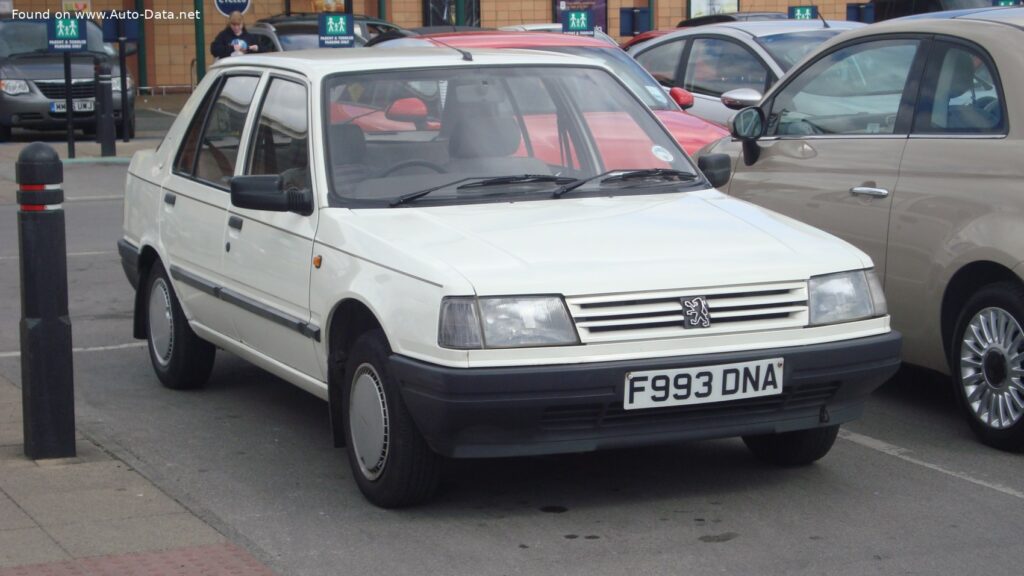
The Peugeot 309 (10C,10A) 1.9 D (64 Hp) represents a significant chapter in the European automotive landscape of the late 1980s. Launched in 1986, the 309 was a compact family car designed primarily for the European market, bridging the gap between the smaller 205 and the larger 405. While never officially imported to the United States, its design philosophy and engineering prowess were indicative of Peugeot’s commitment to producing robust, efficient, and practical vehicles for the masses. The 309 was initially conceived as a Talbot model, intended as a successor to the Horizon, but due to the phasing out of the Talbot brand, it was rebadged as a Peugeot. This lineage explains some of its distinctive styling cues and underpinnings. The specific 1.9 D (64 Hp) variant, produced from 1986 to 1989, stood out as a particularly economical and durable choice, catering to a market where diesel power was highly valued for its fuel efficiency and longevity, especially given the rising fuel costs of the era. This model exemplified the no-nonsense approach to motoring, focusing on utility, low running costs, and a comfortable, albeit straightforward, driving experience.
The Peugeot 309 (10C,10A) 1.9 D (64 Hp): A European Workhorse
The Peugeot 309, in its first generation (10C, 10A), quickly established itself as a reliable and versatile compact hatchback across Europe. Its role was to offer a practical solution for families and individuals seeking a car that was economical to run and maintain, yet spacious enough for daily tasks and longer journeys. The 1.9 D (64 Hp) model, in particular, became a symbol of frugal motoring. Its design, while sharing some visual DNA with the highly successful Peugeot 205, also incorporated unique elements that gave it a distinct identity. The 309 was celebrated for its robust build quality and a driving experience that prioritized comfort and predictability over sportiness, a common trait among Peugeot models of this period. Its five-door hatchback configuration, combined with a surprisingly generous cargo capacity, made it an ideal choice for a wide array of buyers, from young families to those needing a dependable commuter vehicle. The car’s longevity on European roads, with many examples still in service decades later, speaks volumes about its inherent durability and the quality of its engineering.
Powertrain and Performance Characteristics
At the heart of the Peugeot 309 (10C,10A) 1.9 D (64 Hp) lies the venerable XUD9 engine, a naturally aspirated, four-cylinder inline diesel unit displacing 1905 cm3 (116.25 cu. in.). This engine was renowned for its reliability and efficiency, becoming a staple across various Peugeot and Citroën models throughout the 1980s and 1990s. It produced a modest 64 horsepower at 4600 rpm, which, while not designed for blistering performance, was perfectly adequate for its intended purpose. More crucial for a diesel of this era was its torque output: 120 Nm (88.51 lb.-ft.) delivered at a low 2000 rpm. This low-end torque provided good drivability in urban environments and made the car feel more responsive than its horsepower figure might suggest, especially when paired with its relatively light kerb weight of 2083.37 lbs. (945 kg).
Power was sent to the front wheels via a 5-speed manual transmission, a standard and effective setup for maximizing both performance and fuel economy. The front-wheel-drive architecture, combined with the transverse engine layout, contributed to efficient packaging and predictable handling characteristics. In terms of acceleration, the 309 1.9 D could reach 60 mph from a standstill in 14.1 seconds, with a top speed of 102.53 mph (165 km/h). These figures clearly indicate its focus on economical transport rather than outright speed, a characteristic that was well-received in its primary markets. The car’s fuel efficiency was a major selling point, with urban consumption rated at an impressive 28.3 US mpg (8.3 l/100 km) and an even more remarkable 49 US mpg (4.8 l/100 km) on the extra-urban cycle. This level of economy made the 309 1.9 D a highly attractive option for drivers covering long distances or looking to minimize their running costs during a period of fluctuating fuel prices. The engine’s high compression ratio of 23.5:1 is typical for a naturally aspirated diesel, ensuring efficient combustion and robust operation.
Design Philosophy and Practicality
The design of the Peugeot 309 (10C,10A) was a blend of utilitarianism and a subtle evolution of Peugeot’s established design language. As a 5-door hatchback, practicality was paramount. Its dimensions—159.49 inches (4051 mm) in length, 64.09 inches (1628 mm) in width, and 54.33 inches (1380 mm) in height—placed it firmly in the compact segment, making it maneuverable in city traffic while still offering a comfortable interior for five occupants. The wheelbase of 97.2 inches (2469 mm) contributed to a stable ride, a hallmark of Peugeot’s chassis tuning.
Inside, the 309 prioritized functionality. The five seats provided adequate space for adults, and the true strength of the hatchback body style was evident in its cargo capacity. With the rear seats in place, the trunk offered 14.02 cu. ft. (397 liters) of space, which could be expanded to a cavernous 45.17 cu. ft. (1279 liters) by folding the rear seats down. This versatility made it an ideal vehicle for everything from grocery runs to family vacations. The car’s drag coefficient (Cd) of 0.30 was respectable for the era, contributing to its fuel efficiency and reducing wind noise at higher speeds.
The chassis and suspension setup further underscored the 309’s practical design. It featured an independent McPherson strut system with coil springs and an anti-roll bar at the front, a configuration known for its balance of ride comfort and handling precision. The rear utilized a torsion bar suspension, a compact and effective solution that allowed for a flatter load floor and contributed to the car’s generous cargo volume. Braking was handled by disc brakes at the front and drum brakes at the rear, a common and reliable setup for vehicles in this class during the late 1980s. The steering system employed a rack and pinion design, offering direct and predictable control. The relatively small 145/70 R13 tires mounted on 13-inch wheel rims were chosen for their low rolling resistance and cost-effectiveness, further emphasizing the car’s economical intent. The Peugeot 309 (10C,10A) 1.9 D (64 Hp) was, therefore, a testament to thoughtful engineering that delivered a highly functional and dependable vehicle for the European market.
Comprehensive Technical Specifications
| Brand | Peugeot |
| Model | 309 |
| Generation | 309 (10C,10A) |
| Engine Type | 1.9 D (64 Hp) |
| Production Start | 1986 year |
| Production End | 1989 year |
| Powertrain Architecture | Internal Combustion engine |
| Body Type | Hatchback |
| Seats | 5 |
| Doors | 5 |
| Fuel Consumption (Urban) | 8.3 l/100 km (28.3 US mpg) |
| Fuel Consumption (Extra Urban) | 4.8 l/100 km (49 US mpg) |
| Fuel Type | Diesel |
| Acceleration 0-60 mph | 14.1 sec |
| Maximum Speed | 165 km/h (102.53 mph) |
| Weight-to-Power Ratio | 14.8 kg/Hp (67.7 Hp/tonne) |
| Weight-to-Torque Ratio | 7.9 kg/Nm (127 Nm/tonne) |
| Power | 64 Hp @ 4600 rpm |
| Power per Liter | 33.6 Hp/l |
| Torque | 120 Nm @ 2000 rpm (88.51 lb.-ft. @ 2000 rpm) |
| Engine Layout | Front, Transverse |
| Engine Model/Code | XUD9 |
| Engine Displacement | 1905 cm3 (116.25 cu. in.) |
| Number of Cylinders | 4 |
| Engine Configuration | Inline |
| Cylinder Bore | 83 mm (3.27 in.) |
| Piston Stroke | 88 mm (3.46 in.) |
| Compression Ratio | 23.5:1 |
| Valves per Cylinder | 2 |
| Engine Aspiration | Naturally aspirated engine |
| Valvetrain | OHC |
| Engine Oil Capacity | 5 l (5.28 US qt) |
| Coolant Capacity | 8.5 l (8.98 US qt) |
| Kerb Weight | 945 kg (2083.37 lbs.) |
| Maximum Weight | 1370 kg (3020.33 lbs.) |
| Maximum Load | 425 kg (936.96 lbs.) |
| Trunk Space (Minimum) | 397 l (14.02 cu. ft.) |
| Trunk Space (Maximum) | 1279 l (45.17 cu. ft.) |
| Fuel Tank Capacity | 55 l (14.53 US gal) |
| Permitted Trailer Load (with brakes) | 800 kg (1763.7 lbs.) |
| Length | 4051 mm (159.49 in.) |
| Width | 1628 mm (64.09 in.) |
| Height | 1380 mm (54.33 in.) |
| Wheelbase | 2469 mm (97.2 in.) |
| Front Track | 1408 mm (55.43 in.) |
| Rear Track | 1376 mm (54.17 in.) |
| Front Overhang | 753 mm (29.65 in.) |
| Rear Overhang | 829 mm (32.64 in.) |
| Drag Coefficient (Cd) | 0.30 |
| Drivetrain Architecture | Front-wheel drive, Internal Combustion engine |
| Drive Wheel | Front wheel drive |
| Number of Gears & Gearbox Type | 5 gears, manual transmission |
| Front Suspension | Independent, McPherson with coil spring and anti-roll bar |
| Rear Suspension | Torsion |
| Front Brakes | Disc |
| Rear Brakes | Drum |
| Steering Type | Steering rack and pinion |
| Tires Size | 145/70 R13 |
| Wheel Rims Size | 13 inches |
