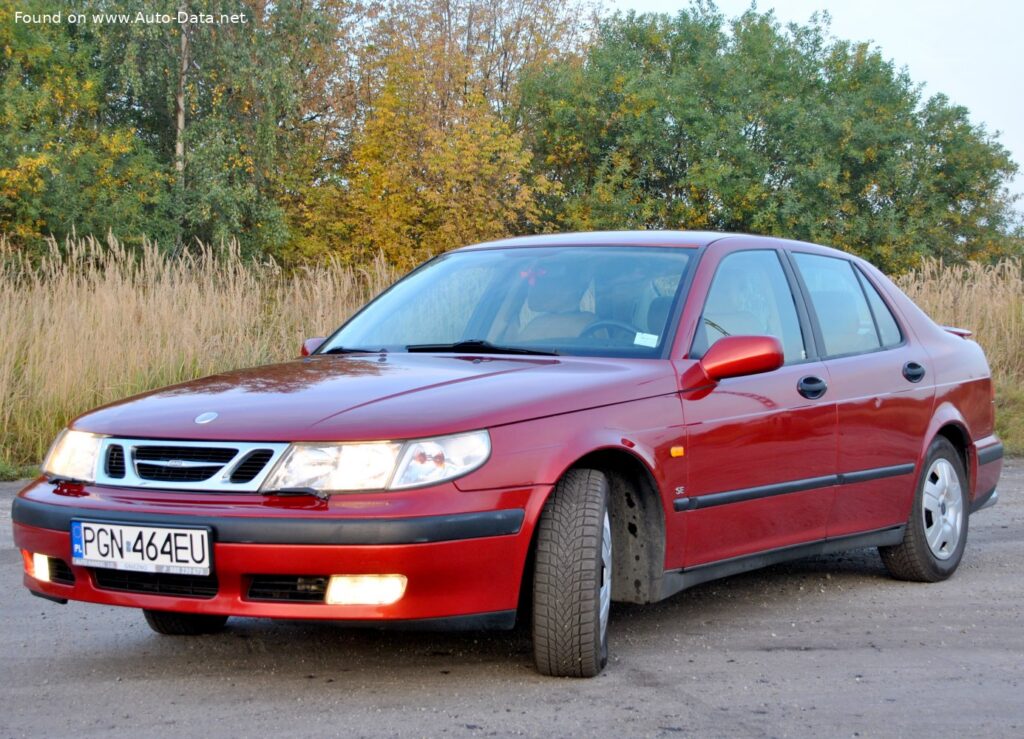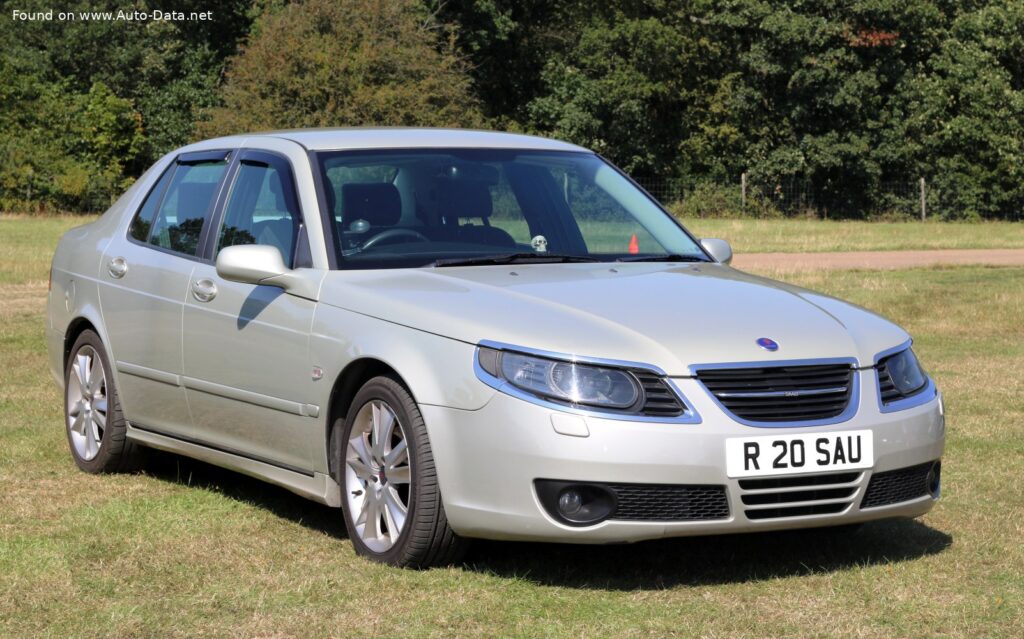
The Saab 9-5, particularly the facelifted model introduced in 2005, represented the pinnacle of Saab’s executive sedan offerings during its production run from 2005 to 2007. As a distinctive premium mid-size vehicle, the Saab 9-5 (facelift 2005) carved out a unique niche in a highly competitive segment dominated by German luxury marques. Originating from Trollhättan, Sweden, Saab cars were renowned for their aviation-inspired design, focus on safety, and pioneering use of turbocharging technology. This particular variant, the 2.3T (220 Hp) Sentronic, combined robust turbocharged performance with the convenience of an automatic transmission, appealing to drivers seeking a blend of sophisticated comfort, spirited driving dynamics, and a departure from conventional luxury choices. Its role in the market was to offer a compelling alternative, emphasizing ergonomic design, advanced safety features for its era, and a driving experience that was both engaging and refined.
The Saab 9-5 (facelift 2005): A Refined Executive Sedan
Evolution and Market Context
The 2005 facelift of the Saab 9-5 marked a significant update to the first-generation model, which had been in production since 1997. This refresh aimed to modernize its aesthetics and enhance its appeal, keeping it competitive in the premium sedan segment. The exterior received a more contemporary look, characterized by revised front and rear fascias, updated lighting signatures, and subtle bodywork enhancements that maintained Saab’s distinctive design language while offering a fresher appearance. The Saab 9-5 (facelift 2005) continued to embody Saab’s core values: a blend of practicality, safety, and a driver-focused experience. Unlike its more conservative rivals, the 9-5 offered a quirky yet functional Scandinavian design philosophy that resonated with a loyal customer base. Its market position was that of an intelligent, performance-oriented sedan, providing a unique proposition for those who valued individuality and thoughtful engineering over brand ubiquity.
Distinctive Design and Cabin Ergonomics
The body type for the Saab 9-5 (facelift 2005) 2.3T (220 Hp) Sentronic was a classic four-door sedan, designed to comfortably accommodate five occupants. The facelift brought a more assertive front grille, updated headlights, and revised taillight clusters, giving the car a more cohesive and modern appearance. Despite these changes, the 9-5 retained its characteristic Saab silhouette, with a low-slung profile and a strong emphasis on aerodynamic efficiency, a nod to the brand’s aviation heritage. Inside, the cabin of the 9-5 was a testament to Saab’s ergonomic prowess. The “cockpit” design theme, with its driver-centric dashboard and intuitively placed controls, aimed to minimize distraction and maximize driver engagement. Materials were of high quality for the segment, with a focus on durability and tactile appeal. Seating comfort was a particular highlight, with supportive seats designed for long-distance travel. Practicality was also a strong suit, evidenced by a generous trunk capacity of 17.66 cubic feet (500 liters), making it well-suited for family use or executive travel. Safety, a paramount concern for Saab, was integrated into every aspect of the design, featuring advanced crumple zones and a comprehensive suite of airbags for its time.
Powertrain and Driving Dynamics of the Saab 9-5 (facelift 2005)
The Turbocharged Heart: 2.3T Engine
At the core of the Saab 9-5 (facelift 2005) 2.3T (220 Hp) Sentronic lay Saab’s venerable B235L engine, a 2.3-liter (2290 cm³ or 139.74 cu. in.) inline four-cylinder unit. This engine was a hallmark of Saab engineering, known for its robust construction and sophisticated turbocharging system. Featuring a DOHC (Dual Overhead Camshaft) valvetrain with four valves per cylinder, the engine was designed for optimal breathing and efficiency. The key to its performance was the turbocharger, which, combined with an intercooler, significantly boosted power output and torque across a broad RPM range. Fuel delivery was managed by a multi-port manifold injection system, ensuring precise fuel metering and combustion. This configuration allowed the engine to produce a healthy 220 horsepower at 5500 rpm, translating to an impressive 96.1 horsepower per liter. More significantly, the engine delivered a substantial 310 Nm (228.64 lb.-ft.) of torque, available from a remarkably low 1800 rpm and sustained up to 4500 rpm. This wide, flat torque curve provided excellent throttle response and strong acceleration in everyday driving situations, characteristic of Saab’s “real-world” performance philosophy.
Sentronic Transmission and Performance Figures
Power from the 2.3T engine was channeled to the front wheels via a 5-speed Sentronic automatic transmission. This gearbox offered both conventional automatic operation and a manual shift mode, allowing drivers to select gears sequentially for a more engaging driving experience. The drivetrain architecture was front-wheel drive, a common layout for Saab, contributing to predictable handling characteristics and good traction in varied conditions. The combination of the potent 2.3T engine and the responsive Sentronic transmission resulted in commendable performance figures for a sedan of its class. The 9-5 2.3T could accelerate from 0 to 60 mph in a brisk 8.3 seconds (0-100 km/h in 8.7 seconds), and it had a maximum speed of 142.92 mph (230 km/h). These figures underscored the car’s capability as a competent performer, capable of comfortable high-speed cruising and confident overtaking maneuvers.
Suspension, Braking, and Efficiency
The driving dynamics of the Saab 9-5 were further enhanced by its well-engineered chassis. The front suspension featured an independent McPherson strut design, complemented by a transverse stabilizer bar to minimize body roll. At the rear, an independent multi-link suspension system, also with a transverse stabilizer, provided a refined ride quality and excellent road holding. This setup contributed to the 9-5’s reputation for stable handling and a comfortable, yet controlled, ride. Braking performance was robust, with 308mm ventilated discs at the front and 286mm solid discs at the rear, augmented by an Anti-lock Braking System (ABS) for enhanced safety and control during emergency stops. The steering system was a hydraulic rack and pinion setup, providing precise feedback and a natural feel. Fuel efficiency, while not class-leading due to the car’s performance focus and the technology of the era, was respectable for a turbocharged executive sedan. The combined fuel consumption (NEDC) was rated at 23.1 US mpg (10.2 l/100 km), with urban figures at 15.3 US mpg (15.4 l/100 km) and extra-urban at 33.1 US mpg (7.1 l/100 km). The vehicle complied with the Euro 4 emission standard, emitting 244 g/km of CO2, reflecting its environmental performance relative to its contemporaries.
Technical Specifications
| Brand | Saab |
| Model | 9-5 |
| Generation | 9-5 (facelift 2005) |
| Type (Engine) | 2.3T (220 Hp) Sentronic |
| Start of production | 2005 year |
| End of production | 2007 year |
| Powertrain Architecture | Internal Combustion engine |
| Body type | Sedan |
| Seats | 5 |
| Doors | 4 |
| Fuel consumption (economy) – urban (NEDC) | 15.3 US mpg (15.4 l/100 km) |
| Fuel consumption (economy) – extra urban (NEDC) | 33.1 US mpg (7.1 l/100 km) |
| Fuel consumption (economy) – combined (NEDC) | 23.1 US mpg (10.2 l/100 km) |
| CO2 emissions (NEDC) | 244 g/km |
| Fuel Type | Petrol (Gasoline) |
| Acceleration 0 – 60 mph | 8.3 sec |
| Acceleration 0 – 100 km/h | 8.7 sec |
| Maximum speed | 142.92 mph (230 km/h) |
| Emission standard | Euro 4 |
| Power | 220 Hp @ 5500 rpm |
| Power per liter | 96.1 Hp/l |
| Torque | 228.64 lb.-ft. @ 1800-4500 rpm (310 Nm) |
| Engine layout | Front, Transverse |
| Engine Model/Code | B235L |
| Engine displacement | 139.74 cu. in. (2290 cm³) |
| Number of cylinders | 4 |
| Engine configuration | Inline |
| Cylinder Bore | 3.54 in. (90 mm) |
| Piston Stroke | 3.54 in. (90 mm) |
| Compression ratio | 9.3:1 |
| Number of valves per cylinder | 4 |
| Fuel injection system | Multi-port manifold injection |
| Engine aspiration | Turbocharger, Intercooler |
| Valvetrain | DOHC |
| Engine oil capacity | 4.23 US qt (4 l) |
| Coolant | 7.82 US qt (7.4 l) |
| Trunk (boot) space – minimum | 17.66 cu. ft. (500 l) |
| Fuel tank capacity | 19.81 US gal (75 l) |
| Max. roof load | 220.46 lbs. (100 kg) |
| Permitted trailer load with brakes (12%) | 3968.32 lbs. (1800 kg) |
| Permitted trailer load without brakes | 1653.47 lbs. (750 kg) |
| Length | 190.39 in. (4836 mm) |
| Width | 70.55 in. (1792 mm) |
| Width including mirrors | 81.5 in. (2070 mm) |
| Height | 57.01 in. (1448 mm) |
| Wheelbase | 106.42 in. (2703 mm) |
| Front track | 59.92 in. (1522 mm) |
| Rear (Back) track | 60.16 in. (1528 mm) |
| Front overhang | 40.59 in. (1031 mm) |
| Rear overhang | 43.39 in. (1102 mm) |
| Minimum turning circle (turning diameter) | 35.43 ft. (10.8 m) |
| Drivetrain Architecture | The Internal combustion engine (ICE) drives the front wheels of the vehicle. |
| Drive wheel | Front wheel drive |
| Number of gears and type of gearbox | 5 gears, automatic transmission Sentronic |
| Front suspension | Independent type McPherson, Transverse stabilizer |
| Rear suspension | Independent multi-link suspension, Transverse stabilizer |
| Front brakes | Ventilated discs, 308 mm |
| Rear brakes | Disc, 286 mm |
| Assisting systems | ABS (Anti-lock braking system) |
| Steering type | Steering rack and pinion |
| Power steering | Hydraulic Steering |
| Tires size | 225/45 R17 |
| Wheel rims size | 7J x 17 |