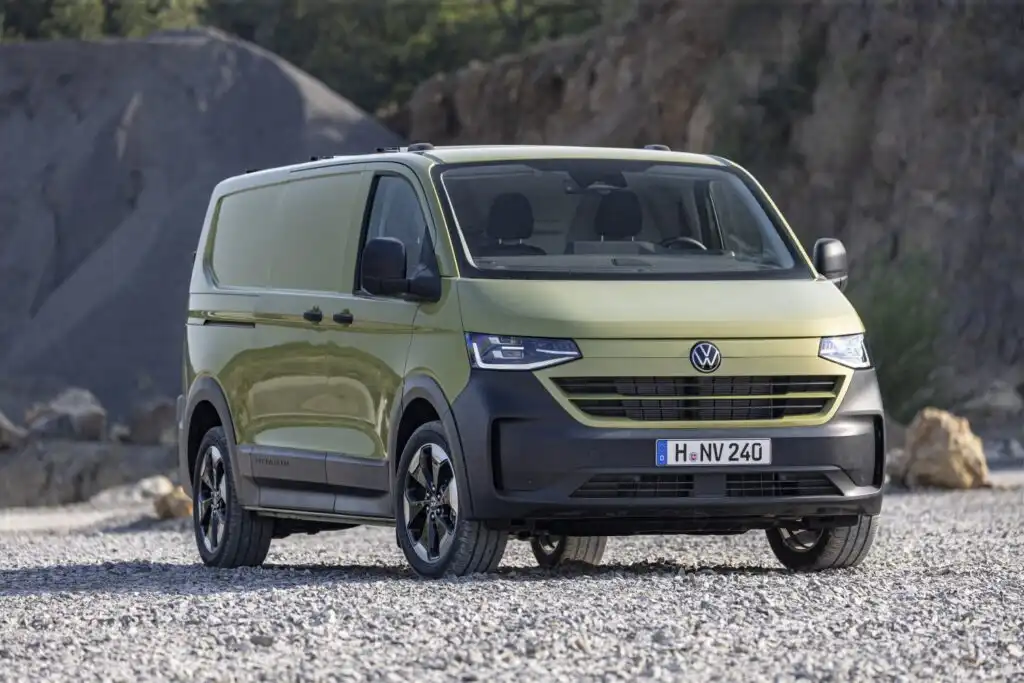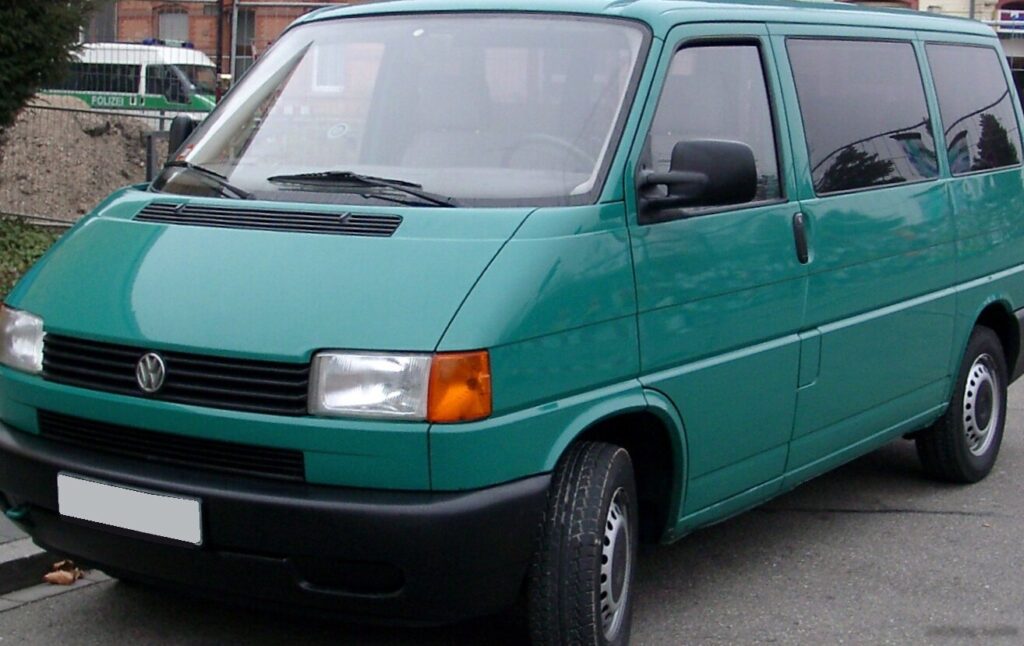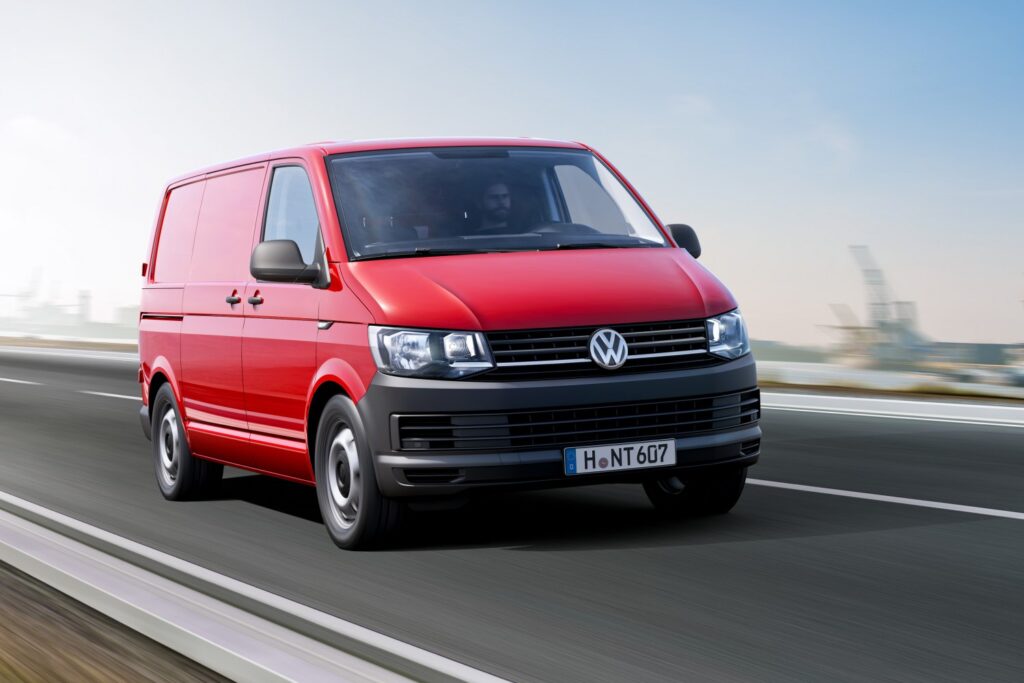
The Volkswagen Transporter (T6) Panel Van 2.0 TDI (204 Hp) DSG L1H2 represents the sixth generation of Volkswagen’s iconic light commercial vehicle, a lineage celebrated globally for its versatility, durability, and practical design. Launched in 2016 and produced until 2019, the T6 generation continued to build upon the success of its predecessors, particularly within the European and international markets where it serves as a ubiquitous workhorse for businesses, tradespeople, and logistics operations. While not a primary offering in the North American market in this specific configuration, the Transporter’s influence on the global van segment is undeniable, embodying German engineering prowess tailored for utilitarian efficiency. This particular L1H2 variant, signifying a short wheelbase and medium-height roof, combined with the potent 2.0 TDI engine and advanced DSG transmission, was designed to deliver a compelling balance of performance, fuel efficiency, and substantial cargo capacity, making it a highly sought-after model for demanding professional applications.
Powertrain and Performance of the Volkswagen Transporter (T6)
At the heart of this formidable commercial vehicle is Volkswagen’s highly regarded 2.0-liter TDI (Turbocharged Direct Injection) diesel engine, a powerplant engineered for both robust performance and impressive fuel economy. This specific iteration, designated by its 204 horsepower (Hp) output, is achieved at a peak of 4000 revolutions per minute (rpm). The engine’s advanced design, featuring a BiTurbo setup and an intercooler, allows for a remarkable torque output of 450 Nm, or approximately 331.9 lb.-ft., available across a broad and usable range from 1400 to 2400 rpm. This wide torque band is crucial for a commercial vehicle, ensuring strong pulling power from low engine speeds, which is essential for carrying heavy loads or navigating urban stop-and-go traffic.
The 1968 cubic centimeter (120.09 cu. in.) inline four-cylinder engine utilizes a DOHC (Double Overhead Camshaft) valvetrain with four valves per cylinder, optimizing airflow and combustion efficiency. Its common rail fuel injection system, combined with a compression ratio of 15.5:1, contributes to its diesel efficiency. Power is seamlessly managed by a 7-speed automatic DSG (Direct-Shift Gearbox) transmission, known for its rapid and smooth gear changes, which enhances both driving comfort and fuel economy. This sophisticated powertrain enables the Transporter (T6) Panel Van to accelerate from 0 to 60 mph in a swift 8.6 seconds (calculated), reaching a maximum speed of 122.41 mph (197 km/h). These performance figures are exceptional for a vehicle in its class, underscoring its capability not just as a cargo hauler but also as a competent long-distance cruiser.
Fuel efficiency is a critical consideration for commercial operators, and the 2.0 TDI engine does not disappoint. According to NEDC (New European Driving Cycle) standards, the combined fuel consumption ranges from 6.1 to 6.7 liters per 100 kilometers, translating to an impressive 38.6 to 35.1 US mpg. Urban consumption is rated at 7-7.7 l/100 km (33.6-30.5 US mpg), while extra-urban driving yields 5.5-6.1 l/100 km (42.8-38.6 US mpg). These figures highlight the engine’s efficiency across various driving conditions. Furthermore, the vehicle adheres to the Euro 6 emission standard, with CO2 emissions ranging from 158 to 174 g/km, thanks in part to integrated engine systems like the Start & Stop System and a Particulate filter, which minimize environmental impact and optimize fuel usage.
The Volkswagen Transporter (T6): A Legacy of Utility and Design
The design of the {Volkswagen Transporter (T6) Panel Van 2.0 TDI (204 Hp) DSG L1H2} is a testament to Volkswagen’s commitment to functional aesthetics and ergonomic utility. As a panel van, its primary purpose is the efficient transportation of goods, and every aspect of its design reflects this. The L1H2 designation is key: “L1” denotes the standard or short wheelbase, providing better maneuverability in tight urban environments, while “H2” indicates a medium-height roof, offering increased cargo volume without compromising stability excessively. With an overall length of 193.07 inches (4904 mm) and a width of 74.96 inches (1904 mm, 90.43 inches including mirrors), the T6 Panel Van strikes an excellent balance between exterior compactness and interior spaciousness.
The interior is configured for 2-3 occupants, with durable materials designed to withstand the rigors of daily commercial use. The cargo area is vast, offering a maximum trunk (boot) space of 6700 liters (236.61 cu. ft.), making it capable of accommodating a wide array of tools, equipment, or packages. Access to the cargo area is facilitated by 4-5 doors, typically including large sliding side doors and rear barn doors or a tailgate, ensuring ease of loading and unloading. The practical dimensions are complemented by a substantial maximum payload capacity ranging from 2217.85 to 2400.83 lbs (1006-1089 kg), with a maximum gross weight of 6172.94 to 7054.79 lbs (2800-3200 kg).
Beyond its cargo capabilities, the T6 Panel Van is also designed for robust towing, with a permitted trailer load with brakes (12%) of 5511.56 lbs (2500 kg) and a permitted trailer load without brakes of 1653.47 lbs (750 kg). The roof can also support a load of up to 220.46 lbs (100 kg), further enhancing its utility. The vehicle’s ground clearance of 7.91 inches (201 mm) and respectable approach, departure, and ramp-over angles (21.2°, 16.2°, and 13.7° respectively) give it a degree of capability over varied terrains, a useful attribute for delivery routes that extend beyond paved roads.
Chassis, Drivetrain, and Safety Features
The Volkswagen Transporter (T6) Panel Van employs a front-wheel-drive architecture, where the internal combustion engine is transversely mounted and powers the front wheels. This layout is common for vans of this type, offering good traction, packaging efficiency, and a flat load floor. The suspension system is designed for comfort and stability, even when fully loaded. The front utilizes an independent McPherson strut setup with coil springs and an anti-roll bar, providing precise steering and good road holding. The rear suspension also features an independent design with coil springs, wishbones, and a transverse stabilizer, ensuring the rear wheels maintain optimal contact with the road under various load conditions.
Braking performance is managed by large ventilated discs on both the front (340×32.5 mm) and rear (294×22 mm) axles, providing strong, fade-resistant stopping power crucial for a commercial vehicle that may operate with varying loads. Assisting systems include ABS (Anti-lock Braking System) as standard, enhancing control during emergency braking. Steering is handled by a rack and pinion system with hydraulic power steering, offering a direct feel and manageable effort, particularly useful when maneuvering the van in tight spaces. The minimum turning circle is 39.04 feet (11.9 m), which is quite agile for a vehicle of its size.
The T6 offers a range of tire sizes, from 215/60 R17 to 255/45 R18, mounted on corresponding wheel rims (7J x 17 to 8J x 18), allowing for customization based on load requirements, desired ride comfort, or aesthetic preferences. While specific advanced driver-assistance systems (ADAS) are not detailed in the provided data, the T6 generation, in general, introduced a host of safety and convenience features for its time, reflecting Volkswagen’s commitment to occupant safety and driver support in its commercial vehicles. The combination of a robust chassis, advanced suspension, effective braking, and responsive steering ensures that the Volkswagen Transporter (T6) Panel Van 2.0 TDI (204 Hp) DSG L1H2 remains a safe, stable, and highly capable vehicle for its intended commercial applications.
Technical Specifications
| Brand | Volkswagen |
| Model | Transporter |
| Generation | Transporter (T6) Panel Van |
| Type (Engine) | 2.0 TDI (204 Hp) DSG L1H2 |
| Start of production | 2016 year |
| End of production | 2019 year |
| Powertrain Architecture | Internal Combustion engine |
| Body type | Van |
| Seats | 2-3 |
| Doors | 4-5 |
| Fuel consumption (economy) – urban (NEDC) | 7-7.7 l/100 km (33.6 – 30.5 US mpg) |
| Fuel consumption (economy) – extra urban (NEDC) | 5.5-6.1 l/100 km (42.8 – 38.6 US mpg) |
| Fuel consumption (economy) – combined (NEDC) | 6.1-6.7 l/100 km (38.6 – 35.1 US mpg) |
| CO2 emissions (NEDC) | 158-174 g/km |
| Fuel Type | Diesel |
| Acceleration 0 – 100 km/h | 9 sec |
| Acceleration 0 – 62 mph | 9 sec |
| Acceleration 0 – 60 mph (Calculated) | 8.6 sec |
| Maximum speed | 197 km/h (122.41 mph) |
| Emission standard | Euro 6 |
| Weight-to-power ratio | 8.8 kg/Hp, 113.7 Hp/tonne |
| Weight-to-torque ratio | 4 kg/Nm, 250.8 Nm/tonne |
| Power | 204 Hp @ 4000 rpm |
| Power per liter | 103.7 Hp/l |
| Torque | 450 Nm @ 1400-2400 rpm (331.9 lb.-ft.) |
| Engine layout | Front, Transverse |
| Engine Model/Code | EA288 / CXEB |
| Engine displacement | 1968 cm3 (120.09 cu. in.) |
| Number of cylinders | 4 |
| Engine configuration | Inline |
| Cylinder Bore | 81 mm (3.19 in.) |
| Piston Stroke | 95.5 mm (3.76 in.) |
| Compression ratio | 15.5:1 |
| Number of valves per cylinder | 4 |
| Fuel injection system | Diesel Commonrail |
| Engine aspiration | BiTurbo, Intercooler |
| Valvetrain | DOHC |
| Engine oil capacity | 7.4 l (7.82 US qt) |
| Engine systems | Start & Stop System, Particulate filter |
| Kerb Weight | 1794-2111 kg (3955.09 – 4653.96 lbs) |
| Max. weight | 2800-3200 kg (6172.94 – 7054.79 lbs) |
| Max load | 1006-1089 kg (2217.85 – 2400.83 lbs) |
| Trunk (boot) space – maximum | 6700 l (236.61 cu. ft.) |
| Fuel tank capacity | 70 l (18.49 US gal) |
| AdBlue tank | 13 l (3.43 US gal) |
| Max. roof load | 100 kg (220.46 lbs) |
| Permitted trailer load with brakes (12%) | 2500 kg (5511.56 lbs) |
| Permitted trailer load without brakes | 750 kg (1653.47 lbs) |
| Permitted towbar download | 100 kg (220.46 lbs) |
| Length | 4904 mm (193.07 in.) |
| Width | 1904 mm (74.96 in.) |
| Width including mirrors | 2297 mm (90.43 in.) |
| Height | 2177 mm (85.71 in.) |
| Wheelbase | 3000 mm (118.11 in.) |
| Front overhang | 908 mm (35.75 in.) |
| Rear overhang | 993 mm (39.09 in.) |
| Ride height (ground clearance) | 201 mm (7.91 in.) |
| Minimum turning circle (turning diameter) | 11.9 m (39.04 ft.) |
| Approach angle | 21.2° |
| Departure angle | 16.2° |
| Ramp-over (brakeover) angle | 13.7° |
| Drivetrain Architecture | The Internal combustion engine (ICE) drives the front wheels of the vehicle. |
| Drive wheel | Front wheel drive |
| Number of gears and type of gearbox | 7 gears, automatic transmission DSG |
| Front suspension | Independent, type McPherson with coil spring and anti-roll bar |
| Rear suspension | Independent coil spring, Wishbone, Transverse stabilizer |
| Front brakes | Ventilated discs, 340×32.5 mm |
| Rear brakes | Ventilated discs, 294×22 mm |
| Assisting systems | ABS (Anti-lock braking system) |
| Steering type | Steering rack and pinion |
| Power steering | Hydraulic Steering |
| Tires size | 215/60 R17; 215/65 R17; 235/55 R17; 255/45 R18 |
| Wheel rims size | 7J x 17; 8J x 18 |