The Toyota Urban Cruiser I 1.4 D-4D (90 Hp) 4×2 represents a distinct chapter in Toyota’s global strategy, specifically targeting the burgeoning compact crossover segment in markets outside of North America. Launched in March 2008 and produced until 2014, this first-generation Urban Cruiser was conceived as a versatile and economical vehicle designed for urban environments, blending the practicality of a hatchback with the rugged styling cues often associated with SUVs. While never officially sold in the United States, its design philosophy and engineering demonstrate Toyota’s commitment to diverse market needs, offering a blend of efficiency, maneuverability, and utility to consumers primarily in Europe and Asia. The 1.4 D-4D variant, in particular, was a cornerstone of its appeal, providing a compelling package of diesel economy and adequate performance for its class, making it a popular choice for city dwellers seeking a compact yet capable vehicle.
The Toyota Urban Cruiser I 1.4 D-4D (90 Hp) 4×2: A Market Overview
Positioned as a subcompact crossover, the Toyota Urban Cruiser I addressed a growing demand for vehicles that could navigate congested city streets with ease while offering a higher driving position and more robust aesthetic than traditional hatchbacks. Its primary markets, predominantly Europe, valued its compact dimensions and fuel-efficient diesel powertrain. The “Urban Cruiser” moniker itself hinted at its intended purpose: a vehicle optimized for urban exploration and daily commuting. Despite its SUV-like appearance, the 1.4 D-4D (90 Hp) 4×2 model, as indicated by its designation, featured a front-wheel-drive architecture, emphasizing efficiency and on-road performance over off-road capability. This strategic positioning allowed Toyota to compete in a highly competitive segment, offering an alternative to more conventional compact cars by providing a sense of adventure and practicality without the associated running costs or larger footprint of a full-sized SUV.
The vehicle’s production span from 2008 to 2014 saw it evolve slightly, but the core principles of its design and engineering remained consistent. It was built on a platform shared with the Yaris, a testament to Toyota’s modular design approach, allowing for cost-effective development and proven mechanicals. The Urban Cruiser was an early entrant into what would become one of the automotive industry’s most popular segments, anticipating the widespread shift towards compact crossovers that continues to this day. Its role was to bridge the gap between small city cars and larger family vehicles, providing a compelling option for individuals and small families who needed flexibility, economy, and a dash of style in their daily transport.
Powertrain and Performance
At the heart of the Toyota Urban Cruiser I 1.4 D-4D (90 Hp) 4×2 lies a highly efficient and robust diesel engine, designated as the 1ND-TV. This 1.4-liter (1364 cm³ or 83.24 cu. in.) inline four-cylinder engine is a testament to Toyota’s prowess in diesel technology, particularly for compact applications. It features a common rail fuel injection system, a turbocharger, and an intercooler, all working in concert to deliver a commendable balance of power and exceptional fuel economy. The engine generates 90 horsepower at a relatively low 3800 rpm, making it tractable and responsive in urban driving conditions. More significantly, it produces a robust 205 Nm (151.2 lb.-ft.) of torque across a broad rev range, from 1800 to 2800 rpm. This wide torque band is crucial for effortless acceleration and reduces the need for frequent gear changes, enhancing the driving experience in stop-and-go traffic.
Power is delivered to the front wheels via a smooth-shifting 6-speed manual transmission, a choice that further contributes to the vehicle’s overall efficiency and driver engagement. This drivetrain architecture, combined with the diesel engine, results in impressive fuel economy figures: a combined rating of 4.5 liters per 100 kilometers, translating to an excellent 52.3 US miles per gallon. Even in urban driving, the Urban Cruiser achieves 45.2 US mpg, while extra-urban cruising sees it reach 58.8 US mpg. These figures were highly competitive for its era and remain respectable today, underscoring its design as an economical daily driver.
Performance-wise, the Urban Cruiser 1.4 D-4D is adequate for its segment. It accelerates from 0 to 60 mph in 11.1 seconds and reaches a maximum speed of 108.74 mph (175 km/h). While not a performance-oriented vehicle, these figures are more than sufficient for city driving and comfortable highway cruising. The vehicle’s compliance with Euro 5 emission standards further highlights its relatively clean operation for a diesel of its time, featuring a particulate filter to reduce harmful emissions. With a kerb weight of 2612.48 lbs (1185 kg), the weight-to-power ratio stands at a reasonable 13.2 kg/Hp, contributing to its agile feel.
Design and Features
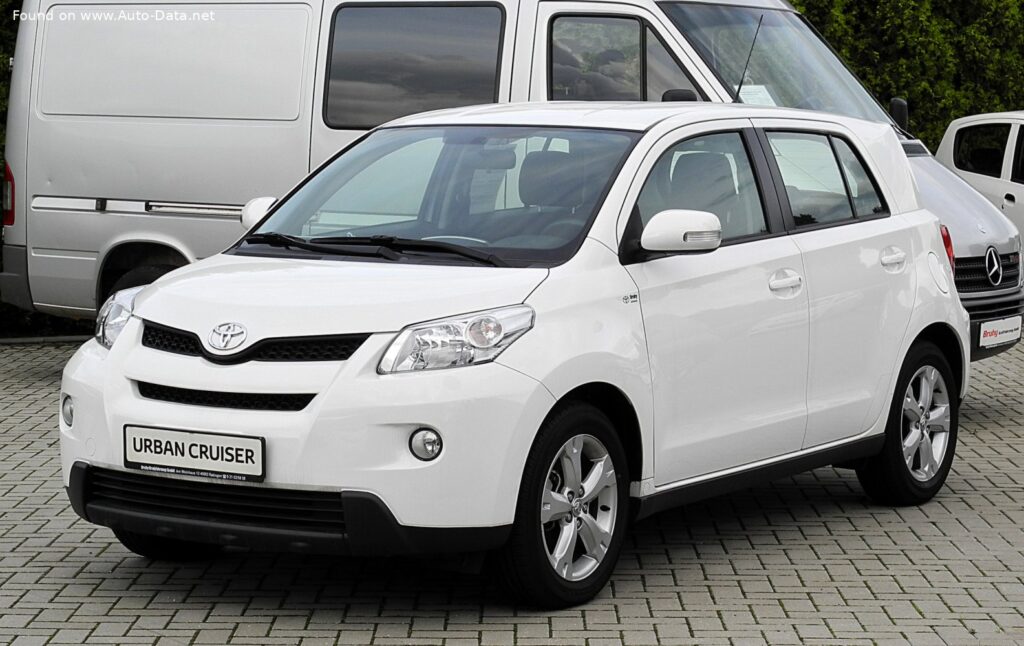
The Toyota Urban Cruiser I adopted a distinctive design language that blended the practicality of a 5-door hatchback with the visual appeal of a compact SUV. Its dimensions, measuring 154.72 inches in length, 67.91 inches in width, and 60.04 inches in height, coupled with a 96.85-inch wheelbase, made it exceptionally maneuverable for city driving, evidenced by its tight turning circle of 36.09 feet (11 meters). The exterior styling featured a chunky, robust aesthetic, with prominent wheel arches, a relatively high ground clearance for its class, and a distinctive front fascia, giving it a more commanding presence than many of its hatchback contemporaries.
Inside, the Urban Cruiser offered seating for five occupants, designed with practicality and comfort in mind. The interior layout was functional and ergonomic, typical of Toyota vehicles, with durable materials chosen to withstand the rigors of daily use. Despite its compact exterior, the vehicle provided surprising versatility. The trunk space ranged from a respectable 13.7 cubic feet (388 liters) with the rear seats up, expanding significantly to 38.14 cubic feet (1080 liters) when the rear seats were folded down, offering ample cargo capacity for shopping, luggage, or equipment. This flexible cargo area was a key selling point for urban dwellers who needed a versatile vehicle for various tasks.
In terms of chassis and safety, the Urban Cruiser was equipped with a well-tuned suspension system. The front featured an independent McPherson strut setup with coil springs and an anti-roll bar, providing a comfortable ride and predictable handling. The rear utilized a torsion beam suspension, a compact and robust solution ideal for space efficiency. Braking duties were handled by disc brakes at both the front and rear, complemented by an Anti-lock Braking System (ABS) for enhanced stopping power and control. Hydraulic power steering provided direct feedback to the driver, contributing to the vehicle’s agile feel. The car rode on 195/60R16 tires mounted on 16-inch wheel rims, offering a good balance of grip and ride comfort.
Technical Specifications: Toyota Urban Cruiser I 1.4 D-4D (90 Hp) 4×2
| Brand | Toyota |
| Model | Urban Cruiser |
| Generation | Urban Cruiser I |
| Type (Engine) | 1.4 D-4D (90 Hp) 4×2 |
| Start of production | March, 2008 year |
| End of production | 2014 year |
| Powertrain Architecture | Internal Combustion engine |
| Body type | Hatchback |
| Seats | 5 |
| Doors | 5 |
| Fuel consumption (economy) – urban | 5.2 l/100 km (45.2 US mpg) |
| Fuel consumption (economy) – extra urban | 4 l/100 km (58.8 US mpg) |
| Fuel consumption (economy) – combined | 4.5 l/100 km (52.3 US mpg) |
| Fuel Type | Diesel |
| Acceleration 0 – 60 mph | 11.1 sec |
| Acceleration 0 – 100 km/h | 11.7 sec |
| Maximum speed | 175 km/h (108.74 mph) |
| Emission standard | Euro 5 |
| Weight-to-power ratio | 13.2 kg/Hp (75.9 Hp/tonne) |
| Weight-to-torque ratio | 5.8 kg/Nm (173 Nm/tonne) |
| Power | 90 Hp @ 3800 rpm |
| Power per litre | 66 Hp/l |
| Torque | 205 Nm @ 1800-2800 rpm (151.2 lb.-ft.) |
| Engine layout | Front, Transverse |
| Engine Model/Code | 1ND-TV |
| Engine displacement | 1364 cm³ (1.4 l, 83.24 cu. in.) |
| Number of cylinders | 4 |
| Engine configuration | Inline |
| Cylinder Bore | 73 mm (2.87 in.) |
| Piston Stroke | 81.5 mm (3.21 in.) |
| Compression ratio | 16.5:1 |
| Number of valves per cylinder | 2 |
| Fuel injection system | Diesel Commonrail |
| Engine aspiration | Turbocharger, Intercooler |
| Valvetrain | SOHC |
| Engine oil capacity | 3.9 l (4.12 US qt) |
| Coolant | 5 l (5.28 US qt) |
| Engine systems | Particulate filter |
| Kerb Weight | 1185 kg (2612.48 lbs.) |
| Max. weight | 1625 kg (3582.51 lbs.) |
| Max load | 440 kg (970.03 lbs.) |
| Trunk (boot) space – minimum | 388 l (13.7 cu. ft.) |
| Trunk (boot) space – maximum | 1080 l (38.14 cu. ft.) |
| Fuel tank capacity | 42 l (11.1 US gal) |
| Length | 3930 mm (154.72 in.) |
| Width | 1725 mm (67.91 in.) |
| Height | 1525 mm (60.04 in.) |
| Wheelbase | 2460 mm (96.85 in.) |
| Front track | 1485 mm (58.46 in.) |
| Rear (Back) track | 1490 mm (58.66 in.) |
| Minimum turning circle (turning diameter) | 11 m (36.09 ft.) |
| Drivetrain Architecture | The Internal combustion engine (ICE) drives the front wheels of the vehicle. |
| Drive wheel | Front wheel drive |
| Number of gears and type of gearbox | 6 gears, manual transmission |
| Front suspension | Independent, type McPherson with coil spring and anti-roll bar |
| Rear suspension | Torsion |
| Front brakes | Disc |
| Rear brakes | Disc |
| Assisting systems | ABS (Anti-lock braking system) |
| Power steering | Hydraulic Steering |
| Tires size | 195/60R16 |
| Wheel rims size | 16 |