
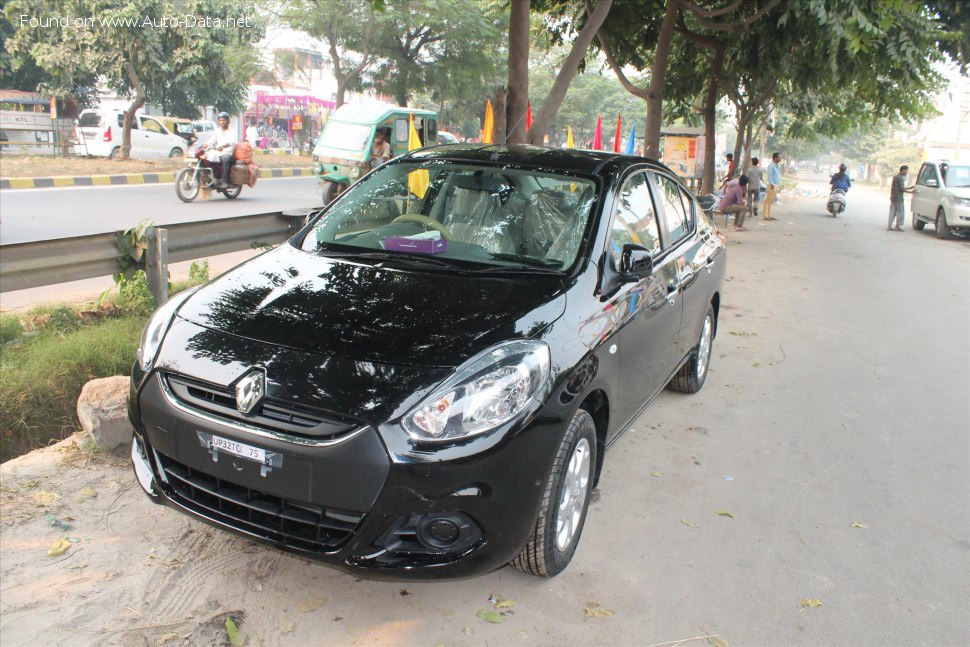
The Renault Scala 1.5 (99 Hp) represents a significant offering within the compact sedan segment, primarily targeting emerging markets where practicality, fuel efficiency, and value are paramount. Launched in 2012 and produced until 2017, this particular generation of the Scala was a strategic move by Renault to penetrate and solidify its presence in regions like India, where it was essentially a rebadged version of the Nissan Sunny (also known as the Versa in some markets). This approach allowed Renault to leverage existing, proven platforms, offering a robust and reliable vehicle tailored to local demands without the extensive development costs of an entirely new model. Positioned as a comfortable and spacious family sedan, the Scala was designed to cater to urban commuters and small families seeking an economical yet well-equipped vehicle for daily use, emphasizing its role as a practical and accessible choice in its competitive landscape.
The Renault Scala: A Market Overview and Design Philosophy
As a key player in its primary markets, the Renault Scala adopted a design philosophy that prioritized interior space, ride comfort, and a conventional aesthetic. The vehicle’s four-door sedan body type, accommodating five occupants, speaks to its intended role as a family-friendly vehicle. With a length of 174.21 inches (4425 mm), a width of 66.73 inches (1695 mm), and a height of 59.25 inches (1505 mm), the Scala presented a substantial road presence for its class, contributing to both interior volume and perceived stability. The wheelbase of 102.36 inches (2600 mm) was particularly instrumental in delivering a spacious cabin, especially for rear-seat passengers, a crucial consideration in markets where multi-generational families often travel together. The exterior design, while not revolutionary, was clean and understated, featuring Renault’s brand identity elements integrated into a familiar sedan silhouette, aiming for broad appeal rather than polarizing styling.
Practicality was further underscored by its generous trunk capacity, offering 17.3 cubic feet (490 liters) of cargo space. This ample storage was a significant advantage for families, accommodating luggage for trips or large grocery hauls. The vehicle’s ground clearance of 6.34 inches (161 mm) was also a thoughtful inclusion, providing an added layer of versatility for navigating varied road conditions, which can often include unpaved sections or speed bumps in its target regions. The minimum turning circle of 34.78 feet (10.6 meters) ensured that despite its length, the Scala remained maneuverable in congested urban environments, a critical attribute for city driving. The overall design language thus harmonized functionality with a respectable appearance, reinforcing the Scala’s position as a sensible and dependable choice for its target demographic.
Powertrain and Performance of the Renault Scala 1.5 (99 Hp)
At the heart of the Renault Scala 1.5 (99 Hp) lies a naturally aspirated 1.5-liter petrol engine, designated by the code XH2. This inline four-cylinder powerplant was engineered for reliability and fuel efficiency, two non-negotiable attributes for the markets it served. With an engine displacement of 1498 cm³ (91.41 cu. in.), it produced a respectable 99 horsepower at 6000 rpm, translating to a power-per-liter output of 66.1 Hp/l. Torque figures stood at 134 Nm, or 98.83 lb.-ft., delivered at a accessible 4000 rpm. This torque band ensured adequate pulling power for city driving and highway cruising, allowing for comfortable daily use without excessive strain on the engine.
The engine featured a DOHC (Dual Overhead Camshaft) valvetrain with four valves per cylinder, optimizing airflow for combustion and contributing to its smooth operation. Fuel delivery was managed by a multi-port manifold injection system, a proven and reliable technology for consistent performance and economy. Power was sent to the front wheels via a five-speed manual transmission, a common and efficient choice that offered drivers direct control over power delivery while keeping manufacturing costs competitive. This drivetrain architecture, where the internal combustion engine drives the front wheels, is typical for compact sedans, providing a good balance of traction and interior packaging efficiency.
In terms of performance, the Scala 1.5 (99 Hp) was designed for practical rather than spirited driving. It accelerated from 0 to 60 mph in a calculated 13.3 seconds (0-100 km/h in 14 seconds), with a maximum speed of 102.53 mph (165 km/h). These figures reflect its segment focus on consistent, dependable mobility. However, where the Scala truly shined was in its fuel economy. With a combined consumption rating of 39.9 US mpg (5.9 l/100 km), it offered an attractive cost of ownership, a critical factor for budget-conscious consumers. Its weight-to-power ratio of 10.2 kg/Hp (98.5 Hp/tonne) and weight-to-torque ratio of 7.5 kg/Nm (133.3 Nm/tonne) further illustrate its engineering for efficiency and balanced performance within its class, rather than outright speed.
Chassis, Suspension, and Safety Features
The chassis and suspension setup of the Renault Scala were configured to provide a comfortable ride, crucial for the often-demanding road conditions in its primary markets. The front suspension utilized an independent McPherson strut system, known for its simplicity, robustness, and ability to absorb road imperfections effectively. At the rear, a semi-independent suspension with coil springs was employed, offering a good balance between ride comfort and load-carrying capability. This combination ensured a pliant ride quality, minimizing harshness over bumps and undulations, which contributed significantly to passenger comfort during longer journeys.
Braking performance was handled by ventilated discs at the front, providing effective heat dissipation and strong stopping power, while the rear utilized drum brakes. This brake configuration is a cost-effective and reliable solution for a vehicle of this size and performance level. An essential safety feature, the Anti-lock Braking System (ABS), was included as an assisting system, enhancing control during emergency braking by preventing wheel lock-up. The steering system featured a rack and pinion setup with electric power steering, making the vehicle easy to maneuver at low speeds, such as during parking, and offering appropriate feedback at higher speeds. This electric power steering system also contributed to overall fuel efficiency by reducing parasitic engine load compared to hydraulic systems.
The Scala rode on 15-inch wheel rims, fitted with 185/65 R15 tires. This tire size offered a good balance of grip, comfort, and durability, and its common availability in many markets made replacements both accessible and affordable. The robust construction and well-tuned suspension, combined with essential safety features like ABS, underscored Renault’s commitment to delivering a reliable and secure vehicle. The Renault Scala 1.5 (99 Hp) ultimately served as a testament to thoughtful engineering aimed at specific market needs, delivering a comprehensive package of performance, efficiency, and practicality.
Technical Specifications: Renault Scala 1.5 (99 Hp)
| Brand | Renault |
| Model | Scala |
| Generation | Scala |
| Type (Engine) | 1.5 (99 Hp) |
| Start of production | 2012 year |
| End of production | 2017 year |
| Powertrain Architecture | Internal Combustion engine |
| Body type | Sedan |
| Seats | 5 |
| Doors | 4 |
| Fuel consumption (economy) – combined | 5.9 l/100 km | 39.9 US mpg | 47.9 UK mpg | 16.9 km/l |
| Fuel Type | Petrol (Gasoline) |
| Acceleration 0 – 100 km/h | 14 sec |
| Acceleration 0 – 62 mph | 14 sec |
| Acceleration 0 – 60 mph (Calculated by Auto-Data.net) | 13.3 sec |
| Maximum speed | 165 km/h | 102.53 mph |
| Weight-to-power ratio | 10.2 kg/Hp | 98.5 Hp/tonne |
| Weight-to-torque ratio | 7.5 kg/Nm | 133.3 Nm/tonne |
| Power | 99 Hp @ 6000 rpm. |
| Power per litre | 66.1 Hp/l |
| Torque | 134 Nm @ 4000 rpm. | 98.83 lb.-ft. @ 4000 rpm. |
| Engine layout | Front, Transverse |
| Engine Model/Code | XH2 |
| Engine displacement | 1498 cm³ | 91.41 cu. in. |
| Number of cylinders | 4 |
| Engine configuration | Inline |
| Number of valves per cylinder | 4 |
| Fuel injection system | Multi-port manifold injection |
| Engine aspiration | Naturally aspirated engine |
| Valvetrain | DOHC |
| Kerb Weight | 1005 kg | 2215.65 lbs. |
| Trunk (boot) space – minimum | 490 l | 17.3 cu. ft. |
| Fuel tank capacity | 41 l | 10.83 US gal | 9.02 UK gal |
| Length | 4425 mm | 174.21 in. |
| Width | 1695 mm | 66.73 in. |
| Height | 1505 mm | 59.25 in. |
| Wheelbase | 2600 mm | 102.36 in. |
| Front track | 1480 mm | 58.27 in. |
| Rear (Back) track | 1485 mm | 58.46 in. |
| Ride height (ground clearance) | 161 mm | 6.34 in. |
| Minimum turning circle (turning diameter) | 10.6 m | 34.78 ft. |
| Drivetrain Architecture | The Internal combustion engine (ICE) drives the front wheels of the vehicle. |
| Drive wheel | Front wheel drive |
| Number of gears and type of gearbox | 5 gears, manual transmission |
| Front suspension | Independent type McPherson |
| Rear suspension | Semi-independent, coil spring |
| Front brakes | Ventilated discs |
| Rear brakes | Drum |
| Assisting systems | ABS (Anti-lock braking system) |
| Steering type | Steering rack and pinion |
| Power steering | Electric Steering |
| Tires size | 185/65 R15 |
| Wheel rims size | 15 |
