
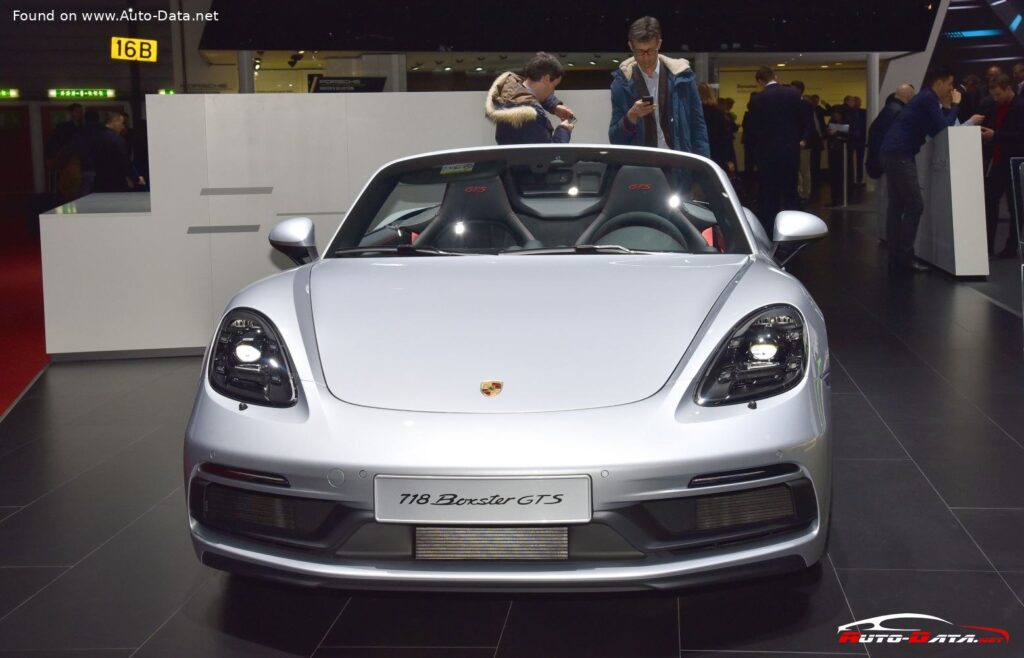
The Porsche 718 Boxster (982) 2.0 (300 Hp) represents a significant evolution in Porsche’s lineage of mid-engine, two-seater roadsters, combining the brand’s storied performance heritage with contemporary engineering and efficiency. Launched in 2018 as part of the 982 generation, this iteration of the Boxster cemented its position as a highly desirable compact sports car, offering an exhilarating open-top driving experience without compromising on everyday usability. The 718 designation, a nod to Porsche’s racing history with four-cylinder engines, marked a pivotal shift from the naturally aspirated flat-six engines of its predecessors to a new generation of turbocharged flat-four powerplants. This particular model, produced until September 2020, was designed to appeal to enthusiasts seeking a purer driving connection, characterized by its responsive engine, balanced chassis, and precise handling. While retaining the iconic Boxster silhouette, the 718 Boxster (982) brought a sharper aesthetic and a suite of technological advancements, making it a formidable contender in the premium sports car segment. Its introduction underscored Porsche’s commitment to innovation, adapting to increasingly stringent emission standards while simultaneously delivering the performance expected of a vehicle bearing the Zuffenhausen crest. The strategic decision to downsize and turbocharge the engine not only improved fuel efficiency and reduced emissions but also provided a substantial boost in low-end torque, transforming the car’s dynamic character. This generation of the Boxster solidified its reputation as a driver-focused machine, offering a compelling blend of speed, agility, and the unmistakable Porsche driving feel, all within the captivating form of a cabriolet.
Engine & Performance: The Heart of the Porsche 718 Boxster (982) 2.0 (300 Hp)
At the core of the Porsche 718 Boxster (982) 2.0 (300 Hp) lies a meticulously engineered turbocharged flat-four engine, a departure from the atmospheric six-cylinder units that previously defined the Boxster. This 2.0-liter (1988 cm3 or 121.32 cu. in.) powerhouse delivers a robust 300 horsepower at a peak of 6500 rpm, translating to an impressive power output of 150.9 Hp per liter. More significantly, it generates a substantial 280.27 lb.-ft. of torque, available across a broad and usable rev range from 2150 to 4500 rpm. This wide torque band is a direct benefit of the turbocharger and intercooler setup, providing instant throttle response and relentless acceleration. The engine’s boxer configuration, a signature Porsche trait, contributes to the car’s low center of gravity, enhancing stability and handling dynamics, while its mid-longitudinal layout ensures optimal weight distribution for a truly balanced driving experience. Fuel is delivered via a direct injection system, optimizing combustion efficiency and power delivery.
Performance figures for the 718 Boxster (982) 2.0 (300 Hp) are impressive for its class. It sprints from 0 to 60 mph in a swift 5 seconds, with 0-100 km/h achieved in 5.3 seconds, showcasing its immediate responsiveness. The top speed reaches an exhilarating 170.88 mph (275 km/h), firmly placing it in the realm of serious sports cars. Power is channeled to the rear wheels through a precise 6-speed manual transmission, offering an engaging and direct connection between driver and machine, a hallmark of Porsche’s philosophy. This rear-wheel-drive architecture, combined with the mid-engine layout, provides exceptional traction and agile handling. Despite its performance capabilities, the 718 Boxster also demonstrates commendable efficiency for a sports car, with a combined fuel economy of 29 US mpg (8.1 l/100 km). Urban driving yields 20.8 US mpg (11.3 l/100 km), while extra-urban cruising can achieve 37.3 US mpg (6.3 l/100 km). With CO2 emissions rated at 186 g/km and adhering to the Euro 6d-TEMP-EVAP-ISC emission standard, it reflects Porsche’s efforts to balance performance with environmental responsibility. The vehicle’s impressive weight-to-power ratio of 4.5 kg/Hp (224.7 Hp/tonne) and weight-to-torque ratio of 3.5 kg/Nm (284.6 Nm/tonne) further underscore its athletic prowess, ensuring that every horsepower and pound-foot of torque is efficiently utilized to propel the lightweight chassis.
Design & Features: Form Meets Function in the 718 Boxster
The design of the Porsche 718 Boxster (982) is a masterful blend of iconic Porsche aesthetics and modern aerodynamic principles, embodying the spirit of a pure two-seater cabriolet. Its sleek, low-slung profile, characterized by taut lines and purposeful curves, is instantly recognizable as a Porsche. The body type is a classic 2-door cabriolet, designed specifically for open-top driving pleasure, accommodating two occupants in a driver-focused cabin. With a length of 172.4 inches (4379 mm), a width of 70.91 inches (1801 mm, or 78.5 inches including mirrors), and a height of 50.43 inches (1281 mm), the 718 Boxster possesses compact dimensions that contribute to its agility and nimble handling. The wheelbase of 97.44 inches (2475 mm) provides a stable platform, while the front track of 59.65 inches (1515 mm) and rear track of 60.28 inches (1531 mm) ensure a wide, planted stance on the road, further enhancing its cornering capabilities.
Aerodynamic efficiency is a key aspect of the 718 Boxster’s design, reflected in its low drag coefficient (Cd) of 0.31. This careful aerodynamic tuning not only contributes to its high-speed stability but also aids in fuel efficiency. Underpinning its dynamic performance is a sophisticated chassis featuring independent McPherson strut suspension at both the front and rear. This setup provides a superb balance of ride comfort and sporting precision, allowing the Boxster to tackle various road conditions with confidence. Stopping power is equally impressive, with large ventilated disc brakes at both ends: 320 mm in the front and 299 mm in the rear. These are complemented by an Anti-lock Braking System (ABS) as a standard assisting system, ensuring controlled and effective deceleration in critical situations. The steering system is a modern electric power-assisted rack and pinion unit, offering sharp feedback and precise control, allowing the driver to place the car exactly where intended. The Boxster rides on 18-inch wheels, fitted with performance-oriented tires sized 235/45 ZR18 94Y at the front and wider 265/45 ZR18 101Y at the rear, optimizing grip and handling balance. The interior, though not detailed in the raw data, is typically Porsche: driver-centric, with high-quality materials and ergonomic controls. Practicality for a sports car is reasonable, with a minimum trunk space of 5.3 cu. ft. (150 liters) and a fuel tank capacity of 14.27 US gallons (54 liters), providing a decent range for spirited drives. The overall design emphasizes a harmonious blend of aesthetic appeal, engineering excellence, and the unadulterated joy of open-air motoring.
Technical Specifications
| Brand | Porsche |
| Model | 718 |
| Generation | 718 Boxster (982) |
| Type (Engine) | 2.0 (300 Hp) |
| Start of production | 2018 year |
| End of production | September, 2020 year |
| Powertrain Architecture | Internal Combustion engine |
| Body type | Cabriolet |
| Seats | 2 |
| Doors | 2 |
| Fuel consumption (economy) – urban | 11.3 l/100 km (20.8 US mpg) |
| Fuel consumption (economy) – extra urban | 6.3 l/100 km (37.3 US mpg) |
| Fuel consumption (economy) – combined | 8.1 l/100 km (29 US mpg) |
| CO2 emissions | 186 g/km |
| Fuel Type | Petrol (Gasoline) |
| Acceleration 0 – 60 mph (Calculated) | 5 sec |
| Acceleration 0 – 100 km/h | 5.3 sec |
| Maximum speed | 275 km/h (170.88 mph) |
| Emission standard | Euro 6d-TEMP-EVAP-ISC |
| Weight-to-power ratio | 4.5 kg/Hp (224.7 Hp/tonne) |
| Weight-to-torque ratio | 3.5 kg/Nm (284.6 Nm/tonne) |
| Power | 300 Hp @ 6500 rpm |
| Power per litre | 150.9 Hp/l |
| Torque | 380 Nm @ 2150-4500 rpm (280.27 lb.-ft.) |
| Engine layout | Middle, Longitudinal |
| Engine Model/Code | MDD.PB |
| Engine displacement | 1988 cm3 (121.32 cu. in.) |
| Number of cylinders | 4 |
| Engine configuration | Boxer |
| Cylinder Bore | 91 mm (3.58 in.) |
| Piston Stroke | 76.4 mm (3.01 in.) |
| Number of valves per cylinder | 4 |
| Fuel injection system | Direct injection |
| Engine aspiration | Turbocharger, Intercooler |
| Engine oil capacity | 5.7 l (6.02 US qt) |
| Engine systems | Particulate filter |
| Kerb Weight | 1335 kg (2943.17 lbs.) |
| Max. weight | 1655 kg (3648.65 lbs.) |
| Max load | 320 kg (705.48 lbs.) |
| Trunk (boot) space – minimum | 150 l (5.3 cu. ft.) |
| Fuel tank capacity | 54 l (14.27 US gal) |
| Length | 4379 mm (172.4 in.) |
| Width | 1801 mm (70.91 in.) |
| Width including mirrors | 1994 mm (78.5 in.) |
| Height | 1281 mm (50.43 in.) |
| Wheelbase | 2475 mm (97.44 in.) |
| Front track | 1515 mm (59.65 in.) |
| Rear (Back) track | 1531 mm (60.28 in.) |
| Drag coefficient (Cd) | 0.31 |
| Drivetrain Architecture | The Internal combustion engine (ICE) drives the rear wheels of the vehicle. |
| Drive wheel | Rear wheel drive |
| Number of gears and type of gearbox | 6 gears, manual transmission |
| Front suspension | Independent type McPherson |
| Rear suspension | McPherson |
| Front brakes | Ventilated discs, 320 mm |
| Rear brakes | Ventilated discs, 299 mm |
| Assisting systems | ABS (Anti-lock braking system) |
| Steering type | Steering rack and pinion |
| Power steering | Electric Steering |
| Tires size | 235/45 ZR18 94Y; 265/45 ZR18 101Y |
| Wheel rims size | 18 |
