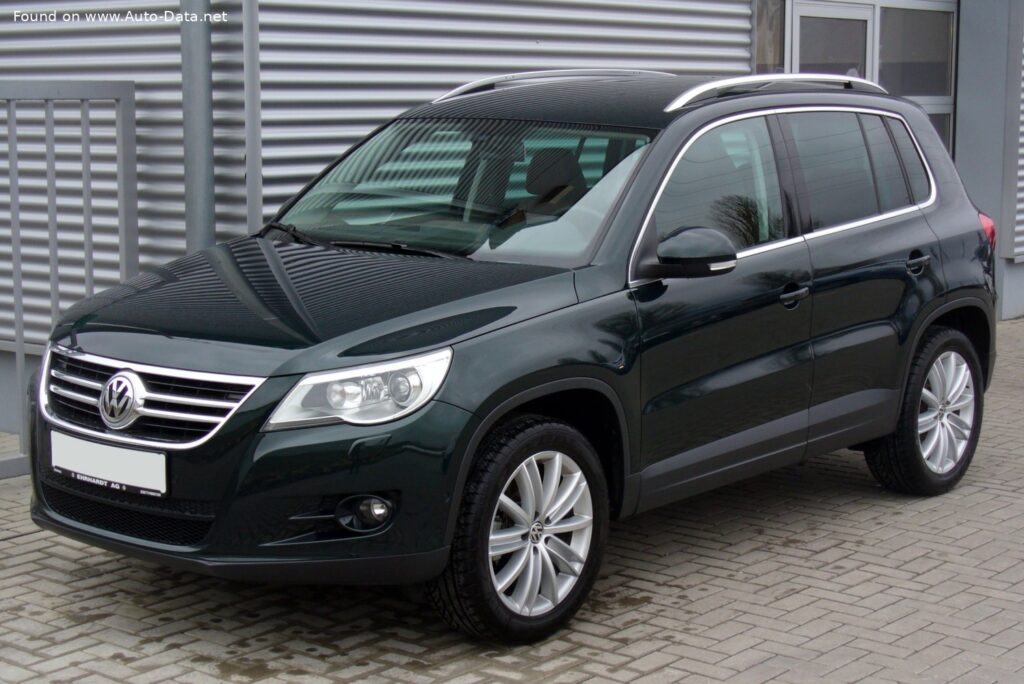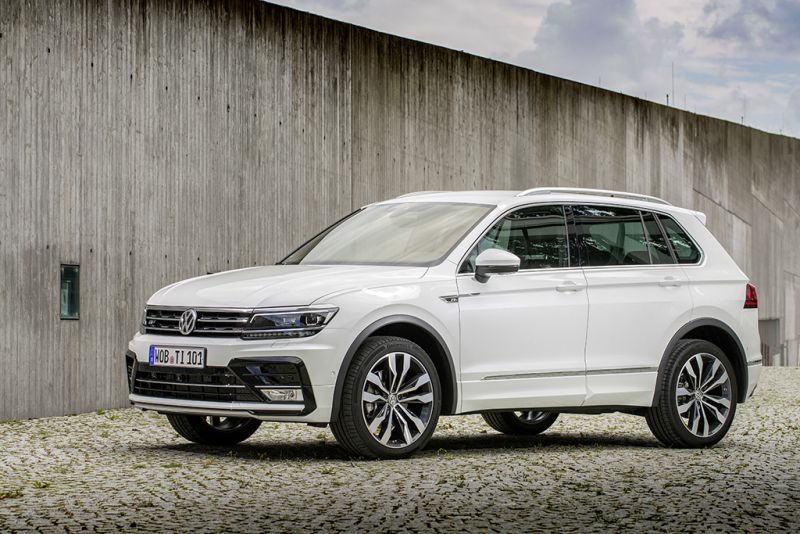
The Volkswagen Tiguan II 1.4 TSI (150 Hp) 4MOTION DSG represents a compelling iteration of Volkswagen’s popular compact SUV, bridging the gap between urban practicality and light off-road capability. Introduced in 2016 as the second generation of the Tiguan, this specific variant, produced until 2018, was a core offering in markets where efficiency and all-wheel-drive versatility were paramount, particularly across Europe. It quickly established itself as a benchmark in its segment, offering a sophisticated blend of advanced powertrain technology, refined driving dynamics, and a spacious, well-appointed interior. This generation marked a significant evolution for the Tiguan, moving to Volkswagen’s highly adaptable MQB platform, which brought substantial improvements in packaging, safety, and connectivity. For the discerning buyer, the 1.4 TSI engine, paired with the responsive 4MOTION all-wheel-drive system and the seamless DSG automatic transmission, promised a driving experience that was both engaging and remarkably economical, making it a standout choice in the fiercely competitive compact SUV category.
The Volkswagen Tiguan II 1.4 TSI (150 Hp) 4MOTION DSG: A European Compact SUV Standard
The second-generation Volkswagen Tiguan, specifically the 1.4 TSI (150 Hp) 4MOTION DSG model, emerged as a highly significant vehicle in the European automotive landscape between 2016 and 2018. While not as widely marketed in the United States with this particular powertrain, its design philosophy and technical prowess heavily influenced global SUV trends. Built on the versatile MQB architecture, it showcased Volkswagen’s commitment to modularity, enabling greater interior space, improved crash performance, and the integration of advanced driver-assistance systems. This Tiguan variant was designed to appeal to families and individuals seeking a flexible, reliable, and fuel-efficient vehicle capable of handling diverse driving conditions, from city commutes to snowy mountain passes. Its all-wheel-drive capability, coupled with a highly efficient turbocharged gasoline engine, positioned it as a smart choice for consumers prioritizing both performance and environmental responsibility. The Tiguan II’s success in its primary markets underscored Volkswagen’s ability to deliver high-quality, technically advanced vehicles tailored to specific regional demands, setting new standards for the compact SUV segment.
Engine and Performance Dynamics
At the heart of the Volkswagen Tiguan II 1.4 TSI (150 Hp) 4MOTION DSG lies a sophisticated 1.4-liter (1395 cm3 or 85.13 cu. in.) inline four-cylinder engine, designated by codes such as CZDA, CZEA, CHPB, or DJVA. This powerplant is a prime example of Volkswagen’s commitment to downsizing without compromising performance, employing direct fuel injection and a turbocharger with an intercooler to produce a robust 150 horsepower at 5000-6000 rpm. Critically, it delivers a substantial 250 Nm (184.39 lb.-ft.) of torque across a broad and accessible rev range, from 1500 to 3500 rpm. This wide torque band is instrumental in providing excellent responsiveness and effortless acceleration, making the Tiguan feel nimble in urban environments and confident during highway overtakes. The engine’s layout is front and transverse, optimizing packaging efficiency and weight distribution.
The power is seamlessly managed by a 6-speed DSG (Direct Shift Gearbox) automatic transmission, renowned for its rapid and smooth gear changes. This dual-clutch system contributes significantly to both the vehicle’s lively performance and its impressive fuel economy. Mated to this powertrain is Volkswagen’s 4MOTION all-wheel-drive system. This intelligent drivetrain architecture operates primarily as a front-wheel-drive vehicle for enhanced efficiency, with the rear wheels engaging through an electrically or mechanically operated clutch only when additional traction is required. This adaptive system ensures optimal grip in slippery conditions while minimizing fuel consumption during normal driving. Performance figures for this Tiguan are commendable for its class: it accelerates from 0 to 60 mph in a brisk 8.7 seconds (0-100 km/h in 9.2 seconds) and achieves a maximum speed of 123 mph (198 km/h).
Fuel efficiency is a strong suit, with combined consumption rated at 7.1 liters per 100 kilometers, translating to an impressive 33.1 US mpg. Urban driving yields 27.7 US mpg, while extra-urban cruising can achieve up to 37.3 US mpg. These figures are complemented by CO2 emissions of 163 g/km, adhering to the stringent Euro 6 emission standard. The inclusion of a Start & Stop System further enhances efficiency by automatically shutting off the engine when the vehicle is stationary, reducing idle emissions and fuel waste. With a 60-liter (15.85 US gallon) fuel tank, the Tiguan offers a substantial cruising range, making it ideal for longer journeys. The engine’s oil capacity is 4 liters (4.23 US quarts), highlighting its compact yet potent design. The vehicle’s weight-to-power ratio stands at 10.1 kg/Hp (98.9 Hp/tonne), and its weight-to-torque ratio is 6.1 kg/Nm (164.8 Nm/tonne), indicating a well-balanced power-to-weight characteristic that contributes to its agile and efficient performance.
Design, Features, and Practicality
The Volkswagen Tiguan II 1.4 TSI (150 Hp) 4MOTION DSG showcases a design language that is both contemporary and unmistakably Volkswagen. As an SUV with five doors and seating for five occupants, it offers a blend of rugged appeal and sophisticated aesthetics. Its exterior dimensions – a length of 176.61 inches (4486 mm), a width of 72.4 inches (1839 mm, expanding to 82.64 inches or 2099 mm including mirrors), and a height of 65.87 inches (1673 mm) – position it perfectly within the compact SUV segment. The wheelbase of 105.39 inches (2677 mm) contributes to a stable ride and a surprisingly spacious interior, while the 7.87-inch (200 mm) ground clearance provides confidence over varied terrain and light off-road excursions. The design is characterized by sharper lines and a more assertive stance than its predecessor, aligning with Volkswagen’s more mature and premium brand identity.
Inside, the Tiguan II prioritizes practicality and comfort. The spacious cabin provides ample legroom and headroom for all five occupants. Cargo capacity is a significant highlight, offering a minimum trunk space of 21.72 cubic feet (615 liters), which expands to a cavernous 58.45 cubic feet (1655 liters) with the rear seats folded down. This flexibility makes it highly adaptable for family trips, grocery runs, or hauling larger items. The maximum roof load capacity of 165.35 lbs (75 kg) further enhances its utility for adventurers needing to transport bikes or roof boxes.
From a safety and handling perspective, the Tiguan II is well-equipped. It features ventilated disc brakes at the front and disc brakes at the rear, complemented by an Anti-lock Braking System (ABS) for superior stopping power and control. The steering system is a rack and pinion type with electric power steering, providing precise feedback and ease of maneuverability, particularly in tight parking situations, evidenced by its minimum turning circle of 37.73 feet (11.5 meters). The vehicle comes with standard tire sizes of 215/65 R17 on 7J x 17 rims, with an option for 235/55 R18 tires on 7J x 18 rims, offering a balance of ride comfort and grip. The robust kerb weight, ranging from 3344.41 to 3809.59 lbs (1517-1728 kg), and a maximum permissible weight of 4806.08 lbs (2180 kg), underscore its solid construction. Furthermore, its towing capabilities are impressive, allowing for a permitted trailer load with brakes of up to 4850.17 lbs (2200 kg) and 1653.47 lbs (750 kg) without brakes, emphasizing its versatility as a capable utility vehicle. The Tiguan II’s comprehensive package of thoughtful design, practical features, and robust engineering cemented its status as a highly competitive and desirable compact SUV.
Technical Specifications
| Brand | Volkswagen |
| Model | Tiguan |
| Generation | Tiguan II |
| Type (Engine) | 1.4 TSI (150 Hp) 4MOTION DSG |
| Start of production | 2016 year |
| End of production | 2018 year |
| Powertrain Architecture | Internal Combustion engine |
| Body type | SUV |
| Seats | 5 |
| Doors | 5 |
| Fuel consumption (economy) – urban | 8.5 l/100 km (27.7 US mpg) |
| Fuel consumption (economy) – extra urban | 6.3 l/100 km (37.3 US mpg) |
| Fuel consumption (economy) – combined | 7.1 l/100 km (33.1 US mpg) |
| CO2 emissions | 163 g/km |
| Fuel Type | Petrol (Gasoline) |
| Acceleration 0 – 60 mph (Calculated) | 8.7 sec |
| Acceleration 0 – 100 km/h | 9.2 sec |
| Maximum speed | 198 km/h (123.03 mph) |
| Emission standard | Euro 6 |
| Weight-to-power ratio | 10.1 kg/Hp (98.9 Hp/tonne) |
| Weight-to-torque ratio | 6.1 kg/Nm (164.8 Nm/tonne) |
| Power | 150 Hp @ 5000-6000 rpm. |
| Power per liter | 107.5 Hp/l |
| Torque | 250 Nm @ 1500-3500 rpm (184.39 lb.-ft.) |
| Engine layout | Front, Transverse |
| Engine Model/Code | CZDA, CZEA, CHPB, DJVA |
| Engine displacement | 1395 cm3 (85.13 cu. in.) |
| Number of cylinders | 4 |
| Engine configuration | Inline |
| Number of valves per cylinder | 4 |
| Fuel injection system | Direct injection |
| Engine aspiration | Turbocharger, Intercooler |
| Engine oil capacity | 4 l (4.23 US qt) |
| Engine systems | Start & Stop System |
| Kerb Weight | 1517-1728 kg (3344.41 – 3809.59 lbs) |
| Max. weight | 2180 kg (4806.08 lbs) |
| Max load | 452-663 kg (996.49 – 1461.66 lbs) |
| Trunk (boot) space – minimum | 615 l (21.72 cu. ft.) |
| Trunk (boot) space – maximum | 1655 l (58.45 cu. ft.) |
| Fuel tank capacity | 60 l (15.85 US gal) |
| Max. roof load | 75 kg (165.35 lbs) |
| Permitted trailer load with brakes (8%) | 2100-2200 kg (4629.71 – 4850.17 lbs) |
| Permitted trailer load with brakes (12%) | 2000 kg (4409.25 lbs) |
| Permitted trailer load without brakes | 750 kg (1653.47 lbs) |
| Permitted towbar download | 100 kg (220.46 lbs) |
| Length | 4486 mm (176.61 in.) |
| Width | 1839 mm (72.4 in.) |
| Width including mirrors | 2099 mm (82.64 in.) |
| Height | 1673 mm (65.87 in.) |
| Wheelbase | 2677 mm (105.39 in.) |
| Front track | 1576-1586 mm (62.05 – 62.44 in.) |
| Rear (Back) track | 1566-1576 mm (61.65 – 62.05 in.) |
| Ride height (ground clearance) | 200 mm (7.87 in.) |
| Minimum turning circle (turning diameter) | 11.5 m (37.73 ft.) |
| Drivetrain Architecture | ICE drives front wheels permanently, rear wheels driven through clutch if necessary. |
| Drive wheel | All wheel drive (4×4) |
| Number of gears and type of gearbox | 6 gears, automatic transmission DSG |
| Front brakes | Ventilated discs |
| Rear brakes | Disc |
| Assisting systems | ABS (Anti-lock braking system) |
| Steering type | Steering rack and pinion |
| Power steering | Electric Steering |
| Tires size | 215/65 R17; 235/55 R18 |
| Wheel rims size | 7J x 17; 7J x 18 |