
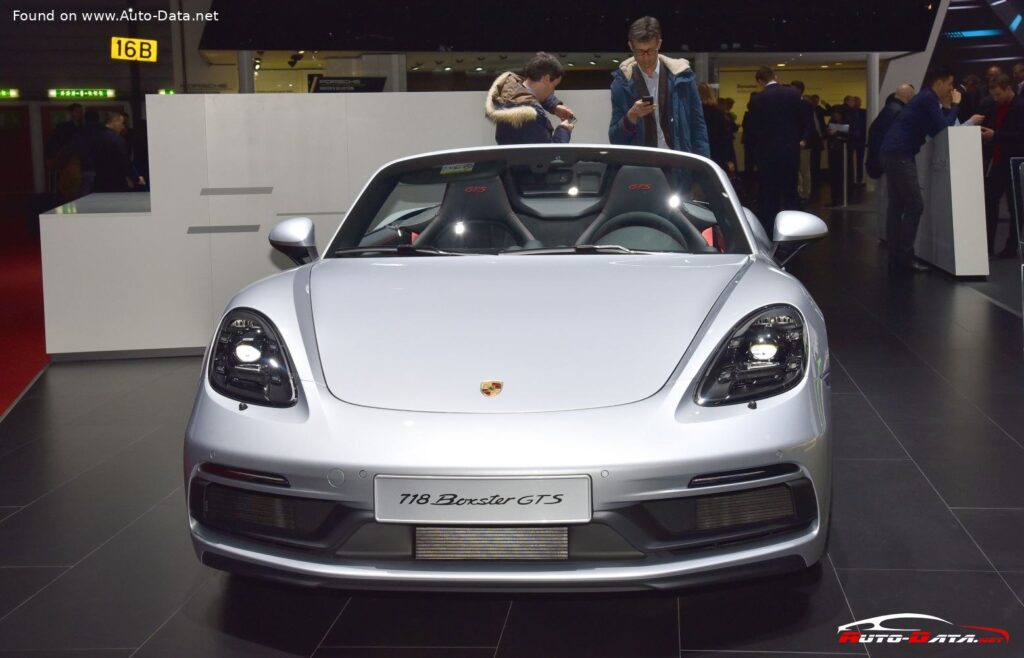
The Porsche 718 Boxster (982) 2.0 (300 Hp) PDK represents a significant evolution in the celebrated lineage of Porsche’s mid-engine roadsters. Introduced in September 2016 as part of the 982 generation, this specific variant marked a pivotal shift for the Boxster model line, embracing a turbocharged four-cylinder engine architecture over the previous naturally aspirated flat-six. This change was a bold move by the German marque, aimed at enhancing efficiency and boosting low-end torque while maintaining the dynamic driving experience synonymous with the Boxster name. Positioned in the premium sports car segment, the 718 Boxster (982) continued to offer a compelling blend of open-top motoring, precise handling, and everyday usability, cementing its status as a benchmark against which other two-seater cabriolets are often measured. Produced until August 2018, this iteration of the Boxster delivered a refined and exhilarating driving proposition, blending traditional Porsche craftsmanship with modern engineering advancements.
The Porsche 718 Boxster (982): A New Era of Performance
The 718 Boxster (982) generation, and particularly the 2.0 (300 Hp) PDK model, introduced a new chapter for Porsche’s entry-level sports car. The “718” designation itself was a nod to Porsche’s racing heritage, referencing the company’s successful four-cylinder race cars of the late 1950s and early 1960s. This car was engineered to deliver a driving experience that was both thrilling and accessible, catering to enthusiasts who valued agility, balance, and the visceral connection only a mid-engine roadster can provide. The move to a four-cylinder turbocharged engine, while initially met with some purist apprehension, ultimately proved to be a masterstroke in modernizing the Boxster’s appeal, aligning it with contemporary demands for performance and environmental consciousness.
Powertrain and Dynamic Capability
At the heart of the Porsche 718 Boxster (982) 2.0 (300 Hp) PDK lies its critically acclaimed turbocharged 2.0-liter flat-four engine, an engineering marvel that delivered a robust 300 horsepower at 6500 rpm. This powerplant, designated MDD.PB, was not only powerful but also remarkably efficient, producing a specific output of 150.9 horsepower per liter. A significant aspect of this engine was its torque delivery: a substantial 280.27 lb.-ft. (380 Nm) available across a broad rev range, from 1950 to 4500 rpm. This wide torque band ensured immediate responsiveness and formidable acceleration, a notable improvement in everyday driving scenarios compared to its naturally aspirated predecessors.
The engine’s mid-longitudinal layout was fundamental to the Boxster’s exceptional balance and handling dynamics, placing the mass centrally within the chassis. Power was channeled to the rear wheels through Porsche’s renowned 7-speed PDK (Porsche Doppelkupplung) automatic transmission. This dual-clutch gearbox was celebrated for its lightning-fast shifts and seamless power delivery, contributing significantly to the car’s impressive performance figures. The 718 Boxster (982) 2.0 (300 Hp) PDK could sprint from 0 to 60 mph in a mere 4.7 seconds, with a top speed reaching 170.88 mph (275 km/h). This level of acceleration and top-end performance firmly positioned it as a serious contender in the sports car market.
Beyond raw speed, the powertrain was designed with efficiency in mind. The combined fuel economy for this model was rated at 34.1 US mpg (6.9 l/100 km), an impressive figure for a high-performance sports car. Urban driving yielded 26.1 US mpg (9 l/100 km), while extra-urban cruising could achieve up to 41.3 US mpg (5.7 l/100 km). With CO2 emissions of 158 g/km, the vehicle met the stringent Euro 6 emission standard, underscoring Porsche’s commitment to environmental responsibility alongside performance. The engine’s aspiration system, featuring a turbocharger and intercooler, was key to achieving both the high power output and the improved fuel efficiency.
Design, Ergonomics, and Advanced Features
The design of the 718 Boxster (982) 2.0 (300 Hp) PDK remained true to its iconic roadster heritage, presenting a sleek and athletic silhouette. As a cabriolet with two doors and two seats, it offered an immersive open-air driving experience. The exterior dimensions—a length of 172.4 inches (4379 mm), a width of 70.91 inches (1801 mm) (78.5 inches including mirrors), and a height of 50.43 inches (1281 mm)—contributed to its compact and agile stance. A low drag coefficient of 0.31 further enhanced its aerodynamic efficiency and high-speed stability.
The chassis and suspension components were meticulously engineered to complement the powerful engine. The car featured an independent McPherson strut setup for both the front and rear suspensions, coupled with coil springs and an anti-roll bar at the front, ensuring precise handling and a comfortable ride. The stopping power was equally impressive, with ventilated disc brakes on both the front and rear axles, supported by an Anti-lock Braking System (ABS) for optimal control under heavy braking. Steering was managed by an electric rack and pinion system, providing direct feedback and effortless maneuverability, with a minimum turning circle of 36.02 feet (10.98 meters).
The 718 Boxster (982) was equipped with a sophisticated set of tires and wheels, featuring 235/35 ZR 18 tires on 8J x 18 ET 57 wheels at the front, and wider 265/45 ZR 18 tires on 9.5J x 18 ET 49 wheels at the rear. This staggered setup optimized grip and handling balance. Inside, the cabin reflected Porsche’s driver-centric philosophy, with high-quality materials and intuitive controls. While being a sports car, it offered a decent level of practicality, with a trunk capacity of 9.71 cu. ft. (275 liters) and a fuel tank capacity of 14.27 US gallons (54 liters), allowing for reasonable touring range. The 718 Boxster (982) 2.0 (300 Hp) PDK masterfully blended exhilarating performance with refined design and advanced technology, making it a truly compelling sports car for its era.
Technical Specifications of the Porsche 718 Boxster (982) 2.0 (300 Hp) PDK
| Brand | Porsche |
| Model | 718 |
| Generation | 718 Boxster (982) |
| Type (Engine) | 2.0 (300 Hp) PDK |
| Start of Production | September, 2016 year |
| End of Production | August, 2018 year |
| Powertrain Architecture | Internal Combustion engine |
| Body type | Cabriolet |
| Seats | 2 |
| Doors | 2 |
| Fuel consumption (economy) – urban | 26.1 US mpg (9 l/100 km) |
| Fuel consumption (economy) – extra urban | 41.3 US mpg (5.7 l/100 km) |
| Fuel consumption (economy) – combined | 34.1 US mpg (6.9 l/100 km) |
| CO2 emissions | 158 g/km |
| Fuel Type | Petrol (Gasoline) |
| Acceleration 0 – 60 mph | 4.7 sec |
| Maximum speed | 170.88 mph (275 km/h) |
| Emission standard | Euro 6 |
| Weight-to-power ratio | 4.6 kg/Hp, 219.8 Hp/tonne |
| Weight-to-torque ratio | 3.6 kg/Nm, 278.4 Nm/tonne |
| Power | 300 Hp @ 6500 rpm |
| Power per liter | 150.9 Hp/l |
| Torque | 280.27 lb.-ft. @ 1950-4500 rpm (380 Nm) |
| Engine layout | Middle, Longitudinal |
| Engine Model/Code | MDD.PB |
| Engine displacement | 121.32 cu. in. (1988 cm3) |
| Number of cylinders | 4 |
| Engine configuration | Boxer |
| Cylinder Bore | 3.58 in. (91 mm) |
| Piston Stroke | 3.01 in. (76.4 mm) |
| Compression ratio | 9.5:1 |
| Number of valves per cylinder | 4 |
| Fuel injection system | Direct injection |
| Engine aspiration | Turbocharger, Intercooler |
| Engine oil capacity | 6.02 US qt (5.7 l) |
| Kerb Weight | 3009.31 lbs. (1365 kg) |
| Max. weight | 3714.79 lbs. (1685 kg) |
| Max load | 705.48 lbs. (320 kg) |
| Trunk (boot) space – minimum | 9.71 cu. ft. (275 l) |
| Fuel tank capacity | 14.27 US gal (54 l) |
| Length | 172.4 in. (4379 mm) |
| Width | 70.91 in. (1801 mm) |
| Width including mirrors | 78.5 in. (1994 mm) |
| Height | 50.43 in. (1281 mm) |
| Wheelbase | 97.44 in. (2475 mm) |
| Front track | 59.65 in. (1515 mm) |
| Rear (Back) track | 60.31 in. (1532 mm) |
| Drag coefficient (Cd) | 0.31 |
| Minimum turning circle (turning diameter) | 36.02 ft. (10.98 m) |
| Drivetrain Architecture | The Internal combustion engine (ICE) drives the rear wheels of the vehicle. |
| Drive wheel | Rear wheel drive |
| Number of gears and type of gearbox | 7 gears, automatic transmission PDK |
| Front suspension | Independent, type McPherson with coil spring and anti-roll bar |
| Rear suspension | McPherson |
| Front brakes | Ventilated discs |
| Rear brakes | Ventilated discs |
| Assisting systems | ABS (Anti-lock braking system) |
| Steering type | Steering rack and pinion |
| Power steering | Electric Steering |
| Tires size | 235/35 ZR 18 (Front); 265/45 ZR 18 (Rear) |
| Wheel rims size | 8J x 18 ET 57 (Front); 9.5J x 18 ET 49 (Rear) |
