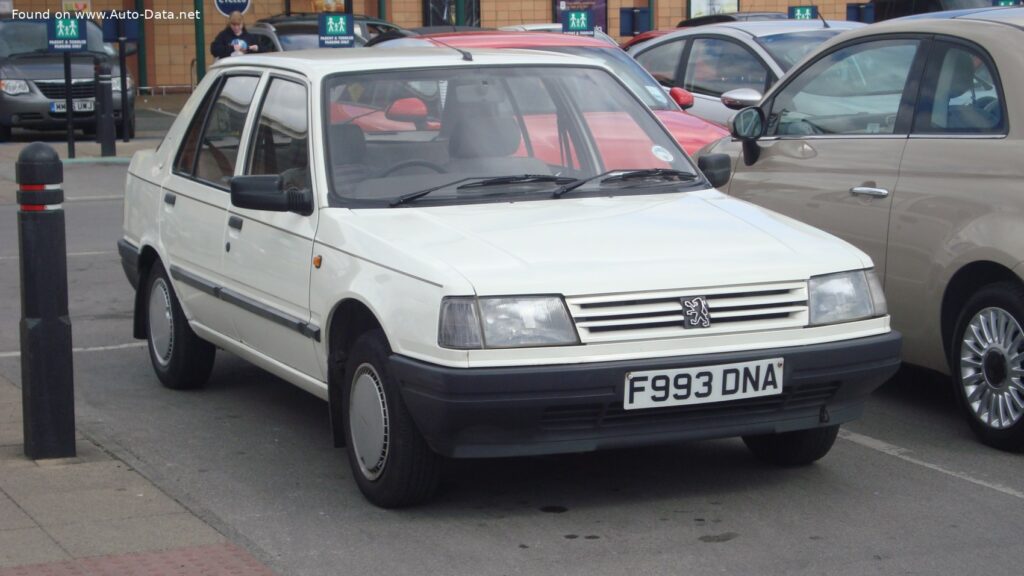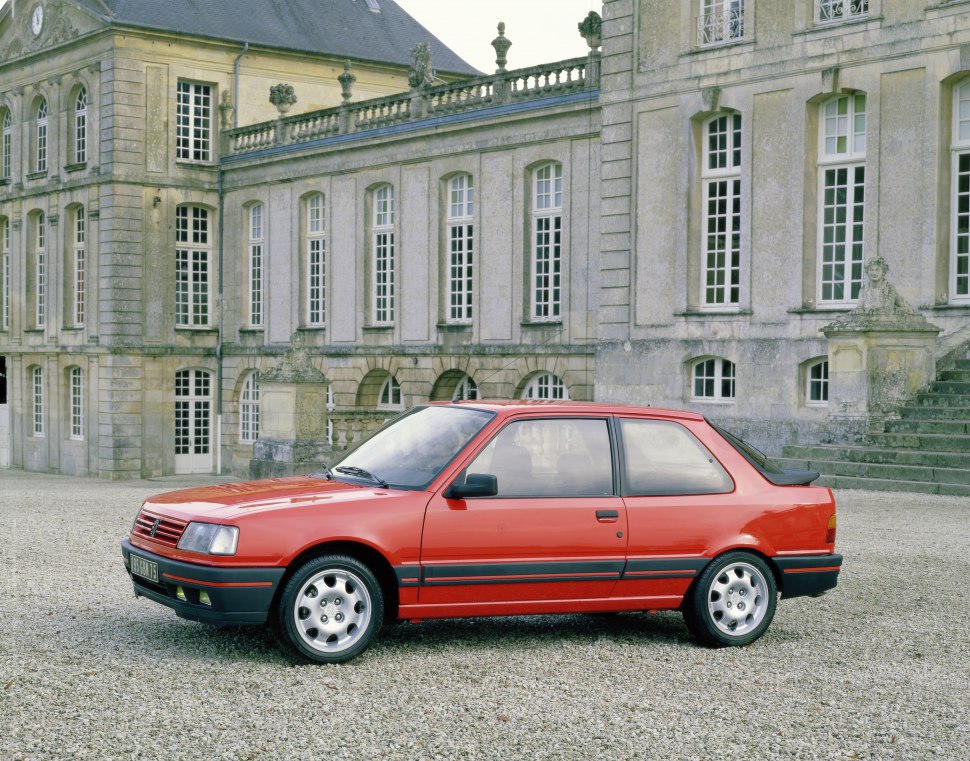
The Peugeot 309 (10C,10A) 3-door 1.3 (64 Hp) Profil represents a significant chapter in the European automotive landscape of the late 1980s. Launched in 1985, this model was Peugeot’s answer to the evolving demands for a compact family car, positioned strategically between the smaller, hugely successful 205 supermini and the larger 405 family sedan. The 309, particularly in its 3-door hatchback configuration, was designed primarily for European markets, where it competed fiercely in the C-segment. While never officially sold in the United States, its engineering and design ethos reflect the prevailing trends and priorities of its era, emphasizing practicality, fuel efficiency, and a robust, straightforward mechanical package.
Engine and Performance of the Peugeot 309
At the heart of the Peugeot 309 (10C,10A) 3-door 1.3 (64 Hp) Profil lies a naturally aspirated 1.3-liter (1294 cm3 or 78.96 cu. in.) inline four-cylinder engine, designated with the code G1B. This powerplant, characteristic of its time, utilized a carbureted fuel injection system and an Overhead Valve (OHV) valvetrain, a design choice that favored simplicity and durability over outright performance or complex emissions control. The engine produced a modest 64 horsepower at 5600 rpm, which was respectable for a compact car of its class in the mid-1980s. Torque output stood at 103 Nm (75.97 lb.-ft.) delivered at a relatively low 2800 rpm, indicating an engine designed for accessible low-end pulling power, suitable for city driving and general utility rather than high-speed acceleration.
Performance figures for the 1.3 (64 Hp) Profil variant reflect its utilitarian intent. The vehicle could accelerate from 0 to 60 mph in an estimated 14.1 seconds, with a 0 to 100 km/h sprint taking 14.8 seconds. Its maximum speed was rated at 102.53 mph (165 km/h). These numbers highlight that the Peugeot 309 was not engineered for exhilarating performance but rather for dependable, economical transportation. The power-to-weight ratio of 13.3 kg/Hp (75.3 Hp/tonne) and a torque-to-weight ratio of 8.3 kg/Nm (121.2 Nm/tonne) further underscore its focus on efficiency and manageable driving dynamics. Fuel economy was a strong suit, with an extra-urban consumption figure of 4.8 liters per 100 km (approximately 49 US mpg), making it an attractive option for budget-conscious buyers in an era where fuel costs were a growing concern. Even in urban environments, it achieved a commendable 8.3 l/100 km (28.3 US mpg), demonstrating its overall efficiency.
Design and Features of the Peugeot 309
The Peugeot 309 (10C,10A) 3-door adopted a practical and widely accepted hatchback body style, offering a blend of compact exterior dimensions with a versatile interior. Its 3-door configuration provided a clean, somewhat sporty profile, appealing to younger buyers or those who prioritized style over rear-door access. With seating for five occupants, the 309 was well-suited for small families or individuals needing adaptable cargo space. The overall dimensions were compact for its segment, measuring 159.49 inches (4051 mm) in length, 64.09 inches (1628 mm) in width, and 54.33 inches (1380 mm) in height. The wheelbase of 97.2 inches (2469 mm) contributed to its maneuverability and stable ride for its size.
Practicality was a key design pillar for the 309. The hatchback design allowed for a generous minimum trunk (boot) space of 14.02 cubic feet (397 liters), which could be expanded significantly to 45.56 cubic feet (1290 liters) by folding down the rear seats. This flexibility made the 309 a highly functional vehicle for various daily needs, from grocery runs to transporting larger items. The design also incorporated aerodynamic considerations, boasting a drag coefficient (Cd) of 0.30, which was quite respectable for the mid-1980s and played a role in its favorable fuel economy. While specific features for the “Profil” trim are not extensively detailed, it generally denoted a well-equipped, yet still value-oriented, variant in the Peugeot lineup, offering a balance of essential comforts and cost-effectiveness. Safety features of the era were rudimentary compared to modern standards, focusing on basic structural integrity and seatbelts rather than advanced driver-assistance systems.
Chassis and Drivetrain Dynamics
The chassis architecture of the Peugeot 309 (10C,10A) 3-door 1.3 (64 Hp) Profil was conventional yet effective for its class, employing a front-wheel-drive layout. This configuration, which was becoming increasingly prevalent in compact cars of the 1980s, offered advantages in terms of packaging efficiency, interior space, and predictable handling characteristics. Power from the 1.3-liter engine was transmitted to the front wheels via a 5-speed manual transmission, a standard choice for optimizing both performance and fuel efficiency in smaller vehicles of the period. The manual gearbox provided the driver with direct control over the engine’s output, allowing for optimal gear selection based on driving conditions.
Suspension design was typical for compact European cars. The front featured an independent McPherson strut setup with coil springs and an anti-roll bar, a robust and space-efficient arrangement known for providing a good balance of ride comfort and handling precision. At the rear, the 309 utilized a torsion beam suspension, a compact and cost-effective design that allowed for a flatter load floor and maximized cargo space, aligning with the car’s practical nature. Braking duties were handled by disc brakes at the front, offering effective stopping power, complemented by drum brakes at the rear, a common setup for cars in this segment. Steering was managed by a rack and pinion system, providing direct and responsive control. The vehicle rode on 13-inch wheels fitted with 145/70 R13 tires, a size indicative of its economical and light-duty design, prioritizing ride comfort and low rolling resistance.
Technical Specifications: Peugeot 309 (10C,10A) 3-door 1.3 (64 Hp) Profil
| Brand | Peugeot |
| Model | 309 |
| Generation | 309 (10C,10A) 3-door |
| Type (Engine) | 1.3 (64 Hp) Profil |
| Start of production | 1985 year |
| End of production | 1989 year |
| Powertrain Architecture | Internal Combustion engine |
| Body type | Hatchback |
| Seats | 5 |
| Doors | 3 |
| Fuel consumption (economy) – urban | 8.3 l/100 km (28.3 US mpg) |
| Fuel consumption (economy) – extra urban | 4.8 l/100 km (49 US mpg) |
| Fuel Type | Petrol (Gasoline) |
| Acceleration 0 – 100 km/h | 14.8 sec |
| Acceleration 0 – 62 mph | 14.8 sec |
| Acceleration 0 – 60 mph (Calculated) | 14.1 sec |
| Maximum speed | 165 km/h (102.53 mph) |
| Weight-to-power ratio | 13.3 kg/Hp, 75.3 Hp/tonne |
| Weight-to-torque ratio | 8.3 kg/Nm, 121.2 Nm/tonne |
| Power | 64 Hp @ 5600 rpm. |
| Power per litre | 49.5 Hp/l |
| Torque | 103 Nm @ 2800 rpm. (75.97 lb.-ft. @ 2800 rpm.) |
| Engine layout | Front, Transverse |
| Engine Model/Code | G1B |
| Engine displacement | 1294 cm3 (78.96 cu. in.) |
| Number of cylinders | 4 |
| Engine configuration | Inline |
| Cylinder Bore | 76.7 mm (3.02 in.) |
| Piston Stroke | 70 mm (2.76 in.) |
| Compression ratio | 9.4:1 |
| Number of valves per cylinder | 2 |
| Fuel injection system | Carburettor |
| Engine aspiration | Naturally aspirated engine |
| Valvetrain | OHV |
| Engine oil capacity | 3.3 l (3.49 US qt) |
| Coolant | 6.6 l (6.97 US qt) |
| Kerb Weight | 850 kg (1873.93 lbs.) |
| Max. weight | 1290 kg (2843.96 lbs.) |
| Max load | 440 kg (970.03 lbs.) |
| Trunk (boot) space – minimum | 397 l (14.02 cu. ft.) |
| Trunk (boot) space – maximum | 1290 l (45.56 cu. ft.) |
| Fuel tank capacity | 55 l (14.53 US gal) |
| Permitted trailer load with brakes (12%) | 800 kg (1763.7 lbs.) |
| Length | 4051 mm (159.49 in.) |
| Width | 1628 mm (64.09 in.) |
| Height | 1380 mm (54.33 in.) |
| Wheelbase | 2469 mm (97.2 in.) |
| Front track | 1408 mm (55.43 in.) |
| Rear (Back) track | 1376 mm (54.17 in.) |
| Front overhang | 753 mm (29.65 in.) |
| Rear overhang | 829 mm (32.64 in.) |
| Drag coefficient (Cd) | 0.30 |
| Drivetrain Architecture | Front wheel drive, Internal Combustion engine |
| Drive wheel | Front wheel drive |
| Number of gears and type of gearbox | 5 gears, manual transmission |
| Front suspension | Independent, type McPherson with coil spring and anti-roll bar |
| Rear suspension | Torsion |
| Front brakes | Disc |
| Rear brakes | Drum |
| Steering type | Steering rack and pinion |
| Tires size | 145/70 R13 |
| Wheel rims size | 13 |