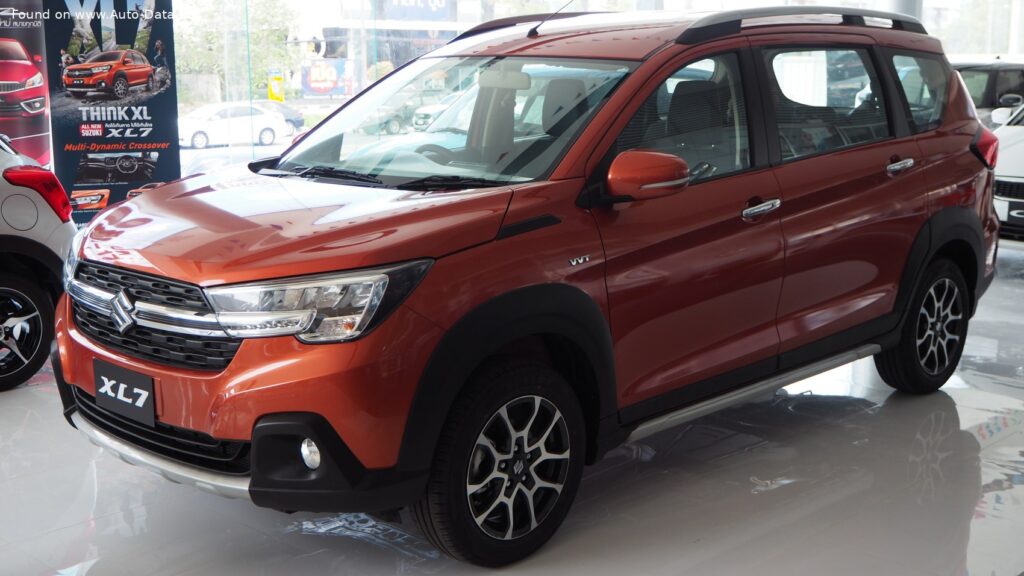
The Suzuki XL7 III 1.5i (105 Hp) Automatic represents a compelling entry in the compact SUV/crossover segment, specifically tailored for markets where practicality, fuel efficiency, and affordability are paramount. Launched in February 2020, this third-generation XL7 is a distinct model from its larger, North American predecessors, instead targeting regions like Southeast Asia and India with its focus on a family-friendly seven-seat configuration and robust design. It embodies Suzuki’s commitment to delivering reliable, versatile vehicles that navigate diverse road conditions with ease, making it a popular choice for urban commuting and light adventurous excursions in its primary markets. The architecture is built around an internal combustion engine powertrain, driving the front wheels, emphasizing a balance of performance and economy for its target demographic.
Powertrain and Performance Dynamics of the Suzuki XL7 III 1.5i (105 Hp) Automatic
At the heart of the Suzuki XL7 III 1.5i (105 Hp) Automatic is the K15B engine, a naturally aspirated 1.5-liter (1462 cm3 or 89.22 cu. in.) inline-four gasoline unit. This powerplant is engineered for dependable performance and efficiency, producing a respectable 105 horsepower at 6000 rpm. Torque output stands at 138 Newton-meters (101.78 lb.-ft.) delivered at 4400 rpm, providing adequate pulling power for city driving and highway cruising, even with a full complement of seven passengers. The engine’s layout is front-transverse, a common configuration for front-wheel-drive vehicles that optimizes interior space and packaging efficiency.
Technically, the K15B engine boasts a bore of 74 mm (2.91 in.) and a piston stroke of 85 mm (3.35 in.), with a compression ratio of 10.5:1. Each of its four cylinders features four valves, totaling 16 valves, controlled by a Variable Valve Timing (VVT) system. This VVT technology optimizes valve overlap and lift, enhancing both low-end torque and high-end power, while also contributing to improved fuel economy and reduced emissions. Fuel delivery is handled by a multi-port manifold injection system, a proven and reliable method for precise fuel metering. Further enhancing its efficiency credentials, the XL7 III incorporates a Start & Stop System, which automatically shuts off the engine when the vehicle is stationary, reducing fuel consumption and emissions in stop-and-go traffic.
Power is transmitted to the front wheels via a 4-speed automatic transmission. While some modern vehicles feature more gears, this 4-speed unit is chosen for its robustness, cost-effectiveness, and smooth operation, aligning with the XL7’s market positioning. This drivetrain architecture is well-suited for the vehicle’s intended use, providing predictable handling and efficient power delivery. The vehicle’s weight-to-power ratio is 11 kg/Hp (90.5 Hp/tonne), and its weight-to-torque ratio is 8.4 kg/Nm (119 Nm/tonne). These figures indicate a balanced performance profile, prioritizing reliability and economy over outright speed, which is characteristic of vehicles in this segment designed for daily family use.
Design, Features, and Practicality
The Suzuki XL7 III 1.5i (105 Hp) Automatic is characterized by its robust and modern SUV/crossover body type, featuring five doors and a versatile seven-seat configuration. This design makes it an ideal vehicle for families requiring flexible seating arrangements and ample cargo space. Its exterior styling projects an adventurous image, with a confident stance and practical dimensions. The vehicle measures 4450 mm (175.2 in.) in length, 1775 mm (69.88 in.) in width, and 1710 mm (67.32 in.) in height, with a generous wheelbase of 2740 mm (107.87 in.). These dimensions contribute to a spacious interior and a stable ride.
Practicality is a cornerstone of the XL7’s design. The ground clearance of 200 mm (7.87 in.) is particularly noteworthy, providing excellent capability for navigating uneven roads, speed bumps, and light off-road conditions often encountered in its primary markets. This elevated ride height also contributes to a commanding driving position. The minimum turning circle of 10.4 meters (34.12 ft.) ensures good maneuverability in tight urban environments. Inside, the XL7 offers impressive versatility with its seating and cargo options. With all seven seats in use, the trunk space is 153 liters (5.4 cu. ft.). However, by folding down the third and second rows, the cargo capacity expands significantly to a maximum of 803 liters (28.36 cu. ft.), allowing for the transport of larger items or luggage for extended trips.
The chassis and suspension systems are engineered for comfort and durability. The front suspension employs an independent McPherson strut setup, known for its ability to provide a comfortable ride and responsive handling. The rear suspension utilizes a torsion beam, a compact and robust design that effectively manages load and contributes to the vehicle’s overall stability. Stopping power comes from ventilated disc brakes at the front, offering strong and consistent braking performance, complemented by reliable drum brakes at the rear. An Anti-lock Braking System (ABS) is standard, enhancing safety by preventing wheel lock-up during emergency braking maneuvers. Steering is managed by an electric power steering rack and pinion system, providing light and precise steering feel, which is particularly beneficial in city driving and parking. The XL7 rides on 195/60 R16 tires mounted on 16-inch wheel rims, a practical size that balances ride comfort with handling characteristics and tire availability.
Overall, the Suzuki XL7 III 1.5i (105 Hp) Automatic is a thoughtfully designed vehicle that delivers on its promise of practical utility, robust construction, and efficient performance. Its blend of SUV aesthetics, multi-purpose interior, and Suzuki’s reputation for reliability makes it a compelling option for families and individuals seeking a versatile and dependable vehicle in its target markets.
Technical Specifications
| Brand | Suzuki |
| Model | XL7 |
| Generation | XL7 III |
| Type (Engine) | 1.5i (105 Hp) Automatic |
| Start of production | February, 2020 |
| Powertrain Architecture | Internal Combustion engine |
| Body type | SUV, Crossover |
| Seats | 7 |
| Doors | 5 |
| Fuel Type | Petrol (Gasoline) |
| Weight-to-power ratio | 11 kg/Hp, 90.5 Hp/tonne |
| Weight-to-torque ratio | 8.4 kg/Nm, 119 Nm/tonne |
| Power | 105 Hp @ 6000 rpm. |
| Power per liter | 71.8 Hp/l |
| Torque | 138 Nm @ 4400 rpm (101.78 lb.-ft. @ 4400 rpm) |
| Engine layout | Front, Transverse |
| Engine Model/Code | K15B |
| Engine displacement | 1462 cm3 (89.22 cu. in.) |
| Number of cylinders | 4 |
| Engine configuration | Inline |
| Cylinder Bore | 74 mm (2.91 in.) |
| Piston Stroke | 85 mm (3.35 in.) |
| Compression ratio | 10.5:1 |
| Number of valves per cylinder | 4 |
| Fuel injection system | Multi-port manifold injection |
| Valvetrain | VVT |
| Engine oil capacity | 3.1 l (3.28 US qt | 2.73 UK qt) |
| Coolant | 4 l (4.23 US qt | 3.52 UK qt) |
| Engine systems | Start & Stop System |
| Kerb Weight | 1160-1180 kg (2557.36 – 2601.45 lbs.) |
| Max. weight | 1730 kg (3814 lbs.) |
| Max load | 550-570 kg (1212.54 – 1256.63 lbs.) |
| Trunk (boot) space – minimum | 153 l (5.4 cu. ft.) |
| Trunk (boot) space – maximum | 803 l (28.36 cu. ft.) |
| Fuel tank capacity | 45 l (11.89 US gal | 9.9 UK gal) |
| Length | 4450 mm (175.2 in.) |
| Width | 1775 mm (69.88 in.) |
| Height | 1710 mm (67.32 in.) |
| Wheelbase | 2740 mm (107.87 in.) |
| Front track | 1515 mm (59.65 in.) |
| Rear (Back) track | 1530 mm (60.24 in.) |
| Ride height (ground clearance) | 200 mm (7.87 in.) |
| Minimum turning circle (turning diameter) | 10.4 m (34.12 ft.) |
| Drivetrain Architecture | The Internal combustion engine (ICE) drives the front wheels of the vehicle. |
| Drive wheel | Front wheel drive |
| Number of gears and type of gearbox | 4 gears, automatic transmission |
| Front suspension | Independent type McPherson |
| Rear suspension | Torsion |
| Front brakes | Ventilated discs |
| Rear brakes | Drum |
| Assisting systems | ABS (Anti-lock braking system) |
| Steering type | Steering rack and pinion |
| Power steering | Electric Steering |
| Tires size | 195/60 R16 |
| Wheel rims size | 16 inches |