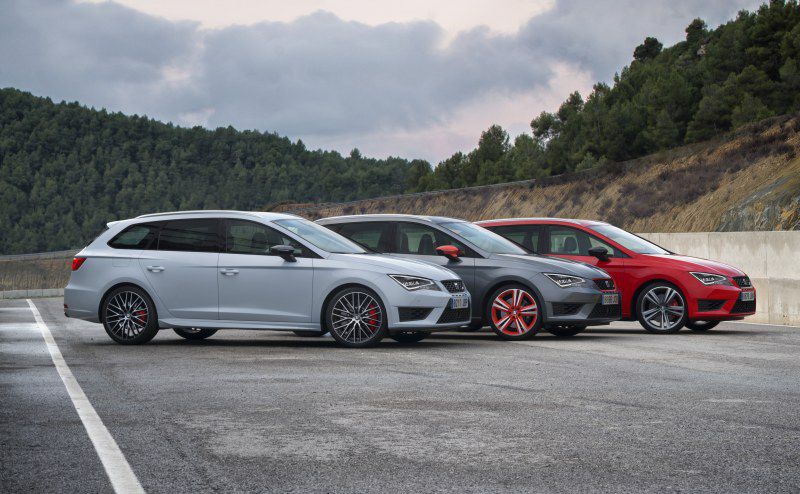
The Seat Leon III ST 2.0 TDI (150 Hp) start/stop 4Drive represents a compelling offering within the highly competitive European compact station wagon segment during its production run from 2014 to 2015. Developed by the Spanish automaker Seat, a subsidiary of the Volkswagen Group, this particular iteration of the Leon ST (Sport Tourer) combined the practicality of an estate body with a robust and efficient diesel powertrain, enhanced by an all-wheel-drive system. While not officially sold in the United States, the Leon III ST carved out a significant niche in its primary markets, appealing to families and individuals seeking a versatile vehicle capable of handling diverse driving conditions with impressive fuel economy and performance. Its design philosophy underscored Seat’s commitment to delivering a more dynamic and emotionally charged driving experience compared to some of its more conservative Volkswagen Group siblings, without sacrificing the core attributes of reliability and cost-effectiveness. The inclusion of a start/stop system further emphasized its modern approach to urban efficiency, aligning with the growing demand for environmentally conscious automotive solutions in the mid-2010s.
Engineering and Performance of the Seat Leon III ST 2.0 TDI (150 Hp) start/stop 4Drive
At the heart of the Seat Leon III ST 2.0 TDI (150 Hp) start/stop 4Drive lies a highly regarded 2.0-liter TDI (Turbocharged Direct Injection) diesel engine, a testament to Volkswagen Group’s proficiency in diesel technology. This inline four-cylinder engine, with a displacement of 1968 cm3 (120.09 cu. in.), delivered a robust 150 horsepower at 3500-4000 rpm, paired with a substantial 236.02 lb.-ft. (320 Nm) of torque available across a broad rev range from 1750 to 3000 rpm. This wide torque band ensured excellent drivability and responsive acceleration, particularly in everyday driving scenarios. The engine’s architecture featured a front, transverse layout, and utilized a sophisticated Diesel Commonrail fuel injection system, coupled with a turbocharger and intercooler for optimal air-fuel mixture and power delivery. With a compression ratio of 16:1 and four valves per cylinder, the engine was designed for both power and efficiency.
Performance figures for the Leon III ST 2.0 TDI were quite respectable for its class. It could accelerate from 0 to 60 mph in a brisk 8.3 seconds, reaching a maximum speed of 131.11 mph (211 km/h). These numbers highlight its capability not just as a practical family hauler but also as a competent long-distance cruiser. Fuel economy was a major selling point, with a combined rating of 49 US mpg (4.8 l/100 km), dropping to an impressive 56 US mpg (4.2 l/100 km) on the extra-urban cycle, and 40.6 US mpg (5.8 l/100 km) in urban conditions. These figures were further enhanced by the standard start/stop system, which automatically shut off the engine when the vehicle was stationary, reducing fuel consumption and CO2 emissions, rated at 124 g/km. The engine also met the Euro 5 emission standard, reflecting its compliance with contemporary environmental regulations. Power was channeled through a precise 6-speed manual transmission to Seat’s “4Drive” all-wheel-drive system, providing enhanced traction and stability, especially beneficial in adverse weather conditions or on challenging road surfaces, a feature highly valued in many European regions.
Design, Utility, and Features
The design of the Seat Leon III ST was characterized by sharp lines, angular headlights, and a distinctive grille, reflecting Seat’s modern design language that aimed for a sportier and more youthful appeal. As a station wagon (estate), it prioritized practicality and cargo versatility. The body measured 178.54 inches (4535 mm) in length, 71.5 inches (1816 mm) in width, and 57.13 inches (1451 mm) in height, with a wheelbase of 103.78 inches (2636 mm). These dimensions provided a spacious cabin for five occupants and a generous cargo area, making it an ideal choice for families and those requiring ample luggage capacity.
The interior of the Leon III ST was thoughtfully designed to maximize utility. It offered a minimum trunk space of 20.73 cu. ft. (587 liters), which could be expanded to a cavernous 51.91 cu. ft. (1470 liters) with the rear seats folded down. This flexibility was crucial for accommodating everything from groceries to sports equipment or holiday luggage. The vehicle’s kerb weight stood at 3249.61 lbs. (1474 kg), with a maximum permissible weight of 4497.43 lbs. (2040 kg), allowing for a substantial maximum load of 1247.82 lbs. (566 kg). From a safety perspective, the Leon III ST came equipped with essential assisting systems like ABS (Anti-lock Braking System), a fundamental safety feature for modern vehicles. The steering system utilized a precise rack and pinion setup, ensuring direct and engaging handling characteristics, which was a hallmark of the Leon lineup. The combination of a practical estate body, a sophisticated all-wheel-drive system, and efficient diesel power made the Seat Leon III ST 2.0 TDI (150 Hp) start/stop 4Drive a highly competent and appealing option in the European market for drivers who demanded both versatility and driving enjoyment.
Technical Specifications
| Brand | Seat |
| Model | Leon |
| Generation | Leon III ST |
| Type (Engine) | 2.0 TDI (150 Hp) start/stop 4Drive |
| Start of production | 2014 year |
| End of production | 2015 year |
| Powertrain Architecture | Internal Combustion engine |
| Body type | Station wagon (estate) |
| Seats | 5 |
| Doors | 5 |
| Fuel consumption (economy) – urban | 5.8 l/100 km (40.6 US mpg) |
| Fuel consumption (economy) – extra urban | 4.2 l/100 km (56 US mpg) |
| Fuel consumption (economy) – combined | 4.8 l/100 km (49 US mpg) |
| CO2 emissions | 124 g/km |
| Fuel Type | Diesel |
| Acceleration 0 – 60 mph | 8.3 sec |
| Acceleration 0 – 100 km/h | 8.7 sec |
| Maximum speed | 211 km/h (131.11 mph) |
| Emission standard | Euro 5 |
| Weight-to-power ratio | 9.8 kg/Hp (101.8 Hp/tonne) |
| Weight-to-torque ratio | 4.6 kg/Nm (217.1 Nm/tonne) |
| Power | 150 Hp @ 3500-4000 rpm |
| Power per litre | 76.2 Hp/l |
| Torque | 320 Nm (236.02 lb.-ft.) @ 1750-3000 rpm |
| Engine layout | Front, Transverse |
| Engine Model/Code | CRBC, CKFC, CRLB, CRMB |
| Engine displacement | 1968 cm3 (120.09 cu. in.) |
| Number of cylinders | 4 |
| Engine configuration | Inline |
| Cylinder Bore | 81 mm (3.19 in.) |
| Piston Stroke | 95.5 mm (3.76 in.) |
| Compression ratio | 16:1 |
| Number of valves per cylinder | 4 |
| Fuel injection system | Diesel Commonrail |
| Engine aspiration | Turbocharger, Intercooler |
| Engine oil capacity | 4.6 l (4.86 US qt) |
| Coolant | 8 l (8.45 US qt) |
| Engine systems | Start & Stop System, Particulate filter |
| Kerb Weight | 1474 kg (3249.61 lbs.) |
| Max. weight | 2040 kg (4497.43 lbs.) |
| Max load | 566 kg (1247.82 lbs.) |
| Trunk (boot) space – minimum | 587 l (20.73 cu. ft.) |
| Trunk (boot) space – maximum | 1470 l (51.91 cu. ft.) |
| Length | 4535 mm (178.54 in.) |
| Width | 1816 mm (71.5 in.) |
| Height | 1451 mm (57.13 in.) |
| Wheelbase | 2636 mm (103.78 in.) |
| Front track | 1549 mm (60.98 in.) |
| Rear (Back) track | 1520 mm (59.84 in.) |
| Drive wheel | All wheel drive (4×4) |
| Number of gears and type of gearbox | 6 gears, manual transmission |
| Assisting systems | ABS (Anti-lock braking system) |
| Steering type | Steering rack and pinion |