
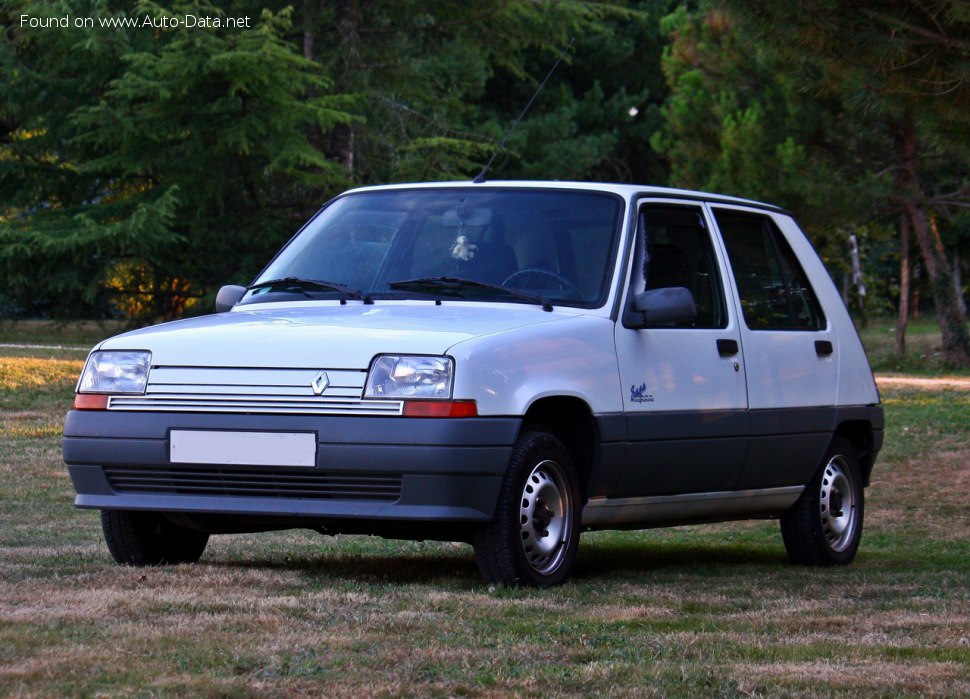
The Renault Super 5 (B/C40) 1.1 (B/C/S401) (45 Hp) represents a significant chapter in the history of European motoring, serving as the second generation of Renault’s highly successful compact hatchback, the Renault 5. Produced from 1989 until 1995, this specific variant, identified by its 1.1-liter engine, was a cornerstone of the supermini segment, a fiercely competitive class crucial to the European automotive landscape. While never officially imported into the United States, the Super 5 was an omnipresent vehicle across Europe, embodying the French automaker’s commitment to practical, efficient, and affordable personal transportation. It built upon the legendary status of its predecessor, which had sold over 5 million units, by offering a modernized design, improved ergonomics, and enhanced mechanicals tailored for the evolving demands of the late 20th century European driver. This iteration of the Super 5 was particularly renowned for its economic operation and robust construction, making it an ideal choice for both urban commuting and longer journeys across the continent’s varied terrains.
Delving into the Renault Super 5 (B/C40) 1.1 (B/C/S401) (45 Hp) Powertrain
At the heart of the Renault Super 5 (B/C40) 1.1 (B/C/S401) (45 Hp) lies a humble yet remarkably resilient powertrain. The vehicle is propelled by an internal combustion engine, specifically a 1.1-liter (1108 cc) unit, designated by the engine code C1E. This powerplant is a naturally aspirated gasoline engine, meaning it relies solely on atmospheric pressure to draw air into its cylinders, a common and cost-effective approach for entry-level vehicles of its era. With a power output of 45 horsepower, the engine was designed not for blistering performance, but for dependable, economical operation. For the European market, where fuel efficiency and low running costs were paramount for many buyers, this output was entirely adequate for the vehicle’s intended purpose.
The 45 HP delivered by the 1.1-liter engine provided the Super 5 with sufficient thrust for navigating congested city streets and maintaining reasonable speeds on secondary roads. While acceleration figures were modest by today’s standards, the lightweight nature of the Super 5 meant that the engine felt surprisingly sprightly in urban environments. Its design emphasized torque delivery at lower RPMs, which contributed to a flexible driving experience in stop-and-go traffic. Furthermore, the C1E engine was part of Renault’s long-standing ‘Cléon-Fonte’ family, an engine design that earned a reputation for its exceptional durability and ease of maintenance, a significant factor in the car’s appeal to budget-conscious owners. This legacy of reliability ensured that many Super 5s remained on the road for decades, a testament to the engineering philosophy that prioritized longevity over outright power.
Fuel economy was another strong suit of this powertrain. The naturally aspirated design, combined with a relatively low power output and lightweight chassis, allowed the Super 5 1.1 to achieve impressive fuel consumption figures for its time, making it an economical choice for daily use. The engine’s simplicity also meant fewer complex components to fail, contributing to lower ownership costs. With an engine oil capacity of 3.5 liters (3.7 US quarts) and a coolant capacity of 5.5 liters (5.81 US quarts), its fluid requirements were standard for a vehicle of its size and era, making routine servicing straightforward and accessible.
Design and Features of the Renault Super 5
The Renault Super 5 (B/C40) marked a significant evolution in design from its groundbreaking predecessor. While retaining the fundamental compact dimensions and practical philosophy, the Super 5 benefited from a more contemporary aesthetic penned by the acclaimed Italian designer Marcello Gandini, known for his work with Bertone. Gandini’s influence brought a softer, more aerodynamic profile to the Super 5, replacing the angular lines of the original R5 with smoother curves and flush-fitting glass. This not only modernized its appearance but also improved its aerodynamic efficiency, contributing to better fuel economy and reduced wind noise.
The body type of this specific Super 5 variant is a 5-door hatchback, a configuration that underscores its focus on practicality and versatility. The five-door layout provided easy access for all occupants and facilitated loading and unloading cargo, making it a highly functional vehicle for families and individuals alike. With seating for five passengers, the Super 5 offered a surprisingly spacious interior for its class. Smart packaging and a relatively tall roofline ensured adequate headroom, while the rear bench could typically be folded down to significantly expand the cargo area, transforming the compact car into a capable load-hauler when needed. This adaptability was a key selling point in the competitive European supermini market.
In terms of features, the 1989-1995 Renault Super 5, particularly in its 1.1-liter guise, prioritized essential functionality and affordability. While it lacked the advanced technological amenities found in modern vehicles, it offered a comfortable and user-friendly cabin for its time. Standard features would have included basic heating and ventilation systems, manual window winders, and perhaps an AM/FM radio as an option. Safety features, by late 1980s and early 1990s standards, were primarily passive, relying on the vehicle’s structural integrity, seatbelts for all occupants, and a clear line of sight for the driver. Active safety systems like ABS or airbags were not standard on entry-level models of this period, but the Super 5 met the prevailing safety regulations of its primary markets.
The interior design was characterized by its simplicity and robust materials, designed to withstand the rigors of daily use. Ergonomics were carefully considered to ensure controls were within easy reach, and instrumentation was clear and legible. The overall design ethos was one of no-nonsense utility, aiming to provide reliable and cost-effective transport without unnecessary frills. This focus on durability and practicality, combined with its charming design and economical operation, cemented the Renault Super 5’s position as a beloved and enduring icon of European motoring, a testament to its thoughtful engineering and market-appropriate execution.
Technical Specifications
| Brand | Renault |
| Model | Super 5 |
| Generation | Super 5 (B/C40) |
| Type (Engine) | 1.1 (B/C/S401) (45 Hp) |
| Start of production | 1989 year |
| End of production | 1995 year |
| Powertrain Architecture | Internal Combustion engine |
| Body type | Hatchback |
| Seats | 5 |
| Doors | 5 |
| Fuel Type | Petrol (Gasoline) |
| Power | 45 Hp |
| Engine Model/Code | C1E |
| Engine aspiration | Naturally aspirated engine |
| Engine oil capacity | 3.5 l (3.7 US qt | 3.08 UK qt) |
| Coolant | 5.5 l (5.81 US qt | 4.84 UK qt) |
| Fuel tank capacity | 43 l (11.36 US gal | 9.46 UK gal) |
