
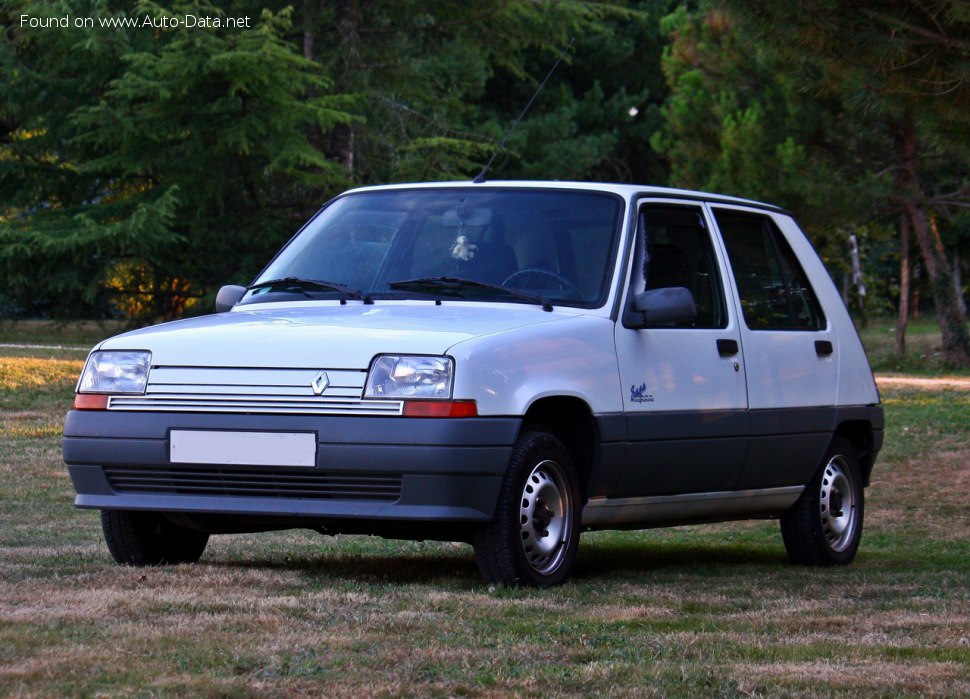
The Renault Super 5, specifically the B/C40 generation, represents a pivotal chapter in the history of the European supermini segment. Launched in 1984 as the successor to the immensely popular and groundbreaking Renault 5, the Super 5, known internally by its project code B40 (3-door) and C40 (5-door), aimed to modernize the iconic design while retaining its predecessor’s core strengths of practicality, efficiency, and nimble urban performance. The variant under scrutiny, the 1.1 (B/C/S401) with 49 horsepower, produced from 1986 to 1996, exemplifies the accessible and economical motoring that defined this era for millions of consumers across Europe. While never officially imported into the United States, the Renault Super 5 played a crucial role in shaping the automotive landscape in its primary markets, offering a compelling blend of compact dimensions, surprising interior space, and frugal operation, all wrapped in a distinctly French design aesthetic.
The Evolution of the Renault Super 5
The original Renault 5, introduced in 1972, was a sensation, effectively creating the supermini class in Europe and setting benchmarks for compact car design and practicality. By the early 1980s, however, its design was beginning to show its age, prompting Renault to develop a successor that could carry on its legacy. The Super 5, designed by Marcello Gandini, was not a radical departure but rather a thoughtful evolution. Gandini, famed for his work with Bertone on cars like the Lamborghini Countach, brought a more aerodynamic and contemporary look to the Super 5, while retaining the familiar silhouette that made the R5 so recognizable. The B/C40 generation was built on an entirely new platform, which significantly improved handling, ride comfort, and safety compared to its predecessor. Its longer wheelbase and wider track contributed to better stability and more generous interior room, a critical factor for a car designed to serve as primary family transport for many European households. The extended production run from 1986 to 1996 for this specific 1.1-liter variant underscores its enduring appeal and reliability in a highly competitive market segment.
Engine and Performance: The 1.1 (B/C/S401) Powertrain
At the heart of the Renault Super 5 (B/C40) 1.1 (B/C/S401) lies a venerable C1E engine, a naturally aspirated, four-cylinder gasoline unit with a displacement of 1108 cubic centimeters, or approximately 1.1 liters. This powerplant, delivering 49 horsepower, was a testament to Renault’s focus on efficiency and cost-effective manufacturing. While 49 HP might seem modest by contemporary standards, it was entirely adequate for the Super 5’s intended purpose and lightweight chassis. The engine’s power output of 44.2 HP per liter was respectable for its time, and its internal combustion architecture utilized a carburettor fuel injection system, a common and reliable setup before the widespread adoption of electronic fuel injection. This configuration provided a straightforward and easily maintainable engine, crucial for a car aimed at the mass market.
Performance figures for the 1.1-liter Super 5 reflect its practical orientation. With a maximum speed of 96.31 miles per hour (155 km/h), it was capable of holding its own on European highways, though its true strength lay in urban and suburban environments. The car’s remarkable lightness, with a kerb weight of just 1576.31 pounds (715 kg), contributed significantly to its agility and fuel economy. This resulted in an impressive weight-to-power ratio of 14.6 kg/HP, or 68.5 HP per tonne, which allowed the 49 HP engine to deliver sprightly acceleration in city traffic. Fuel efficiency was a key selling point, with a combined fuel consumption of 33.6 US miles per gallon (7 liters per 100 km). Urban driving saw consumption around 29.4 US mpg (8 l/100 km), while extra-urban figures were even more impressive at 40.9 US mpg (5.75 l/100 km), highlighting its economical nature on longer journeys. The 11.36 US gallon (43-liter) fuel tank provided a decent range, further enhancing its practicality for daily use and weekend trips.
Engine maintenance was also straightforward, with an engine oil capacity of 3.7 US quarts (3.5 liters) and a coolant capacity of 5.81 US quarts (5.5 liters), making routine servicing accessible for owners and independent garages alike. The Super 5’s powertrain was a reliable workhorse, contributing to its reputation for durability and low running costs, which were vital factors for European consumers in the late 20th century.
Design and Features of the Renault Super 5 (B/C40)
The Renault Super 5 (B/C40) was offered predominantly as a practical five-door hatchback, a configuration that maximized interior versatility and ease of access for passengers and cargo. Its design, while evolutionary, featured smoother lines and a more cohesive aesthetic than its predecessor. The five-door body type, with seating for five occupants, underscored its role as a versatile compact family car. The Super 5’s exterior was characterized by its distinctive “wrap-around” rear window and a more upright, yet still aerodynamic, front fascia. Its compact footprint made it ideal for navigating the often-narrow streets and congested parking spaces of European cities.
Underneath its practical skin, the Super 5 employed a robust and proven chassis. The steering system utilized a rack and pinion setup, offering direct and predictable handling, a characteristic prized in small European cars. For suspension, the Super 5 featured MacPherson struts at the front, providing a good balance of comfort and handling precision. The rear suspension, while not explicitly detailed for this specific variant, typically involved a torsion bar system in the Super 5 range, which was effective in maximizing interior space by having a compact design that did not intrude significantly into the luggage area. Braking performance was handled by disc brakes at the front, offering reliable stopping power, complemented by drum brakes at the rear, a common and cost-effective solution for cars of this class and era. The vehicle rode on 13-inch wheel rims, fitted with 165/70 R13 tires, a standard size that prioritized ride comfort and affordability of replacement.
While modern safety features like airbags or advanced driver-assistance systems were not present, the Super 5 represented an improvement in passive safety over the original R5, benefiting from a stiffer body structure and crumple zones designed to absorb impact energy. The focus was on fundamental engineering principles to provide a safe and predictable driving experience. Inside, the Super 5 offered a functional and ergonomic cabin, with controls logically placed and good visibility, essential for urban driving. The five-seat configuration, combined with the hatchback’s flexible cargo area, made it a highly adaptable vehicle, capable of handling everything from daily commutes to grocery runs and even modest road trips. The enduring popularity of the Renault Super 5 (B/C40) 1.1 (B/C/S401) (49 Hp) throughout its production run cemented its status as a true automotive icon in the European market, valued for its blend of practicality, economy, and driving charm.
Technical Specifications: Renault Super 5 (B/C40) 1.1 (B/C/S401) (49 Hp)
| Brand | Renault |
| Model | Super 5 |
| Generation | Super 5 (B/C40) |
| Type (Engine) | 1.1 (B/C/S401) (49 Hp) |
| Start of production | 1986 year |
| End of production | 1996 year |
| Powertrain Architecture | Internal Combustion engine |
| Body type | Hatchback |
| Seats | 5 |
| Doors | 5 |
| Fuel consumption (economy) – urban | 8 l/100 km (29.4 US mpg) |
| Fuel consumption (economy) – extra urban | 5.75 l/100 km (40.9 US mpg) |
| Fuel consumption (economy) – combined | 7 l/100 km (33.6 US mpg) |
| Fuel Type | Petrol (Gasoline) |
| Maximum speed | 155 km/h (96.31 mph) |
| Weight-to-power ratio | 14.6 kg/Hp (68.5 Hp/tonne) |
| Power | 49 Hp |
| Power per litre | 44.2 Hp/l |
| Engine Model/Code | C1E |
| Engine displacement | 1108 cm3 (67.61 cu. in.) |
| Number of cylinders | 4 |
| Fuel injection system | Carburettor |
| Engine aspiration | Naturally aspirated engine |
| Engine oil capacity | 3.5 l (3.7 US qt) |
| Coolant | 5.5 l (5.81 US qt) |
| Kerb Weight | 715 kg (1576.31 lbs) |
| Fuel tank capacity | 43 l (11.36 US gal) |
| Rear suspension | McPherson |
| Front brakes | Disc |
| Rear brakes | Drum |
| Steering type | Steering rack and pinion |
| Tires size | 165/70 R13 |
| Wheel rims size | 13 |
