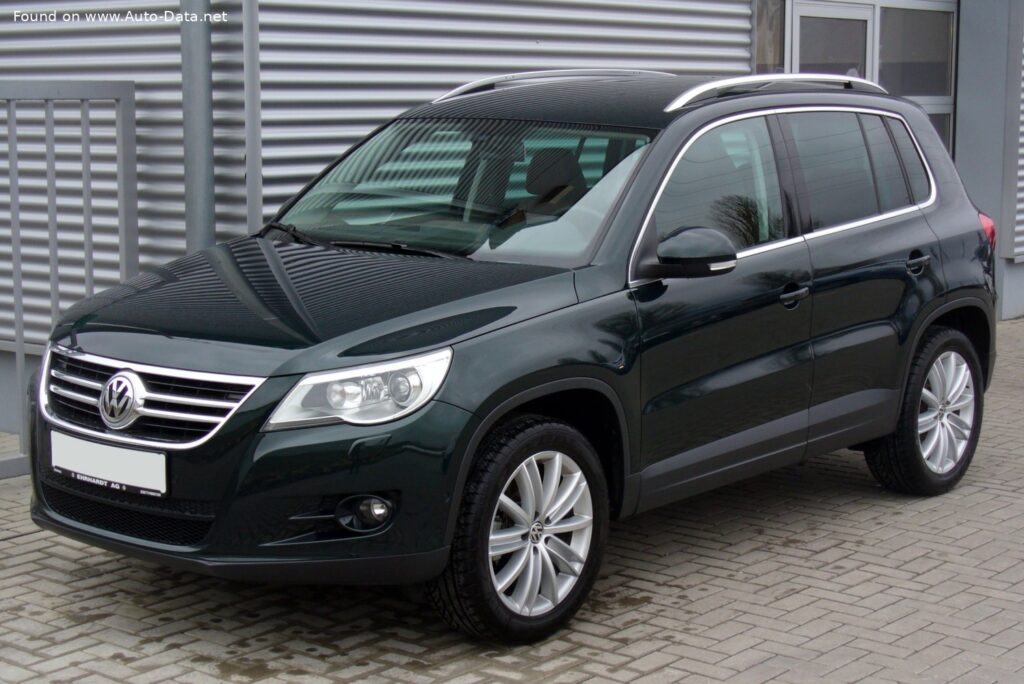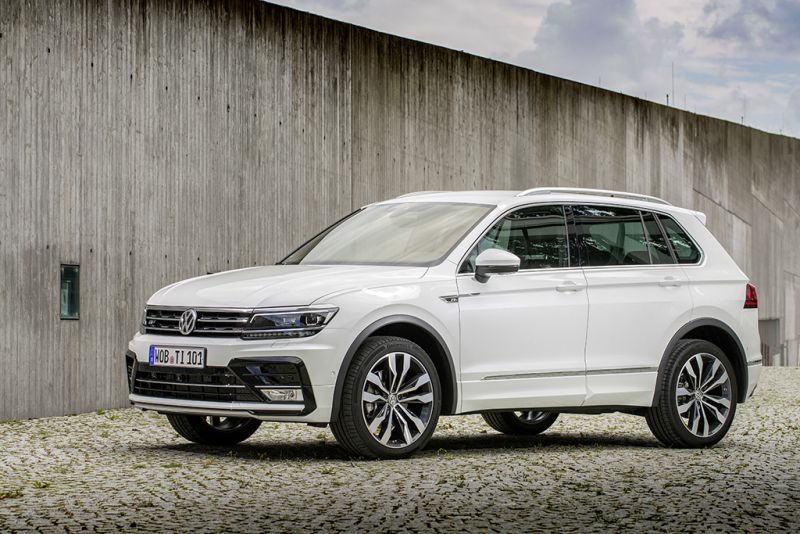
The Volkswagen Tiguan II 1.5 TSI (150 Hp) ACT represents a compelling offering in the highly competitive compact SUV segment, specifically tailored for the European and international markets where it was produced between 2019 and 2020. As the second generation of Volkswagen’s popular Tiguan, this particular variant highlights the brand’s commitment to efficiency, modern powertrain technology, and practical design within a versatile Sport Utility Vehicle (SUV) platform. While not directly sold in the United States with this specific engine and transmission configuration, its underlying architecture and technological advancements are indicative of Volkswagen’s global engineering prowess, influencing models found worldwide. This iteration of the Tiguan II, known for its refined driving dynamics and spacious interior, served as a cornerstone of Volkswagen’s SUV lineup, appealing to a broad demographic seeking a balance of performance, economy, and utility.
Engine & Performance: The Volkswagen Tiguan II 1.5 TSI (150 Hp) ACT Powertrain
At the heart of the Volkswagen Tiguan II 1.5 TSI (150 Hp) ACT lies a sophisticated 1.5-liter turbocharged inline four-cylinder engine, designated with the model code DPCA. This powerplant delivers a robust 150 horsepower (Hp) at a broad range of 5000-6000 revolutions per minute (rpm), making it a responsive and capable performer for its class. Torque figures are equally impressive, peaking at 250 Newton-meters (Nm), or 184.39 lb.-ft., available from a low 1500 rpm and sustained up to 3500 rpm. This wide torque band ensures strong acceleration and flexible in-gear performance, crucial for both urban commuting and highway cruising.
A standout feature of this engine is its Active Cylinder Technology (ACT), which allows the engine to seamlessly deactivate two of its four cylinders under light load conditions. This innovative system, combined with a Start & Stop system and a particulate filter, significantly enhances fuel efficiency and reduces emissions without compromising overall performance. The engine’s advanced fuel injection system, utilizing direct injection, further optimizes combustion for improved power output and economy. A turbocharger with an intercooler ensures that the engine consistently delivers its rated power, even under varying ambient conditions, by providing a denser air charge to the cylinders. With an engine displacement of 1498 cubic centimeters (91.41 cu. in.), this 1.5-liter unit achieves a respectable power per liter ratio of 100.1 Hp/l, showcasing its high-tech design.
Performance metrics for the Tiguan II 1.5 TSI (150 Hp) ACT are competitive within its segment. It accelerates from 0 to 60 miles per hour (mph) in an estimated 8.8 seconds, while the 0-100 km/h sprint is completed in 9.3 seconds. The vehicle can reach a maximum speed of 125.52 mph (202 km/h), demonstrating its capability for sustained highway speeds. Power is delivered to the front wheels through a precise 6-speed manual transmission, offering an engaging driving experience and allowing the driver to maximize the engine’s efficiency. The drivetrain architecture, with the internal combustion engine driving the front wheels, contributes to both cost-effectiveness and favorable fuel economy.
Fuel economy figures are a strong selling point for this variant. In urban driving cycles, it achieves between 32.7 and 33.1 US mpg (7.1-7.2 l/100 km). On extra-urban routes, efficiency improves significantly, ranging from 47 to 49 US mpg (4.8-5.0 l/100 km). The combined fuel consumption is an impressive 40.6 to 41.3 US mpg (5.7-5.8 l/100 km), underscoring the effectiveness of the ACT system and other efficiency technologies. Emissions are kept in check, with CO2 output between 129-132 g/km, meeting the stringent Euro 6d-TEMP-EVAP-ISC emission standard, reflecting Volkswagen’s commitment to environmental responsibility.
Design & Features: Practicality and Refinement
The Volkswagen Tiguan II, introduced in its second generation, adopts a contemporary and robust design language characteristic of modern Volkswagen SUVs. As a 5-door, 5-seat SUV, it prioritizes practicality and passenger comfort. Its exterior dimensions are well-proportioned, with a length of 176.61 inches (4486 mm), a width of 72.4 inches (1839 mm) (or 82.64 inches / 2099 mm including mirrors), and a height of 65.12 inches (1654 mm). The generous wheelbase of 105.39 inches (2677 mm) contributes to a stable ride and a spacious cabin, providing ample legroom for both front and rear passengers.
The Tiguan II’s design is both functional and aesthetically pleasing, featuring clean lines, a distinctive front grille, and well-integrated lighting. The SUV stance is complemented by a respectable ground clearance of 7.52 inches (191 mm), which, while not extreme, is sufficient for light off-road excursions and navigating challenging urban terrain. The front and rear tracks, ranging from 62.17-62.56 inches (1579-1589 mm) and 61.81-62.2 inches (1570-1580 mm) respectively, contribute to the vehicle’s stable road presence.
Inside, the Tiguan II offers a well-appointed and ergonomically designed cabin. The focus is on user-friendliness and high-quality materials, typical of Volkswagen. Practicality extends to cargo capacity, which is a significant advantage for this SUV. The trunk (boot) space starts at an impressive 21.72 cubic feet (615 liters) with all seats in place, expanding to a cavernous 58.45 cubic feet (1655 liters) when the rear seats are folded down. This flexibility makes the Tiguan II an ideal choice for families, offering ample room for luggage, groceries, or sports equipment.
The vehicle’s kerb weight stands at 3152.61 lbs (1430 kg), with a maximum permissible weight of 4365.15 lbs (1980 kg) and a maximum load capacity of 1212.54 lbs (550 kg). Its towing capabilities are also noteworthy, with a permitted trailer load of 4188.78 lbs (1900 kg) with brakes (8% gradient) or 3968.32 lbs (1800 kg) (12% gradient), and 1653.47 lbs (750 kg) without brakes. The fuel tank capacity of 15.32 US gallons (58 liters) provides a good cruising range, especially given the vehicle’s excellent fuel economy. Standard features include ventilated disc brakes at the front and disc brakes at the rear, complemented by an Anti-lock Braking System (ABS) for enhanced safety. The electric power steering, a rack and pinion system, ensures light and precise handling, making the Tiguan II easy to maneuver in tight spaces, as indicated by its minimum turning circle of 37.73 feet (11.5 meters).
Technical Specifications
| Brand | Volkswagen |
| Model | Tiguan |
| Generation | Tiguan II |
| Type (Engine) | 1.5 TSI (150 Hp) ACT |
| Start of production | 2019 year |
| End of production | 2020 year |
| Powertrain Architecture | Internal Combustion engine |
| Body type | SUV |
| Seats | 5 |
| Doors | 5 |
| Fuel consumption (economy) – urban | 7.1-7.2 l/100 km (33.1 – 32.7 US mpg) |
| Fuel consumption (economy) – extra urban | 4.8-5.0 l/100 km (49 – 47 US mpg) |
| Fuel consumption (economy) – combined | 5.7-5.8 l/100 km (41.3 – 40.6 US mpg) |
| CO2 emissions | 129-132 g/km |
| Fuel Type | Petrol (Gasoline) |
| Acceleration 0 – 100 km/h | 9.3 sec |
| Acceleration 0 – 62 mph | 9.3 sec |
| Acceleration 0 – 60 mph (Calculated) | 8.8 sec |
| Maximum speed | 202 km/h (125.52 mph) |
| Emission standard | Euro 6d-TEMP-EVAP-ISC |
| Weight-to-power ratio | 9.5 kg/Hp, 104.9 Hp/tonne |
| Weight-to-torque ratio | 5.7 kg/Nm, 174.8 Nm/tonne |
| Power | 150 Hp @ 5000-6000 rpm |
| Power per litre | 100.1 Hp/l |
| Torque | 250 Nm @ 1500-3500 rpm (184.39 lb.-ft.) |
| Engine layout | Front, Transverse |
| Engine Model/Code | DPCA |
| Engine displacement | 1498 cm3 (91.41 cu. in.) |
| Number of cylinders | 4 |
| Engine configuration | Inline |
| Number of valves per cylinder | 4 |
| Fuel injection system | Direct injection |
| Engine aspiration | Turbocharger, Intercooler |
| Engine oil capacity | 4.3 l (4.54 US qt) |
| Engine systems | Start & Stop System, Cylinder deactivation system, Particulate filter |
| Kerb Weight | 1430 kg (3152.61 lbs) |
| Max. weight | 1980 kg (4365.15 lbs) |
| Max load | 550 kg (1212.54 lbs) |
| Trunk (boot) space – minimum | 615 l (21.72 cu. ft.) |
| Trunk (boot) space – maximum | 1655 l (58.45 cu. ft.) |
| Fuel tank capacity | 58 l (15.32 US gal) |
| Max. roof load | 75 kg (165.35 lbs) |
| Permitted trailer load with brakes (8%) | 1900 kg (4188.78 lbs) |
| Permitted trailer load with brakes (12%) | 1800 kg (3968.32 lbs) |
| Permitted trailer load without brakes | 750 kg (1653.47 lbs) |
| Permitted towbar download | 100 kg (220.46 lbs) |
| Length | 4486 mm (176.61 in.) |
| Width | 1839 mm (72.4 in.) |
| Width including mirrors | 2099 mm (82.64 in.) |
| Height | 1654 mm (65.12 in.) |
| Wheelbase | 2677 mm (105.39 in.) |
| Front track | 1579-1589 mm (62.17 – 62.56 in.) |
| Rear (Back) track | 1570-1580 mm (61.81 – 62.2 in.) |
| Ride height (ground clearance) | 191 mm (7.52 in.) |
| Minimum turning circle (turning diameter) | 11.5 m (37.73 ft.) |
| Drivetrain Architecture | The Internal combustion engine (ICE) drives the front wheels of the vehicle. |
| Drive wheel | Front wheel drive |
| Number of gears and type of gearbox | 6 gears, manual transmission |
| Front brakes | Ventilated discs |
| Rear brakes | Disc |
| Assisting systems | ABS (Anti-lock braking system) |
| Steering type | Steering rack and pinion |
| Power steering | Electric Steering |
| Tires size | 215/65 R17 |
| Wheel rims size | 7J x 17 |