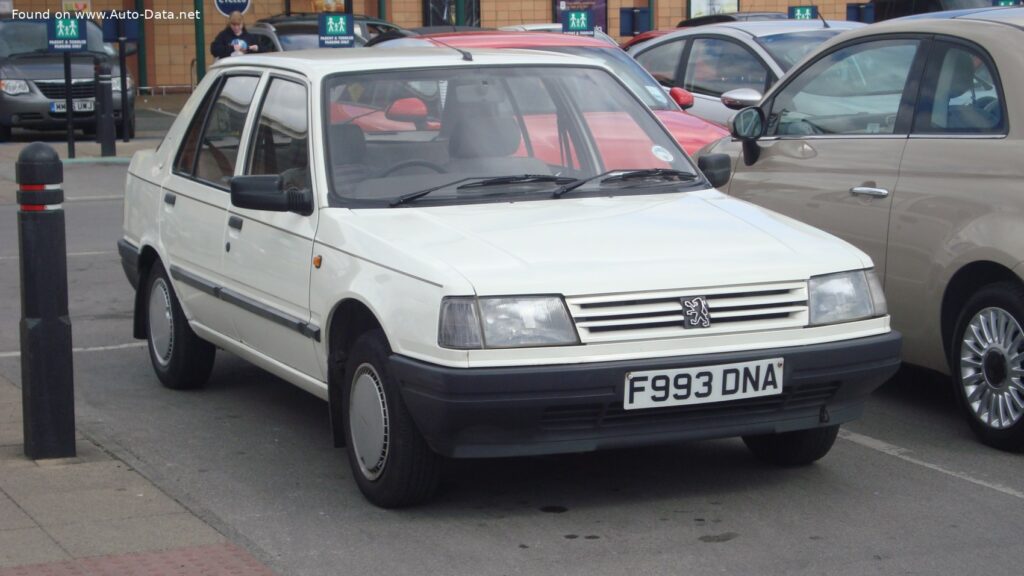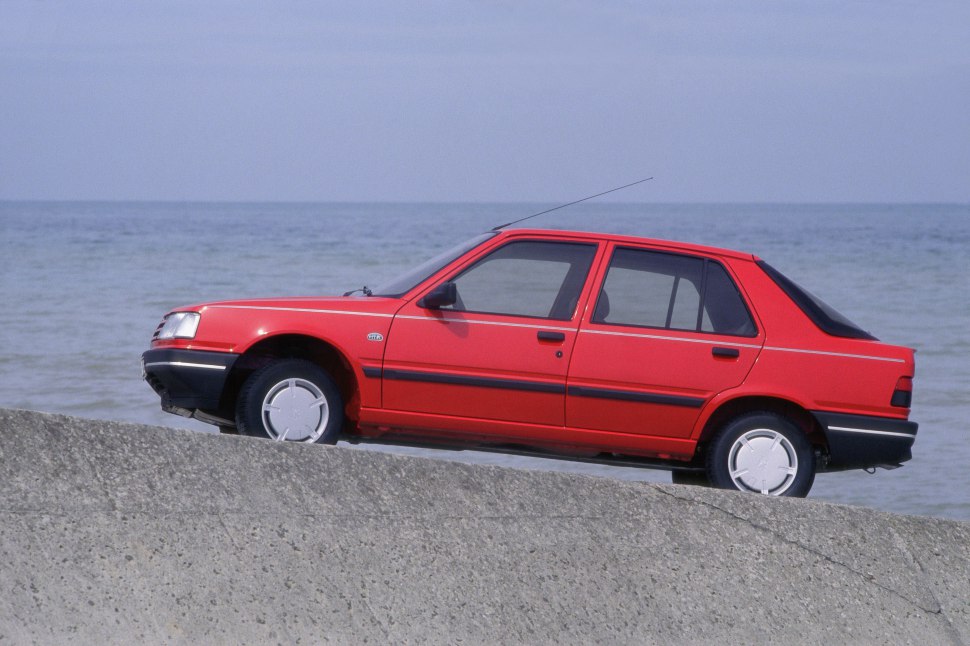
The Peugeot 309, particularly the 3C,3A generation which received a significant facelift in 1989, represents a pivotal model in the French automaker’s history, firmly establishing its presence in the competitive European C-segment. While never officially imported to the United States, the Peugeot 309 (3C,3A facelift 1989) 1.4 i (75 Hp) was a common sight across Europe, known for its practical hatchback design, engaging driving dynamics, and economical operation. This specific variant, produced from 1989 to 1993, offered a compelling blend of everyday usability and characteristic Peugeot charm, bridging the gap between the smaller, iconic 205 and the later 306. Its design and engineering reflected the brand’s commitment to creating accessible yet enjoyable vehicles for the mass market, building on a reputation for robust mechanicals and a distinctive European flair.
Engineering and Performance of the Peugeot 309 1.4 i
At the heart of the 1989 facelifted Peugeot 309 1.4 i lies a robust and efficient 1.4-liter (1361 cm³, or 83.05 cu. in.) inline-four engine, specifically designated with model codes KDY TU3M or KDZ TU3M. This naturally aspirated gasoline powerplant was configured with a front, transverse layout, driving the front wheels through a precise 5-speed manual transmission. While not a powerhouse, its 75 horsepower, delivered at 5800 rpm, and 81.87 lb.-ft. of torque, peaking at a accessible 3400 rpm, provided ample motivation for its relatively light 1873.93-pound curb weight. This resulted in a respectable weight-to-power ratio of 11.3 kg/Hp, or 88.2 Hp per tonne, contributing to its agile feel.
The engine featured an Overhead Camshaft (OHC) valvetrain with two valves per cylinder and a compression ratio of 9.3:1. Fuel delivery was handled by a multi-port manifold injection system, a modern touch for its era, ensuring efficient combustion and improved throttle response compared to older carbureted designs. In terms of performance, the Peugeot 309 1.4 i could accelerate from 0 to 60 mph in a calculated 10.5 seconds, reaching a maximum speed of 105.63 mph. These figures, while not setting any performance records, were perfectly adequate for the everyday driving conditions of the late 1980s and early 1990s, particularly on European roads where compact, efficient vehicles were highly valued. Its powertrain architecture, emphasizing simplicity and reliability, contributed to its reputation as a dependable daily driver.
Fuel economy was a strong suit for this variant. The combined cycle consumption was rated at an impressive 34.6 US mpg (6.8 l/100 km), showcasing its efficiency. Urban driving yielded 31.8 US mpg (7.4 l/100 km), while extra-urban conditions saw it achieve an excellent 48 US mpg (4.9 l/100 km). With a 14.53 US gallon fuel tank, the 309 1.4 i offered a considerable range, making it an economical choice for commuters and small families across its primary markets.
Design and Features of the Peugeot 309
The Peugeot 309, especially after its 1989 facelift, maintained a classic European hatchback silhouette, a design ethos that prioritized practicality and urban maneuverability. Available in both 3-door and 5-door configurations, it comfortably accommodated five occupants, making it a versatile choice for a wide range of buyers. Its dimensions were compact yet functional, with a length of 159.45 inches, a width of 64.17 inches, and a height of 54.33 inches. The 97.24-inch wheelbase contributed to a stable ride quality while maintaining a tight turning radius, ideal for city driving.
The design of the 309 was understated but appealing, featuring clean lines and a functional aesthetic typical of Peugeot during that period. The facelift updated elements like the grille, headlights, and interior trim, bringing it in line with contemporary trends. Inside, the focus was on ergonomics and utility. While not luxurious by modern standards, the cabin offered good visibility and intuitive controls. Storage capacity was practical, with a minimum trunk space of 10.42 cubic feet (295 liters), which could be expanded significantly to 21.72 cubic feet (615 liters) by folding the rear seats, enhancing its cargo-carrying versatility.
Underneath, the 309 featured a well-engineered chassis. The front suspension utilized coil springs, providing a comfortable and compliant ride, while the rear employed a torsion beam setup, a common and space-efficient design for compact front-wheel-drive vehicles of its era. Braking was handled by disc brakes at the front and drum brakes at the rear, a standard configuration for many vehicles in this segment. An Anti-lock Braking System (ABS) was available as an assisting system, a notable safety feature for the time, enhancing driver control during emergency braking. Steering was managed by a rack and pinion system with hydraulic power steering, offering a direct and communicative feel that was characteristic of Peugeot’s reputation for engaging driving dynamics.
The 309 rode on 165/70 SR13 tires, a common size for compact cars, balancing grip, ride comfort, and affordability. The vehicle’s overall design, combining sensible dimensions with practical features and a driver-focused chassis, ensured its enduring appeal in the European market as a reliable and enjoyable family hatchback.
Technical Specifications: Peugeot 309 (3C,3A facelift 1989) 1.4 i (75 Hp)
| Brand | Peugeot |
| Model | 309 |
| Generation | 309 (3C,3A facelift 1989) |
| Type (Engine) | 1.4 i (75 Hp) |
| Start of production | 1989 year |
| End of production | 1993 year |
| Powertrain Architecture | Internal Combustion engine |
| Body type | Hatchback |
| Seats | 5 |
| Doors | 3-5 |
| Fuel consumption (economy) – urban | 7.4 l/100 km (31.8 US mpg / 38.2 UK mpg) |
| Fuel consumption (economy) – extra urban | 4.9 l/100 km (48 US mpg / 57.6 UK mpg) |
| Fuel consumption (economy) – combined | 6.8 l/100 km (34.6 US mpg / 41.5 UK mpg) |
| Fuel Type | Petrol (Gasoline) |
| Acceleration 0 – 100 km/h | 11.1 sec |
| Acceleration 0 – 62 mph | 11.1 sec |
| Acceleration 0 – 60 mph (Calculated) | 10.5 sec |
| Maximum speed | 170 km/h (105.63 mph) |
| Weight-to-power ratio | 11.3 kg/Hp (88.2 Hp/tonne) |
| Weight-to-torque ratio | 7.7 kg/Nm (130.6 Nm/tonne) |
| Power | 75 Hp @ 5800 rpm |
| Power per litre | 55.1 Hp/l |
| Torque | 111 Nm @ 3400 rpm (81.87 lb.-ft. @ 3400 rpm) |
| Engine layout | Front, Transverse |
| Engine Model/Code | KDY TU3M, KDZ TU3M |
| Engine displacement | 1361 cm³ (83.05 cu. in.) |
| Number of cylinders | 4 |
| Engine configuration | Inline |
| Cylinder Bore | 75 mm (2.95 in.) |
| Piston Stroke | 77 mm (3.03 in.) |
| Compression ratio | 9.3:1 |
| Number of valves per cylinder | 2 |
| Fuel injection system | Multi-port manifold injection |
| Engine aspiration | Naturally aspirated engine |
| Valvetrain | OHC |
| Engine oil capacity | 3.2 l (3.38 US qt / 2.82 UK qt) |
| Engine oil specification | Not specified |
| Coolant | 5.7 l (6.02 US qt / 5.02 UK qt) |
| Kerb Weight | 850 kg (1873.93 lbs) |
| Max. weight | 1290 kg (2843.96 lbs) |
| Max load | 440 kg (970.03 lbs) |
| Trunk (boot) space – minimum | 295 l (10.42 cu. ft.) |
| Trunk (boot) space – maximum | 615 l (21.72 cu. ft.) |
| Fuel tank capacity | 55 l (14.53 US gal / 12.1 UK gal) |
| Length | 4050 mm (159.45 in.) |
| Width | 1630 mm (64.17 in.) |
| Height | 1380 mm (54.33 in.) |
| Wheelbase | 2470 mm (97.24 in.) |
| Front track | 1405 mm (55.31 in.) |
| Rear (Back) track | 1380 mm (54.33 in.) |
| Drivetrain Architecture | The Internal combustion engine (ICE) drives the front wheels of the vehicle. |
| Drive wheel | Front wheel drive |
| Number of gears and type of gearbox | 5 gears, manual transmission |
| Front suspension | Coil spring |
| Rear suspension | Torsion |
| Front brakes | Disc |
| Rear brakes | Drum |
| Assisting systems | ABS (Anti-lock braking system) |
| Steering type | Steering rack and pinion |
| Power steering | Hydraulic Steering |
| Tires size | 165/70 SR13 |