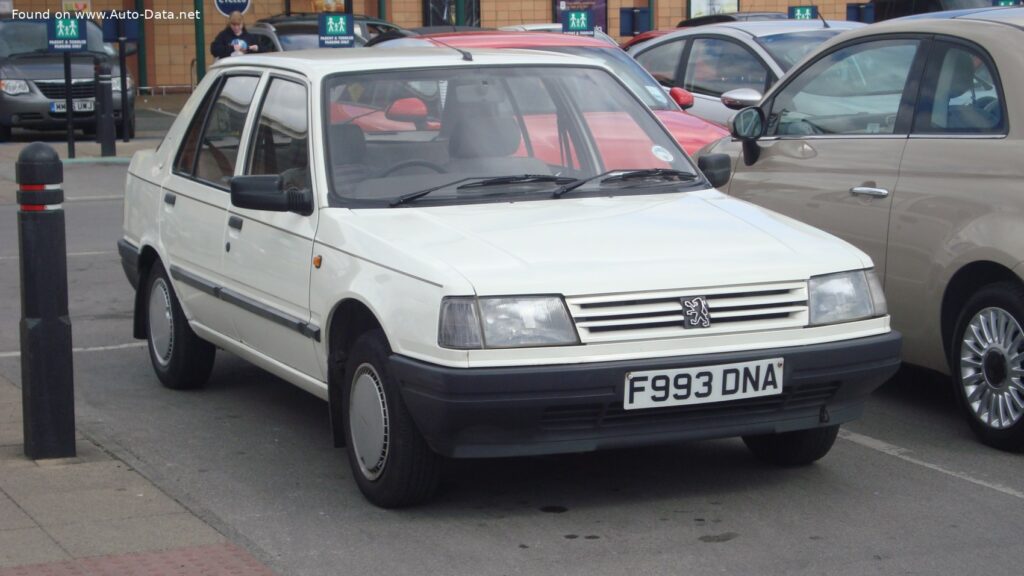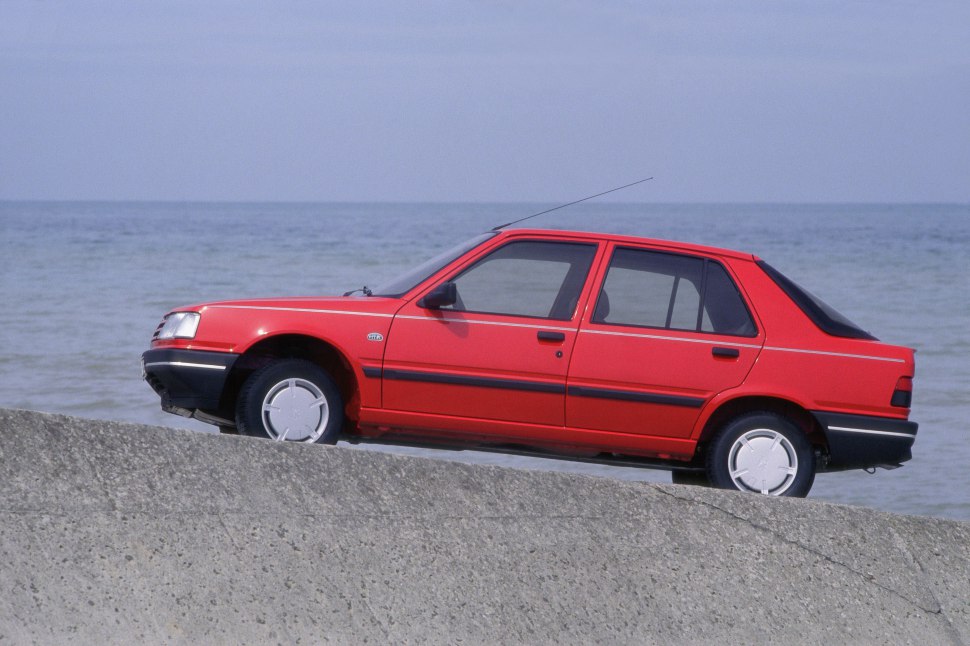
The Peugeot 309 stands as a pivotal model in the history of the French automaker, bridging the gap between the venerable 305 and the highly successful 306. Launched in 1985, the 309 was initially conceived as a Talbot model, a brand Peugeot had acquired, but was eventually rebadged as a Peugeot to help consolidate the brand’s identity in the compact segment. The specific iteration under review, the Peugeot 309 (3C,3A facelift 1989) 1.6 (92 Hp) Automatic, represents a refined version of this popular European hatchback, benefiting from a mid-life refresh that brought subtle yet significant improvements. Produced from 1989 to 1993, this generation was a staple on European roads, prized for its practical hatchback body style, efficient powertrain options, and engaging driving dynamics typical of Peugeot vehicles of that era. While never officially imported to the United States, the 309 carved out a strong niche in its primary markets, offering a compelling blend of affordability, utility, and driving pleasure in the competitive compact family car segment.
Engineering and Performance of the Peugeot 309 (3C,3A facelift 1989) 1.6 (92 Hp) Automatic
At the heart of the 1989 facelifted Peugeot 309 lies a robust 1.6-liter (1580 cm³) naturally aspirated inline-four engine, designated with the model code B2B XU52C. This powerplant, a derivative of Peugeot’s well-regarded XU engine family, was known for its reliability and straightforward design. Despite its relatively modest displacement, the engine delivered a respectable 92 horsepower at 6250 rpm, providing a lively character for a vehicle of its class and era. Torque output was equally competitive, peaking at 94.41 lb.-ft. at 3250 rpm, ensuring adequate pull for urban driving and maintaining momentum on extra-urban routes. The engine’s configuration featured two valves per cylinder and a compression ratio of 8.95:1, utilizing a carburetor fuel injection system, which was standard technology for many mainstream vehicles in the late 1980s. This setup, while not as sophisticated as later multi-point fuel injection systems, was easy to maintain and offered dependable performance.
The power was transmitted to the front wheels via a 4-speed automatic transmission, a common offering for those seeking convenience over outright performance in the compact segment. This automatic gearbox contributed to a smooth driving experience, particularly in congested city traffic, though it naturally introduced a slight compromise in acceleration compared to its manual counterparts. Nonetheless, the 309 1.6 Automatic was capable of reaching 60 mph from a standstill in a commendable 10 seconds, with a top speed of 111.85 mph. These figures underscored its capability as a competent family car, suitable for both daily commuting and longer journeys. The vehicle’s lightweight construction, with a curb weight of just 1918.02 lbs., contributed significantly to its energetic performance and favorable weight-to-power ratio of 9.5 kg/Hp (105.7 Hp/tonne).
Fuel economy for the 1.6-liter automatic model was a key selling point in its European markets. The official figures indicated an urban consumption of 26.7 US mpg, an extra-urban figure of 44.4 US mpg, and a combined average of 34.6 US mpg. These efficiency ratings, particularly for an automatic transmission from that period, highlighted Peugeot’s commitment to economical motoring. The 55-liter (14.53 US gallons) fuel tank capacity provided a substantial cruising range, enhancing its practicality for families and long-distance drivers. The engine’s oil capacity was 4 liters (4.23 US quarts), and the cooling system held 8 liters (8.45 US quarts), both standard for an engine of this size and configuration, facilitating routine maintenance.
Design and Features of the Peugeot 309 (3C,3A facelift 1989)
The Peugeot 309 (3C,3A facelift 1989) maintained the practical and distinctive hatchback body style that defined its market segment. Available in both 3-door and 5-door configurations, it offered seating for five occupants, emphasizing its role as a versatile family vehicle. The facelift introduced subtle enhancements to the exterior styling, typically involving updated grille designs, revised lighting clusters, and minor trim changes, aimed at modernizing its appearance and aligning it with Peugeot’s evolving design language of the late 1980s. Its compact dimensions – a length of 159.45 inches, a width of 64.17 inches, and a height of 54.33 inches – made it maneuverable in tight urban environments while still providing a surprisingly spacious interior for its class. The wheelbase measured 97.24 inches, contributing to a stable ride and decent cabin volume.
Inside, the 309 prioritized functionality and ergonomic design. While specific luxury features were reserved for higher trims, the 1.6 Automatic model would have featured a comfortable and well-appointed cabin for its segment. The trunk space was generous for a compact hatchback, offering a minimum of 10.42 cubic feet (295 liters) with the rear seats in place, which could be expanded to a substantial 21.72 cubic feet (615 liters) by folding the rear seats. This flexibility made it highly practical for carrying luggage, groceries, or larger items, a crucial attribute for its target audience.
In terms of chassis and safety, the 309 utilized a robust and proven architecture. The front suspension employed coil springs, a common and effective setup for providing a comfortable ride and predictable handling. The rear suspension featured a torsion bar system, a Peugeot hallmark of the era, which allowed for a compact design, maximizing interior space while delivering excellent road holding. Braking was handled by disc brakes at the front and drum brakes at the rear, a conventional and reliable combination for a vehicle of this performance level. A notable safety feature for the time was the inclusion of an Anti-lock Braking System (ABS) as an assisting system, which significantly improved braking control in adverse conditions, a premium offering for a compact car in 1989.
Steering for the 309 was managed by a rack and pinion system, enhanced with hydraulic power steering. This setup provided a good balance of driver feedback and ease of maneuverability, particularly at lower speeds, making parking and urban driving less strenuous. The vehicle rode on 13-inch wheel rims fitted with 165/70 SR13 tires, a common size that balanced grip, ride comfort, and affordability. Overall, the facelifted Peugeot 309 1.6 Automatic was a well-engineered and practical vehicle that combined sensible design with reliable mechanics and a solid feature set for its era, securing its place as a popular choice in the European compact segment.
Technical Specifications
| Brand | Peugeot |
| Model | 309 |
| Generation | 309 (3C,3A facelift 1989) |
| Type (Engine) | 1.6 (92 Hp) Automatic |
| Start of production | 1989 year |
| End of production | 1993 year |
| Powertrain Architecture | Internal Combustion engine |
| Body type | Hatchback |
| Seats | 5 |
| Doors | 3-5 |
| Fuel consumption (economy) – urban | 8.8 l/100 km (26.7 US mpg) |
| Fuel consumption (economy) – extra urban | 5.3 l/100 km (44.4 US mpg) |
| Fuel consumption (economy) – combined | 6.8 l/100 km (34.6 US mpg) |
| Fuel Type | Petrol (Gasoline) |
| Acceleration 0 – 60 mph | 10 sec |
| Maximum speed | 180 km/h (111.85 mph) |
| Weight-to-power ratio | 9.5 kg/Hp (105.7 Hp/tonne) |
| Weight-to-torque ratio | 6.8 kg/Nm (147.1 Nm/tonne) |
| Power | 92 Hp @ 6250 rpm |
| Power per litre | 58.2 Hp/l |
| Torque | 128 Nm @ 3250 rpm (94.41 lb.-ft. @ 3250 rpm) |
| Engine layout | Front, Transverse |
| Engine Model/Code | B2B XU52C |
| Engine displacement | 1580 cm3 (96.42 cu. in.) |
| Number of cylinders | 4 |
| Engine configuration | Inline |
| Cylinder Bore | 83 mm (3.27 in.) |
| Piston Stroke | 73 mm (2.87 in.) |
| Compression ratio | 8.95:1 |
| Number of valves per cylinder | 2 |
| Fuel injection system | Carburettor |
| Engine aspiration | Naturally aspirated engine |
| Engine oil capacity | 4 l (4.23 US qt) |
| Coolant | 8 l (8.45 US qt) |
| Kerb Weight | 870 kg (1918.02 lbs.) |
| Max. weight | 1310 kg (2888.06 lbs.) |
| Max load | 440 kg (970.03 lbs.) |
| Trunk (boot) space – minimum | 295 l (10.42 cu. ft.) |
| Trunk (boot) space – maximum | 615 l (21.72 cu. ft.) |
| Fuel tank capacity | 55 l (14.53 US gal) |
| Length | 4050 mm (159.45 in.) |
| Width | 1630 mm (64.17 in.) |
| Height | 1380 mm (54.33 in.) |
| Wheelbase | 2470 mm (97.24 in.) |
| Front track | 1405 mm (55.31 in.) |
| Rear (Back) track | 1380 mm (54.33 in.) |
| Drivetrain Architecture | Front wheel drive. Internal Combustion engine. |
| Drive wheel | Front wheel drive |
| Number of gears and type of gearbox | 4 gears, automatic transmission |
| Front suspension | Coil spring |
| Rear suspension | Torsion |
| Front brakes | Disc |
| Rear brakes | Drum |
| Assisting systems | ABS (Anti-lock braking system) |
| Steering type | Steering rack and pinion |
| Power steering | Hydraulic Steering |
| Tires size | 165/70 SR13 |
| Wheel rims size | 13 |