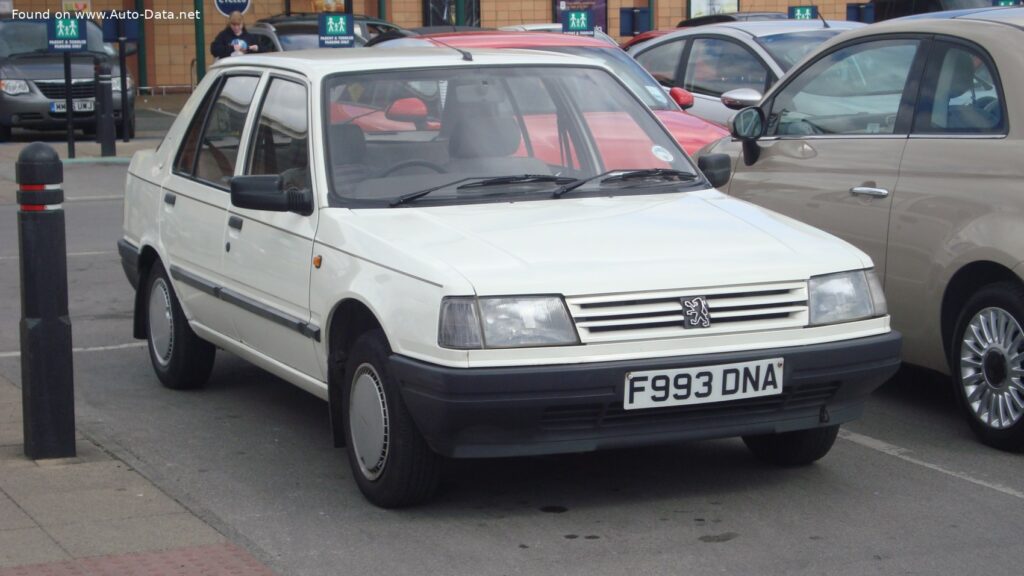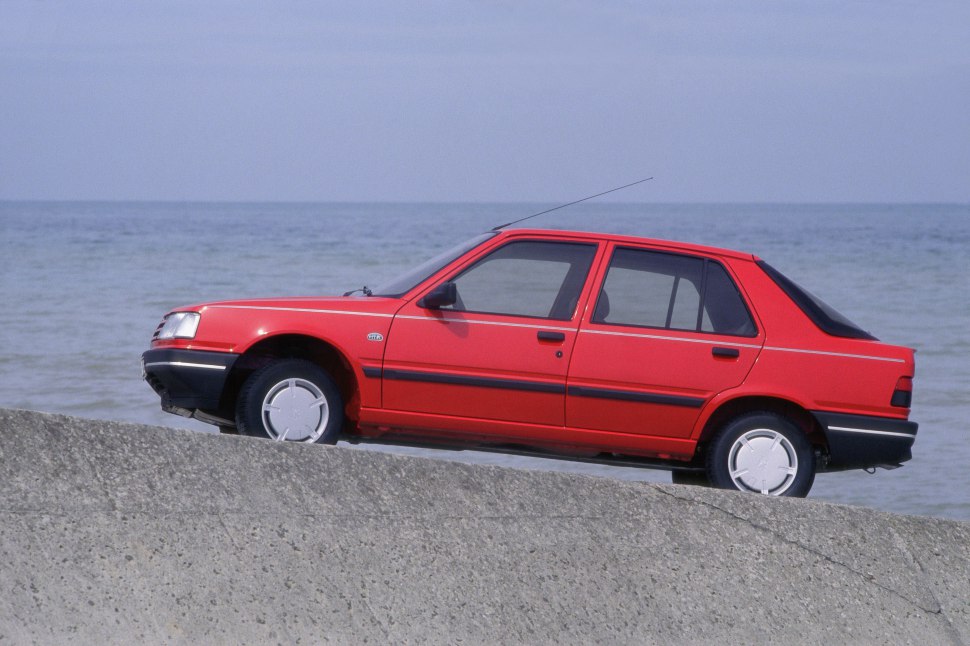
The Peugeot 309, specifically the (3C,3A facelift 1989) 1.6i (88 Hp) variant, represents a significant chapter in the European automotive landscape of the late 1980s and early 1990s. While never officially imported into the United States, this compact hatchback was a staple in its primary markets, particularly across Europe, embodying Peugeot’s reputation for practical, engaging, and robust small family cars. Introduced as a facelifted model in 1989, it aimed to refine the original 309’s design and enhance its mechanical package, ensuring its competitiveness in a fiercely contested segment. Positioned between the smaller 205 and the larger 405, the 309 filled a crucial niche, offering a blend of compact dimensions with commendable interior space and a driving experience that often exceeded expectations for its class. Its production run from 1989 to 1993 saw it evolve as a versatile and economical choice for a wide range of drivers, from young families to commuters seeking reliability and efficiency.
Engine and Performance of the Peugeot 309
At the heart of the 1989 Peugeot 309 (3C,3A facelift 1989) 1.6i (88 Hp) was a naturally aspirated 1.6-liter (1580 cubic centimeters or 96.42 cubic inches) inline four-cylinder engine, designated by the code BDY XU5M3Z. This powerplant, a testament to Peugeot’s engineering prowess during that era, was configured with a front, transverse layout, driving the front wheels. Featuring an OHC (Overhead Camshaft) valvetrain and two valves per cylinder, it was a straightforward yet effective design, prioritizing reliability and smooth power delivery over outright complexity. Fueling was managed by a multi-port manifold injection system, a modern touch for its time, ensuring efficient combustion and improved throttle response compared to carbureted predecessors.
The engine produced a respectable 88 horsepower at 6000 rpm, translating to a power-per-liter output of 55.7 horsepower per liter. More significantly for daily driving, it generated 95.88 pound-feet of torque (130 Nm) at a relatively low 2600 rpm. This low-end torque characteristic was a hallmark of Peugeot engines of the period, contributing to the car’s tractable nature in urban environments and its ability to pull strongly from lower engine speeds without excessive downshifting. The compression ratio stood at 9.2:1, a balanced figure that allowed for decent efficiency while still running on readily available petrol (gasoline).
Mated to a 5-speed manual transmission, the 1.6i (88 Hp) propelled the lightweight 309 with surprising agility for its class. With a curb weight of just 1962.11 pounds (890 kg), the car boasted a favorable weight-to-power ratio of 10.1 kg/Hp (98.9 Hp/tonne). This allowed for an acceleration from 0 to 60 mph in approximately 10 seconds, with a 0 to 62 mph (0-100 km/h) sprint completing in 10.5 seconds. The maximum speed achieved was 108.74 mph (175 km/h), making it a capable performer on European highways. Fuel economy was another strong suit, with a combined rating of 34.6 US mpg (6.8 l/100 km). Urban driving yielded 26.7 US mpg (8.8 l/100 km), while extra-urban conditions saw an impressive 44.4 US mpg (5.3 l/100 km), underscoring its economical appeal.
Design and Features of the Peugeot 309
The Peugeot 309, in its (3C,3A facelift 1989) iteration, retained the practical and understated hatchback design that characterized many European compact cars of its era. Available in both 3-door and 5-door configurations, it offered versatility for different buyer needs, catering to individuals and small families alike. The facelift introduced subtle but effective styling revisions, typically involving updated grille designs, revised lighting clusters, and minor interior enhancements to keep the model fresh and competitive. Its overall dimensions were compact yet efficient, with a length of 159.45 inches (4050 mm), a width of 64.17 inches (1630 mm), and a height of 54.33 inches (1380 mm). The wheelbase of 97.24 inches (2470 mm) contributed to a stable ride and maximized interior volume within its footprint.
Designed to accommodate five occupants, the 309 prioritized functionality and comfort. The seating position was typical for a car of its class, offering a good balance of visibility and ergonomic layout for the controls. While luxury amenities by modern standards were minimal, the focus was on durable materials and intuitive operation, reflecting the practical demands of its target market. The hatchback body style was inherently versatile, offering a generous minimum trunk (boot) space of 10.42 cubic feet (295 liters). With the rear seats folded, this expanded significantly to 21.72 cubic feet (615 liters), providing ample cargo capacity for luggage, groceries, or larger items, a crucial selling point for a family-oriented vehicle. The fuel tank capacity of 14.53 US gallons (55 liters) further enhanced its long-distance touring capabilities, aligning with its impressive extra-urban fuel economy.
Chassis, Drivetrain, and Dynamics
The driving dynamics of the Peugeot 309 were a key aspect of its appeal, building on Peugeot’s reputation for producing cars with excellent ride and handling characteristics. The drivetrain architecture was a straightforward front-wheel-drive setup, which was standard for compact cars of this period, offering predictable handling and efficient packaging. Power was delivered to the front wheels via a 5-speed manual transmission, providing the driver with direct control over the engine’s power band and contributing to the car’s engaging feel.
Suspension-wise, the 309 featured coil springs at the front, a conventional and effective design for managing road imperfections and maintaining wheel contact. At the rear, it employed a torsion bar setup, a design often favored by Peugeot for its compact packaging, which allowed for a lower load floor and thus greater trunk space, while still offering competent handling. This combination contributed to the 309’s characteristic blend of ride comfort and agile handling, a trait often praised in contemporary reviews. Steering was handled by a rack and pinion system, complemented by hydraulic power steering. This setup provided a good balance of assist for low-speed maneuvering and feedback for higher-speed driving, allowing the driver to feel connected to the road.
Braking performance was managed by disc brakes at the front and drum brakes at the rear. While drum brakes on the rear axle might seem basic by today’s standards, they were common for compact cars of the late 1980s and were perfectly adequate for the 309’s weight and performance capabilities. The car rode on 165/70 SR13 tires, offering a comfortable ride and predictable grip, suitable for its intended purpose as an everyday driver. The front track measured 55.31 inches (1405 mm) and the rear track 54.33 inches (1380 mm), contributing to the car’s stable stance on the road.
Market Context and Legacy of the Peugeot 309
The Peugeot 309 holds a unique place in the brand’s history, originally conceived as a replacement for the Talbot Horizon, a car inherited by Peugeot after its acquisition of Chrysler Europe (formerly Simca). It was initially intended to be branded as a Talbot, but Peugeot ultimately decided to market it under its own marque, slotting it into the lineup as a slightly larger and more practical alternative to the wildly popular 205 hatchback, while sitting below the executive 405 sedan. This strategic positioning allowed the 309 to capture a broad segment of the European market, appealing to those who needed more space than a supermini but perhaps didn’t require the full size of a traditional compact family car.
Its robust mechanicals, shared with other successful Peugeot models, and its reputation for a comfortable yet dynamic ride contributed to its popularity. The 1989 facelift, in particular, helped to modernize its aesthetics and refine its driving experience, ensuring it remained competitive against rivals from Ford, Volkswagen, and Renault. Though its production ended in 1993, making way for the highly successful Peugeot 306, the 309 left a legacy as a dependable, efficient, and enjoyable-to-drive vehicle that exemplified Peugeot’s strengths in the late 20th century. It remains a cherished classic among enthusiasts in Europe, valued for its straightforward engineering, engaging handling, and practical design, a true testament to Peugeot’s engineering philosophy of the era.
Technical Specifications: Peugeot 309 (3C,3A facelift 1989) 1.6i (88 Hp)
| Brand | Peugeot |
| Model | 309 |
| Generation | 309 (3C,3A facelift 1989) |
| Type (Engine) | 1.6i (88 Hp) |
| Start of production | 1989 year |
| End of production | 1993 year |
| Powertrain Architecture | Internal Combustion engine |
| Body type | Hatchback |
| Seats | 5 |
| Doors | 3-5 |
| Fuel consumption (economy) – urban | 8.8 l/100 km (26.7 US mpg | 32.1 UK mpg) |
| Fuel consumption (economy) – extra urban | 5.3 l/100 km (44.4 US mpg | 53.3 UK mpg) |
| Fuel consumption (economy) – combined | 6.8 l/100 km (34.6 US mpg | 41.5 UK mpg) |
| Fuel Type | Petrol (Gasoline) |
| Acceleration 0 – 100 km/h | 10.5 sec |
| Acceleration 0 – 62 mph | 10.5 sec |
| Acceleration 0 – 60 mph (Calculated) | 10 sec |
| Maximum speed | 175 km/h (108.74 mph) |
| Weight-to-power ratio | 10.1 kg/Hp (98.9 Hp/tonne) |
| Weight-to-torque ratio | 6.8 kg/Nm (146.1 Nm/tonne) |
| Power | 88 Hp @ 6000 rpm |
| Power per litre | 55.7 Hp/l |
| Torque | 130 Nm @ 2600 rpm (95.88 lb.-ft. @ 2600 rpm) |
| Engine layout | Front, Transverse |
| Engine Model/Code | BDY XU5M3Z |
| Engine displacement | 1580 cm3 (96.42 cu. in.) |
| Number of cylinders | 4 |
| Engine configuration | Inline |
| Cylinder Bore | 83 mm (3.27 in.) |
| Piston Stroke | 73 mm (2.87 in.) |
| Compression ratio | 9.2:1 |
| Number of valves per cylinder | 2 |
| Fuel injection system | Multi-port manifold injection |
| Engine aspiration | Naturally aspirated engine |
| Valvetrain | OHC |
| Engine oil capacity | 4 l (4.23 US qt | 3.52 UK qt) |
| Coolant | 7.5 l (7.93 US qt | 6.6 UK qt) |
| Kerb Weight | 890 kg (1962.11 lbs.) |
| Max. weight | 1330 kg (2932.15 lbs.) |
| Max load | 440 kg (970.03 lbs.) |
| Trunk (boot) space – minimum | 295 l (10.42 cu. ft.) |
| Trunk (boot) space – maximum | 615 l (21.72 cu. ft.) |
| Fuel tank capacity | 55 l (14.53 US gal | 12.1 UK gal) |
| Length | 4050 mm (159.45 in.) |
| Width | 1630 mm (64.17 in.) |
| Height | 1380 mm (54.33 in.) |
| Wheelbase | 2470 mm (97.24 in.) |
| Front track | 1405 mm (55.31 in.) |
| Rear (Back) track | 1380 mm (54.33 in.) |
| Drivetrain Architecture | The Internal combustion engine (ICE) drives the front wheels of the vehicle. |
| Drive wheel | Front wheel drive |
| Number of gears and type of gearbox | 5 gears, manual transmission |
| Front suspension | Coil spring |
| Rear suspension | Torsion |
| Front brakes | Disc |
| Rear brakes | Drum |
| Steering type | Steering rack and pinion |
| Power steering | Hydraulic Steering |
| Tires size | 165/70 SR13 |