
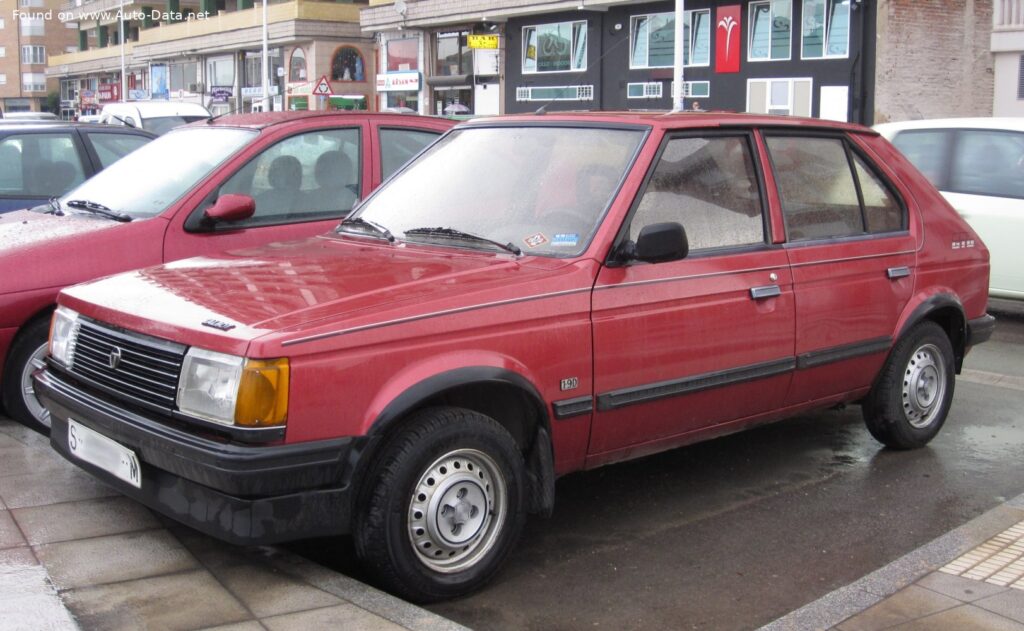
The Talbot Horizon 1.3 (54 Hp) represents a significant chapter in European automotive history, emerging as a compact family hatchback during a period of considerable flux in the industry. Launched in 1981, this particular variant was part of the Horizon generation, a model initially developed under Chrysler Europe before the division was acquired by PSA Peugeot Citroën in 1978. As such, the Horizon was marketed under various badges—Chrysler, Simca, and eventually Talbot—reflecting its complex lineage. Primarily aimed at the European market, the Horizon was conceived as a practical, economical, and spacious vehicle designed to compete in the highly contested C-segment, a class dominated by popular models like the Volkswagen Golf and Ford Escort. Its introduction marked Talbot’s re-entry into the mainstream compact car segment, following the successful but aging Simca 1100. The 1.3-liter variant, with its modest 54 horsepower, underscored the model’s emphasis on fuel efficiency and affordability, characteristics highly valued by consumers in the early 1980s amid global economic shifts and rising fuel prices. This focus positioned the Horizon as a sensible choice for families seeking reliable and cost-effective transportation, rather than a performance-oriented machine.
The Talbot Horizon: European Engineering for the Masses
The Talbot Horizon’s journey began as the “C2-Simca” project within Chrysler Europe, intended to replace the long-running Simca 1100 and the larger Simca 1307/1308 (Chrysler Alpine/Talbot Alpine). Its development was an international affair, with significant input from French and British engineering teams, culminating in a design that sought to blend practicality with contemporary styling. Upon its launch, the Horizon quickly garnered attention, notably winning the prestigious European Car of the Year award in 1979, a testament to its forward-thinking design and packaging at the time. This award highlighted its competitive edge in a crowded market, signaling its potential as a strong contender. However, the brand identity shifts and the economic challenges faced by PSA in the early 1980s meant the Horizon’s full potential was somewhat hampered by a lack of consistent marketing and investment. Despite these hurdles, the Horizon established itself as a common sight on European roads, admired for its comfortable ride, generous interior space, and straightforward mechanicals, all of which contributed to its appeal as a robust family car.
Engine and Performance
The heart of the Talbot Horizon 1.3 (54 Hp) was its naturally aspirated 1.3-liter (1294 cc) internal combustion engine. This powertrain architecture was a carryover from earlier Simca designs, known for its robustness and simplicity. Producing 54 horsepower, this engine was not designed for exhilarating performance but rather for dependable, economical motoring. Its modest output was entirely adequate for the urban and extra-urban driving conditions prevalent in Europe, where high-speed autobahns were less common than winding country roads and congested city streets. The naturally aspirated design meant power delivery was linear and predictable, without the complexities or additional costs associated with forced induction systems. For an average family car of the early 1980s, an engine of this specification prioritized fuel efficiency and low running costs over rapid acceleration or high top speeds. Drivers could expect a smooth, if unhurried, driving experience, with the engine proving reliable for daily commutes and family trips. The focus on practicality extended to its maintenance, with the engine’s straightforward design making it relatively easy and inexpensive to service, a significant factor for budget-conscious owners. The gasoline (petrol) fuel type was standard for the era, and the engine was typically paired with a manual transmission, further emphasizing driver engagement and fuel economy.
Design and Features
The Talbot Horizon adopted a five-door hatchback body type, a configuration that was rapidly gaining popularity in Europe for its versatility and practicality. The hatchback design offered excellent cargo flexibility, allowing for a large rear opening and foldable rear seats to expand luggage capacity, a crucial feature for families. Aesthetically, the Horizon featured a clean, somewhat boxy design characteristic of the late 1970s and early 1980s, prioritizing interior volume and visibility. Its relatively short hood and elongated cabin contributed to a spacious interior, providing comfortable seating for five passengers, a significant advantage in its segment. Large glass areas ensured good all-around visibility, enhancing safety and ease of maneuverability in urban environments. While the 1981 model year would not boast the advanced technological features of modern vehicles, its design incorporated safety considerations typical for the era, such as seatbelts for all occupants and a robust body structure designed to offer reasonable crash protection. Features were generally utilitarian, focusing on functionality rather than luxury. Owners could expect basic heating and ventilation systems, a simple radio, and manually operated windows. The interior materials, while durable, were chosen for their cost-effectiveness, reflecting the car’s position as an accessible family vehicle. Despite its humble origins, the Horizon’s design was considered modern and appealing at its launch, offering a sensible and practical package that resonated with a broad spectrum of European buyers.
Technical Specifications: Talbot Horizon 1.3 (54 Hp)
| Brand | Talbot |
| Model | Horizon |
| Generation | Horizon |
| Type (Engine) | 1.3 (54 Hp) |
| Start of production | 1981 year |
| End of production | 1986 year |
| Powertrain Architecture | Internal Combustion engine |
| Body type | Hatchback |
| Fuel Type | Petrol (Gasoline) |
| Power | 54 Hp |
| Engine aspiration | Naturally aspirated engine |
| Drivetrain | Internal Combustion engine |
