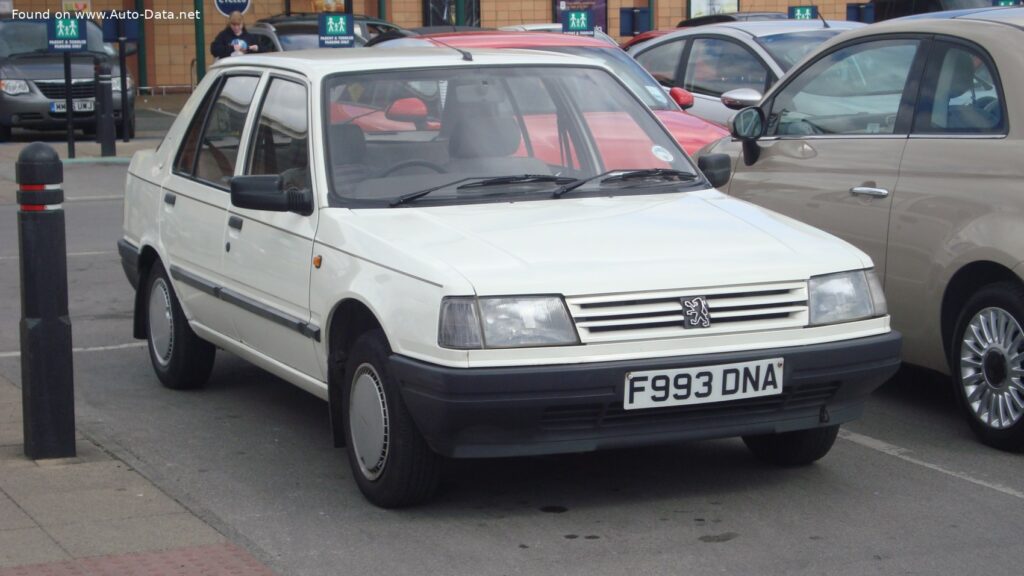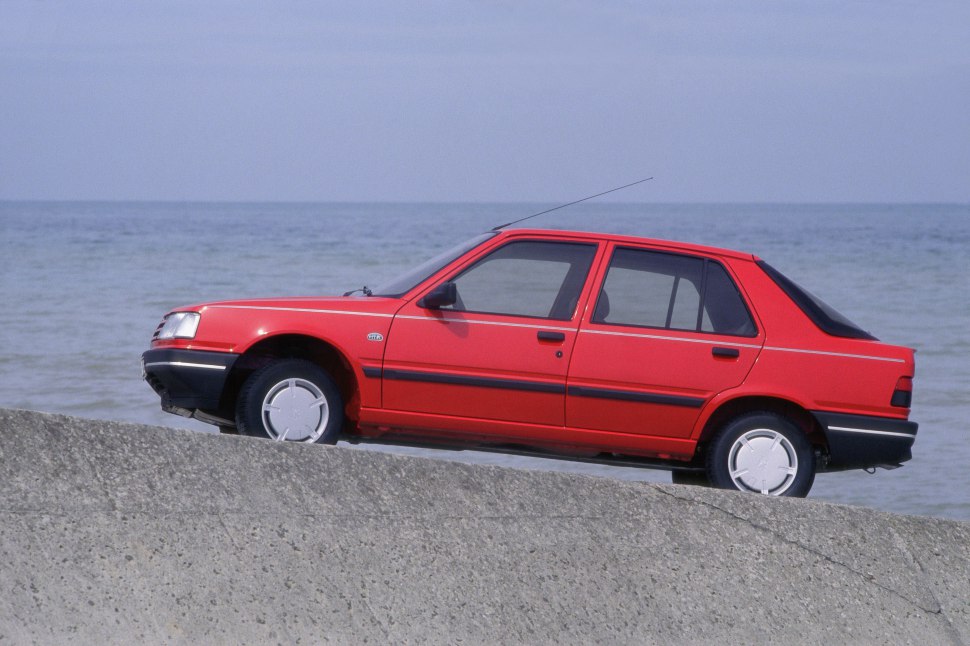
The Peugeot 309 (3C,3A facelift 1989) represents a pivotal chapter in the history of the French automaker, serving as a robust and practical offering in the highly competitive European C-segment, or compact car class, during its production run. Launched in 1985 as a replacement for the Talbot Horizon, the 309 was initially an evolution of the Horizon design, featuring a body developed by the former Chrysler Europe (later Talbot) but rebadged as a Peugeot. The facelifted generation, introduced in 1989, brought subtle but significant updates to its styling, interior, and mechanical underpinnings, solidifying its position as a reliable and economical choice for families and commuters across Europe. This particular variant, the 1.8 D (78 Hp), produced from 1989 to 1993, highlights Peugeot’s expertise in diesel engine technology, offering impressive fuel efficiency and durability that were hallmarks of the brand’s popular XUD engine family.
Engine and Performance of the Peugeot 309 (3C,3A facelift 1989)
At the heart of the 1989 facelifted Peugeot 309 1.8 D lies a highly regarded 1.8-liter (specifically, 1769 cm3 or 107.95 cu. in.) naturally aspirated diesel engine, identified by the robust A8B XUD7TE engine code. This inline-four configuration, with two valves per cylinder, was renowned for its mechanical simplicity, exceptional reliability, and impressive fuel economy, making it a favorite among European drivers prioritizing running costs and longevity. The engine delivers a respectable 78 horsepower at 4300 rpm, a solid output for a naturally aspirated diesel of its era and displacement. More significantly for daily driving, it produces a healthy 115.8 lb.-ft. of torque at a low 2100 rpm, providing ample pulling power for city driving and highway cruising, especially when paired with its relatively light curb weight.
The powertrain architecture is a conventional front-engine, transverse layout, driving the front wheels through a precise 5-speed manual transmission. This setup was standard for compact cars of the period, offering a balanced combination of efficiency and manufacturing cost. Performance figures, while not designed for outright speed, were entirely adequate for its market segment. The 309 1.8 D accelerates from 0 to 60 mph in a competitive 12.4 seconds, with a top speed of 108.74 mph. These numbers underscore its role as a practical, everyday vehicle rather than a performance machine. The weight-to-power ratio stands at 12.7 kg/Hp (78.8 Hp/tonne), while the weight-to-torque ratio is 6.3 kg/Nm (158.6 Nm/tonne), indicating that the engine’s torque delivery effectively compensates for its modest horsepower in real-world driving scenarios.
Fuel efficiency was a primary selling point for this diesel variant. The 1.8 D (78 Hp) achieved excellent consumption figures, particularly for its time. In urban driving, it returned approximately 32.7 US mpg (7.2 l/100 km), while extra-urban conditions saw it reach an impressive 48 US mpg (4.9 l/100 km). The combined cycle yielded 33.6 US mpg (7 l/100 km), showcasing its economical nature. This efficiency, coupled with a 14.53 US gallon (55-liter) fuel tank, provided a substantial driving range, reducing the frequency of fuel stops and enhancing its appeal for long-distance travel. The engine’s precombustion chamber injection system was a common and proven technology for indirect injection diesels, contributing to smoother operation and lower noise levels compared to direct injection systems that would become more prevalent in later decades. The robust design, with a compression ratio of 22:1, ensured reliable cold starts and consistent performance.
Design and Features
The Peugeot 309 (3C,3A facelift 1989) adopted a classic hatchback body type, offering both 3-door and 5-door configurations to cater to diverse customer needs. This design choice provided excellent practicality, making the vehicle versatile for both personal and family use. The exterior styling, refined with the 1989 facelift, featured a more cohesive and modern look compared to its pre-facelift iteration. While sharing some visual cues with the smaller 205 and the larger 405, the 309 carved out its own identity with clean lines and a functional aesthetic that prioritized aerodynamics and interior space. Its dimensions—159.45 inches in length, 64.17 inches in width, and 54.33 inches in height—placed it squarely in the compact segment, making it maneuverable in urban environments while still offering a comfortable ride on highways. The 97.24-inch wheelbase contributed to a stable ride and maximized interior volume for its class.
Inside, the 309 was designed to comfortably accommodate five occupants, with a focus on ergonomics and durability. While lacking the advanced infotainment systems of modern vehicles, the cabin of the 309 was characterized by its straightforward layout, clear instrumentation, and durable materials, reflecting the utilitarian demands of its primary market. Storage versatility was a key strength of the hatchback design, with a minimum trunk (boot) space of 10.42 cu. ft. (295 liters) that could expand significantly to 21.72 cu. ft. (615 liters) with the rear seats folded down, making it highly practical for carrying luggage or larger items. This flexibility was a major draw for European families and individuals who needed a car capable of handling diverse tasks, from daily commutes to weekend trips.
Underneath, the 309 featured a well-engineered chassis designed to provide a comfortable yet engaging driving experience. The front suspension utilized a coil spring setup, while the rear employed a torsion beam, a sophisticated and space-saving design that allowed for a flatter load floor and contributed to stable handling. Braking duties were handled by disc brakes at the front and drum brakes at the rear, a common and effective combination for vehicles of this size and performance level. Notably, the inclusion of ABS (Anti-lock Braking System) as an assisting system was a significant safety feature for a compact car in the late 1980s, enhancing vehicle control during emergency braking. Steering was managed by a rack and pinion system, complemented by hydraulic power steering, providing the driver with responsive feedback and ease of maneuverability. The 175/65 HR14 tire size was carefully selected to balance grip, ride comfort, and fuel efficiency, further cementing the 309’s reputation as a well-rounded and practical vehicle for its time.
Technical Specifications
| Brand | Peugeot |
| Model | 309 |
| Generation | 309 (3C,3A facelift 1989) |
| Type (Engine) | 1.8 D (78 Hp) |
| Start of production | 1989 year |
| End of production | 1993 year |
| Powertrain Architecture | Internal Combustion engine |
| Body type | Hatchback |
| Seats | 5 |
| Doors | 3-5 |
| Fuel consumption (economy) – urban | 7.2 l/100 km (32.7 US mpg) |
| Fuel consumption (economy) – extra urban | 4.9 l/100 km (48 US mpg) |
| Fuel consumption (economy) – combined | 7 l/100 km (33.6 US mpg) |
| Fuel Type | Diesel |
| Acceleration 0 – 60 mph | 12.4 sec |
| Maximum speed | 175 km/h (108.74 mph) |
| Weight-to-power ratio | 12.7 kg/Hp (78.8 Hp/tonne) |
| Weight-to-torque ratio | 6.3 kg/Nm (158.6 Nm/tonne) |
| Power | 78 Hp @ 4300 rpm |
| Power per liter | 44.1 Hp/l |
| Torque | 157 Nm (115.8 lb.-ft.) @ 2100 rpm |
| Engine layout | Front, Transverse |
| Engine Model/Code | A8B XUD7TE |
| Engine displacement | 1769 cm3 (107.95 cu. in.) |
| Number of cylinders | 4 |
| Engine configuration | Inline |
| Cylinder Bore | 80 mm (3.15 in.) |
| Piston Stroke | 88 mm (3.46 in.) |
| Compression ratio | 22:1 |
| Number of valves per cylinder | 2 |
| Fuel injection system | Precombustion chamber injection |
| Engine aspiration | Naturally aspirated engine |
| Engine oil capacity | 5 l (5.28 US qt) |
| Coolant | 8.5 l (8.98 US qt) |
| Kerb Weight | 990 kg (2182.58 lbs.) |
| Max. weight | 1400 kg (3086.47 lbs.) |
| Max load | 410 kg (903.9 lbs.) |
| Trunk (boot) space – minimum | 295 l (10.42 cu. ft.) |
| Trunk (boot) space – maximum | 615 l (21.72 cu. ft.) |
| Fuel tank capacity | 55 l (14.53 US gal) |
| Length | 4050 mm (159.45 in.) |
| Width | 1630 mm (64.17 in.) |
| Height | 1380 mm (54.33 in.) |
| Wheelbase | 2470 mm (97.24 in.) |
| Front track | 1405 mm (55.31 in.) |
| Rear (Back) track | 1380 mm (54.33 in.) |
| Drivetrain Architecture | The Internal combustion engine (ICE) drives the front wheels of the vehicle. |
| Drive wheel | Front wheel drive |
| Number of gears and type of gearbox | 5 gears, manual transmission |
| Front suspension | Coil spring |
| Rear suspension | Torsion |
| Front brakes | Disc |
| Rear brakes | Drum |
| Assisting systems | ABS (Anti-lock braking system) |
| Steering type | Steering rack and pinion |
| Power steering | Hydraulic Steering |
| Tires size | 175/65 HR14 |