
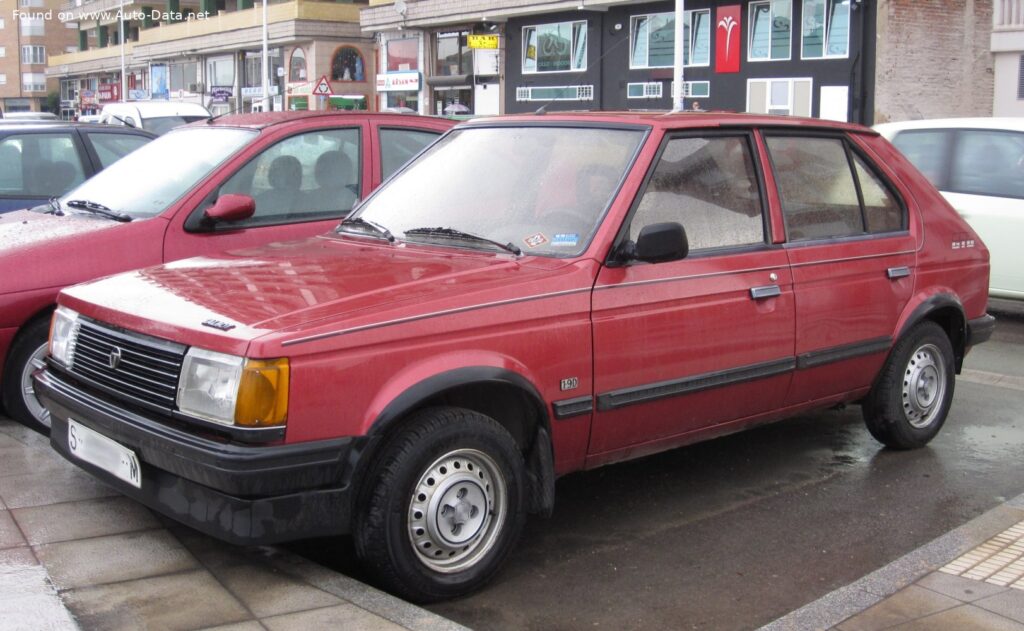
The Talbot Horizon, specifically the 1.3 (68 Hp) variant produced between 1978 and 1980, represents a significant chapter in European automotive history, marking a pivotal moment for the Chrysler Europe division before its acquisition by PSA Peugeot Citroën. Conceived as a “world car” project under the code name C2, the Horizon was designed to be a modern, front-wheel-drive compact hatchback, targeting the burgeoning European family car market. It was intended to replace the aging Simca 1100 and Chrysler Alpine (also known as Simca 1307/1308), offering a more contemporary design and improved practicality. While the Horizon was primarily a European market vehicle, its design philosophy and engineering set precedents that influenced automotive trends globally, emphasizing efficient packaging and economical operation. This particular generation, powered by its 1.3-liter gasoline engine, became a foundational model for the Talbot brand, offering a blend of affordability, spaciousness, and modest performance that appealed to a wide demographic across the continent.
The Talbot Horizon: Engineering a European Compact Pioneer
The engineering philosophy behind the Talbot Horizon was rooted in delivering a highly practical and cost-effective vehicle for the masses. Developed during an era of increasing fuel consciousness, the Horizon prioritized efficiency and interior space within a compact footprint. Its powertrain architecture, based on an internal combustion engine, utilized a transversely mounted engine driving the front wheels, a layout that had become the standard for compact cars due to its efficiency in packaging and weight distribution. This configuration allowed for a spacious cabin relative to the car’s exterior dimensions, a crucial selling point in the competitive European market where city driving and parking were daily considerations. The Horizon’s structure was designed for durability and ease of manufacture, reflecting the pragmatic approach of its creators. While not revolutionary in terms of groundbreaking technology, its engineering represented a solid, well-executed application of established principles, aimed at providing reliable and accessible transportation.
Engine and Performance Characteristics of the Talbot Horizon 1.3 (68 Hp)
At the heart of the 1978-1980 Talbot Horizon 1.3 variant was a naturally aspirated gasoline engine displacing 1.3 liters, producing a respectable 68 horsepower. This engine was a development of the well-regarded Simca Poissy engine, known for its robustness and relatively simple design, which contributed to its reliability and ease of maintenance. For its time and segment, 68 horsepower was considered adequate, providing sufficient motivation for daily commuting, city driving, and moderate highway speeds. The naturally aspirated design meant a linear power delivery, without the complexity or added cost of turbocharging, which was still a nascent technology in mass-market vehicles during the late 1970s. Fuel economy was a key consideration, and the 1.3-liter engine was tuned to offer competitive mileage, a significant factor for European consumers facing rising fuel prices. While specific torque figures are not provided, an engine of this displacement and power output typically delivered torque in the range of 70-80 lb-ft, providing decent low-end grunt for urban maneuverability. The performance, while not exhilarating, was entirely commensurate with the Horizon’s role as an economical family hatchback, focusing on practical usability rather than sporting pretensions.
Design and Features: The Practicality of the Horizon Hatchback
The Talbot Horizon’s design was a product of its era, characterized by a clean, functional aesthetic that prioritized interior volume and aerodynamic efficiency for a compact car of the late 1970s. Its body type was a hatchback, a configuration that was rapidly gaining popularity across Europe for its versatility, offering the practicality of a wagon with the compact dimensions of a sedan. The Horizon’s design, initially penned by Roy Axe’s team at Chrysler UK, featured a distinct wedge profile and large glass areas, contributing to good outward visibility for the driver. This design was not overtly flashy but exuded a sense of modernity and purpose. The five-door hatchback layout provided excellent access to both the passenger compartment and the cargo area, making it an ideal choice for families. Inside, the Horizon emphasized functionality and space. While specific luxury features were minimal for the base 1.3 (68 Hp) model, the interior was designed to be comfortable and durable, with practical upholstery materials and a straightforward dashboard layout. Instrumentation was clear and concise, providing essential information to the driver without unnecessary frills. Safety features, typical for the late 1970s, included three-point seatbelts for front occupants and a robust body structure designed to offer a degree of passive safety. The Horizon also offered a comfortable ride quality, thanks to its independent suspension setup, which was well-suited to varying European road conditions. Its practical dimensions, combined with a spacious cabin and flexible cargo area, solidified its appeal as a well-rounded family car, offering significant value in its segment.
Technical Specifications: Talbot Horizon 1.3 (68 Hp)
| Brand | Talbot |
| Model | Horizon |
| Generation | Horizon |
| Type (Engine) | 1.3 (68 Hp) |
| Start of production | 1978 year |
| End of production | 1980 year |
| Powertrain Architecture | Internal Combustion engine |
| Body type | Hatchback |
| Fuel Type | Petrol (Gasoline) |
| Power | 68 Hp |
| Engine aspiration | Naturally aspirated engine |
