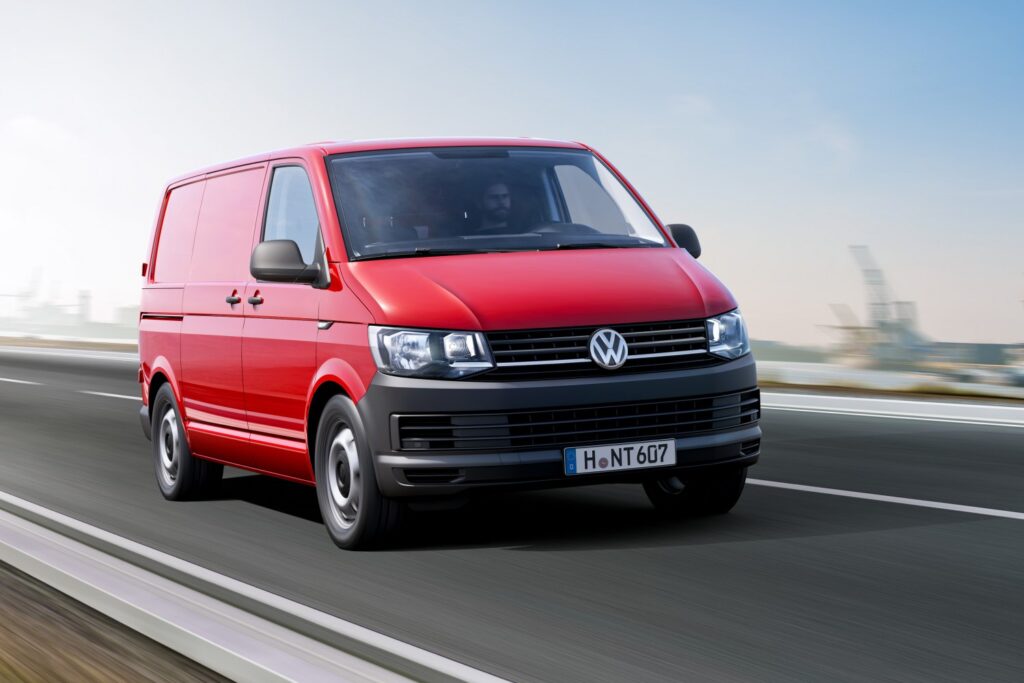
The Volkswagen Transporter (T6) Panel Van 2.0 TDI (84 Hp) L2H3, produced between 2015 and 2016, represents a crucial iteration in Volkswagen’s long-standing legacy of versatile commercial vehicles. As part of the sixth generation of the iconic Transporter series, the T6 built upon its predecessors’ reputation for robustness, practicality, and efficiency. This specific variant, designated L2H3, signifies a long wheelbase and a high roof configuration, making it a particularly capacious and functional choice for businesses across Europe and other global markets where the Transporter is a staple. While not typically sold in the United States, the Transporter series is universally recognized for setting benchmarks in the light commercial vehicle segment, embodying a blend of German engineering precision with the daily demands of professional use. This model, equipped with a 2.0-liter TDI engine producing 84 horsepower, was engineered to prioritize fuel economy and reliability over outright speed, catering directly to the operational needs of delivery services, tradespeople, and various industries requiring dependable transportation of goods and equipment.
Volkswagen Transporter (T6) Panel Van: A Legacy of Utility and Innovation
The Volkswagen Transporter lineage dates back to the original Type 2 “Bus” of the 1950s, a vehicle that became synonymous with versatility, reliability, and cultural significance. Over decades, the Transporter evolved, adapting to changing industrial needs and technological advancements. The T6 generation, launched in 2015, carried forward this rich heritage while introducing significant refinements in design, powertrain technology, and driver assistance systems. For businesses in its primary markets, particularly Europe, the Transporter (T6) Panel Van 2.0 TDI (84 Hp) L2H3 was more than just a vehicle; it was an indispensable mobile workspace and logistical partner. Its design focused on maximizing cargo space, ensuring ease of loading and unloading, and providing a comfortable, ergonomic environment for drivers who spend countless hours on the road. The T6 generation specifically aimed to enhance efficiency and reduce running costs, critical factors for commercial operators, through improved engines and aerodynamic tweaks. Its enduring popularity stems from its ability to consistently deliver on these promises, establishing itself as a benchmark in the highly competitive light commercial vehicle sector.
Powertrain and Performance: The 2.0 TDI Engine
At the heart of the Volkswagen Transporter (T6) Panel Van 2.0 TDI (84 Hp) L2H3 is a meticulously engineered 2.0-liter turbocharged direct injection (TDI) diesel engine, identified by the EA189 / CAAA code. This inline four-cylinder powerplant, featuring a DOHC (Dual Overhead Camshaft) valvetrain and a common rail fuel injection system, was designed for optimal efficiency and robust performance under varying load conditions. It delivers a modest yet highly practical 84 horsepower at 3500 rpm. More critically for a commercial vehicle, the engine produces a substantial 220 Nm (162.26 lb.-ft.) of torque, available across a broad and usable rev range from 1250 to 2500 rpm. This low-end torque is paramount for a van, enabling effortless hauling of heavy loads, confident acceleration from a standstill, and comfortable cruising without constant downshifting, even when fully laden.
The engine’s configuration, with a bore of 3.19 inches and a stroke of 3.76 inches, combined with a compression ratio of 16.5:1, is optimized for diesel combustion efficiency. A turbocharger with an intercooler ensures dense air delivery to the cylinders, enhancing power output and responsiveness while maintaining fuel economy. Mated to a durable 5-speed manual transmission, the front-wheel-drive architecture provides predictable handling and excellent traction. While acceleration from 0 to 60 mph takes approximately 19.3 seconds, and the top speed is around 84.51 mph, these figures are entirely appropriate for a vehicle whose primary role is utility rather than outright speed. The focus is squarely on reliability and cost-effective operation.
Fuel efficiency is a strong suit for this TDI variant, a vital consideration for commercial fleets. According to NEDC (New European Driving Cycle) standards, the Transporter (T6) Panel Van achieves a combined fuel economy of 31.8 to 35.1 US mpg. Urban driving yields 27 to 28.3 US mpg, while extra-urban cycles can see figures between 35.1 and 40.6 US mpg. These impressive figures are complemented by CO2 emissions ranging from 176 to 195 g/km, adhering to Euro 5 emission standards. Further enhancing its eco-credentials and operational efficiency, the vehicle incorporates a Start & Stop System and a Particulate filter, technologies aimed at reducing fuel consumption and harmful emissions, particularly in urban environments.
Design and Practicality: The L2H3 Configuration
The Volkswagen Transporter (T6) Panel Van 2.0 TDI (84 Hp) L2H3 is purpose-built for commercial applications, prioritizing cargo capacity, durability, and ease of use. The “Panel Van” designation indicates a windowless cargo area, maximizing security and load space. With 4 to 5 doors, including side sliding doors and rear barn doors (common configurations), access to the cargo bay is highly flexible. The cabin typically accommodates 2 to 3 occupants, providing a practical workspace for the driver and crew.
The “L2H3” nomenclature is critical to understanding this variant’s utility. “L2” denotes the long wheelbase, measuring 133.86 inches (3400 mm), which contributes significantly to vehicle stability and, more importantly, to the generous cargo volume. “H3” signifies the high roof configuration, resulting in an overall height of 97.52 inches (2477 mm). This combination translates into an exceptional maximum trunk (boot) space of 9300 liters, or 328.43 cubic feet, allowing for the transport of bulky items and tall equipment that would not fit in standard roof vans. The overall length of the vehicle is 208.82 inches (5304 mm), with a width of 74.96 inches (1904 mm), expanding to 90.43 inches (2297 mm) including mirrors, ensuring a substantial footprint for its carrying capabilities.
The robust construction is evident in its weight specifications. The kerb weight ranges from 3829.43 to 4528.29 lbs (1737-2054 kg), while the maximum permissible weight (GVW) is between 6172.94 and 6613.87 lbs (2800-3000 kg). This allows for a substantial maximum payload capacity of 2085.57 to 2343.51 lbs (946-1063 kg), making it suitable for a wide array of trade and delivery tasks. Furthermore, the Transporter is a capable hauler, with a permitted trailer load of 4850.17 lbs (2200 kg) with brakes and 1653.47 lbs (750 kg) without brakes, extending its utility for businesses that need to tow additional equipment.
Underneath, the chassis is designed for a balance of load-carrying capability and driving comfort. The front suspension employs an independent McPherson strut system with coil springs and an anti-roll bar, providing responsive steering and good road holding. The rear features an independent coil spring setup with wishbones and a transverse stabilizer, which is crucial for maintaining stability and comfort even when the van is heavily loaded. Stopping power comes from ventilated disc brakes both at the front (308×29.5 mm) and rear (294×22 mm), complemented by an Anti-lock Braking System (ABS) for enhanced safety and control during braking. The hydraulic rack and pinion steering system, paired with 215/65 R16 tires on 6.5J x 16 wheel rims, ensures precise handling and maneuverability, even with a turning circle of 43.31 feet (13.2 m), which is commendable for a vehicle of its size. With a ground clearance of 7.95 inches (202 mm) and practical approach, departure, and ramp-over angles, the T6 is equipped to handle various road conditions encountered in urban and light-duty off-road commercial environments.
Technical Specifications
| Brand | Volkswagen |
| Model | Transporter |
| Generation | Transporter (T6) Panel Van |
| Type (Engine) | 2.0 TDI (84 Hp) L2H3 |
| Start of production | 2015 year |
| End of production | 2016 year |
| Powertrain Architecture | Internal Combustion engine |
| Body type | Van |
| Seats | 2-3 |
| Doors | 4-5 |
| Fuel consumption (economy) – urban (NEDC) | 28.3 – 27 US mpg |
| Fuel consumption (economy) – extra urban (NEDC) | 40.6 – 35.1 US mpg |
| Fuel consumption (economy) – combined (NEDC) | 35.1 – 31.8 US mpg |
| CO2 emissions (NEDC) | 176-195 g/km |
| Fuel Type | Diesel |
| Acceleration 0 – 60 mph | 19.3 sec |
| Maximum speed | 84.51 mph |
| Emission standard | Euro 5 |
| Weight-to-power ratio | 20.7 kg/Hp, 48.4 Hp/tonne |
| Weight-to-torque ratio | 7.9 kg/Nm, 126.7 Nm/tonne |
| Power | 84 Hp @ 3500 rpm |
| Power per liter | 42.7 Hp/l |
| Torque | 162.26 lb.-ft. @ 1250-2500 rpm |
| Engine layout | Front, Transverse |
| Engine Model/Code | EA189 / CAAA |
| Engine displacement | 2.0 l (120.09 cu. in.) |
| Number of cylinders | 4 |
| Engine configuration | Inline |
| Cylinder Bore | 3.19 in. |
| Piston Stroke | 3.76 in. |
| Compression ratio | 16.5:1 |
| Number of valves per cylinder | 4 |
| Fuel injection system | Diesel Commonrail |
| Engine aspiration | Turbocharger, Intercooler |
| Valvetrain | DOHC |
| Engine oil capacity | 7.4 US qt |
| Engine systems | Start & Stop System, Particulate filter |
| Kerb Weight | 3829.43 – 4528.29 lbs |
| Max. weight | 6172.94 – 6613.87 lbs |
| Max load | 2085.57 – 2343.51 lbs |
| Trunk (boot) space – maximum | 328.43 cu. ft. |
| Fuel tank capacity | 21.13 US gal |
| Permitted trailer load with brakes (12%) | 4850.17 lbs |
| Permitted trailer load without brakes | 1653.47 lbs |
| Permitted towbar download | 220.46 lbs |
| Length | 208.82 in. |
| Width | 74.96 in. |
| Width including mirrors | 90.43 in. |
| Height | 97.52 in. |
| Wheelbase | 133.86 in. |
| Front overhang | 35.75 in. |
| Rear overhang | 39.09 in. |
| Ride height (ground clearance) | 7.95 in. |
| Minimum turning circle (turning diameter) | 43.31 ft. |
| Approach angle | 21.2° |
| Departure angle | 16.2° |
| Ramp-over (brakeover) angle | 12.2° |
| Drivetrain Architecture | Front wheel drive, Internal Combustion engine |
| Drive wheel | Front wheel drive |
| Number of gears and type of gearbox | 5 gears, manual transmission |
| Front suspension | Independent, type McPherson with coil spring and anti-roll bar |
| Rear suspension | Independent coil spring, Wishbone, Transverse stabilizer |
| Front brakes | Ventilated discs, 308×29.5 mm |
| Rear brakes | Ventilated discs, 294×22 mm |
| Assisting systems | ABS (Anti-lock braking system) |
| Steering type | Steering rack and pinion |
| Power steering | Hydraulic Steering |
| Tires size | 215/65 R16 |
| Wheel rims size | 6.5J x 16 |