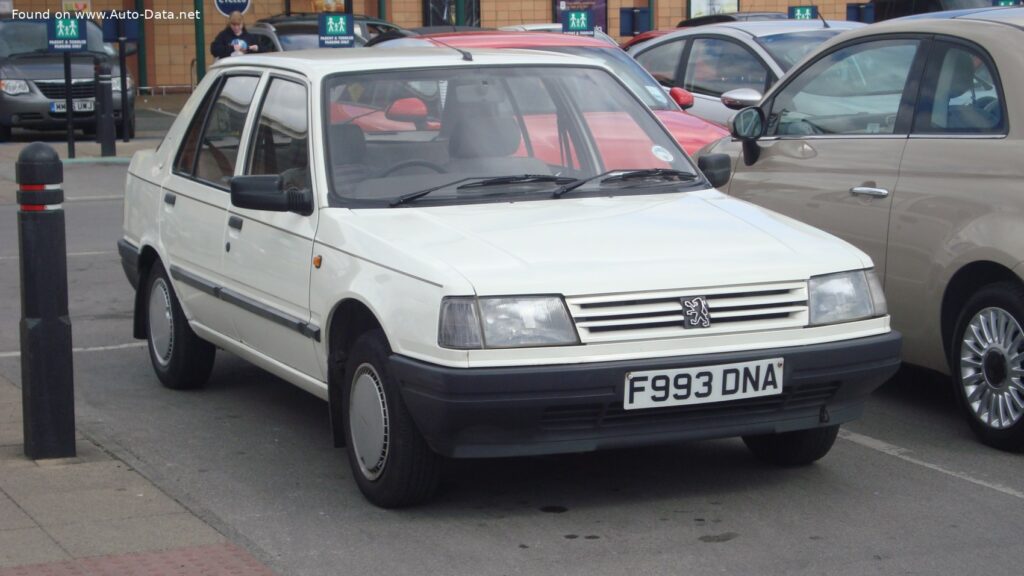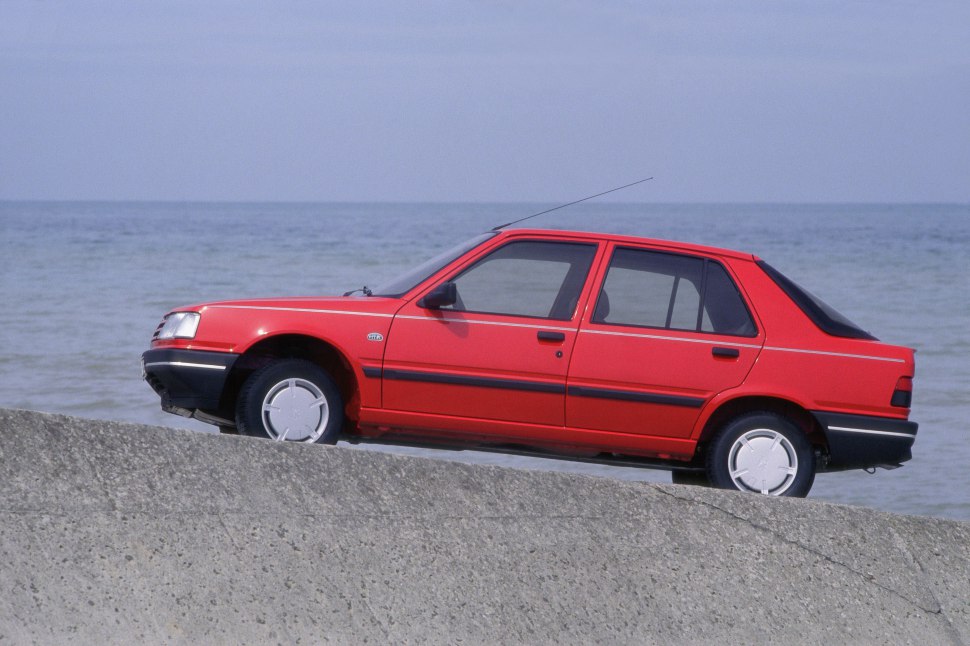
The Peugeot 309 (3C,3A facelift 1989) emerges as a quintessential example of European compact automotive engineering from the late 1980s and early 1990s. This particular variant, powered by a 1.9-liter (109 Hp) automatic powertrain, represents a mid-cycle refresh of a model that filled a crucial niche in Peugeot’s lineup. Produced between 1990 and 1993, this generation of the 309, specifically the facelifted 3C,3A series, continued the brand’s tradition of offering practical, engaging, and well-designed vehicles to the mass market, primarily across Europe. Unlike many of its contemporaries that were destined for global markets, the 309 remained predominantly a European affair, succeeding the Talbot Horizon and slotting between the immensely popular 205 supermini and the larger 405 family sedan. Its development history is noteworthy, having originally been conceived as a Talbot model before being rebadged under the Peugeot marque, showcasing the brand’s strategic consolidation during that era. The 309 was lauded for its blend of driving dynamics, interior space relative to its footprint, and a robust mechanical package, making it a competitive offering in the highly contested C-segment of its time.
The Peugeot 309 (3C,3A facelift 1989): A European Compact Icon
The Peugeot 309 holds a unique position in the brand’s history, bridging the transition from the Talbot brand to a fully consolidated Peugeot lineup. Launched in 1985, the 309 was initially a pragmatic choice for Peugeot, utilizing components from the 205 and 405 to create a cost-effective yet distinctive model. The 1989 facelift, designated as the 3C,3A series, brought a series of refinements that enhanced its appeal and longevity. These updates included subtle exterior styling tweaks, such as a revised front grille and taillight clusters, alongside interior improvements aimed at modernizing the cabin and improving ergonomics. Crucially, the facelift also introduced mechanical updates, ensuring the 309 remained competitive against increasingly sophisticated rivals from Volkswagen, Ford, and Renault. This particular 1.9-liter automatic variant, produced from 1990 to 1993, exemplified the blend of practicality and accessible performance that characterized the 309’s appeal to a broad spectrum of European buyers. While never officially imported to the United States, the 309’s DNA, particularly its lightweight construction and adept chassis tuning, reflected the engineering prowess that garnered Peugeot considerable success in rallying and road car performance during this period.
Powertrain and Performance
At the heart of the 1990-1993 Peugeot 309 (3C,3A facelift 1989) 1.9 Automatic lies a robust 1.9-liter (1905 cm³, 116.25 cu. in.) naturally aspirated inline-four gasoline engine, internally designated as the DDZ XU9M. This engine, a staple in various Peugeot and Citroën models of the era, was renowned for its durability and smooth power delivery. In this application, it produced a respectable 109 horsepower at 6000 rpm and 118.01 lb.-ft. of torque (160 Nm) at a relatively low 3000 rpm. The power output, combined with the vehicle’s remarkably light curb weight of just 2006.21 lbs (910 kg), resulted in an impressive weight-to-power ratio of 8.3 kg/Hp (119.8 Hp/tonne). This allowed the 309 to achieve a 0-60 mph acceleration time of 9.3 seconds (0-100 km/h in 9.8 seconds) and a top speed of 119.3 mph (192 km/h), figures that were highly competitive for a compact automatic hatchback in the early 1990s. The engine’s configuration featured two valves per cylinder and a compression ratio of 9.1:1, fed by a carburettor fuel injection system, a common setup before the widespread adoption of multi-point electronic fuel injection. The engine oil capacity was 4.23 US quarts (4 liters), and the cooling system held 7.93 US quarts (7.5 liters) of coolant, indicating a well-engineered thermal management system for sustained performance.
Power was transferred to the front wheels via a 4-speed automatic transmission, offering a smooth and convenient driving experience, particularly in urban environments. While a manual transmission would have offered slightly sharper acceleration, the automatic variant provided a comfortable alternative without significantly compromising the car’s spirited character. Fuel economy for this specific model was rated at 33.6 US mpg (7 l/100 km) combined, with urban consumption at 25.3 US mpg (9.3 l/100 km) and extra-urban at an impressive 42.8 US mpg (5.5 l/100 km). These efficiency figures were commendable for a gasoline engine of its size and power output in the early 1990s, underscoring Peugeot’s engineering focus on balancing performance with practical running costs. The 55-liter (14.53 US gallon) fuel tank provided a decent cruising range, making the 309 suitable for both daily commutes and longer journeys across the continent.
Design, Ergonomics, and Features
The Peugeot 309 (3C,3A facelift 1989) was offered as a versatile 3-door or 5-door hatchback, a body style highly favored in Europe for its blend of compact dimensions and practical cargo capacity. Measuring 159.45 inches (4050 mm) in length, 64.17 inches (1630 mm) in width, and 54.33 inches (1380 mm) in height, the 309 possessed a compact footprint that made it agile in city traffic and easy to park. Its 97.24-inch (2470 mm) wheelbase contributed to a stable ride and a surprisingly spacious cabin for five occupants. The design, while distinctly Peugeot, featured a more angular and conventional profile compared to the more radical 205, reflecting its role as a more practical family car. The 1989 facelift brought subtle aesthetic enhancements, ensuring the car remained fresh and appealing.
Inside, the 309 offered a functional and straightforward interior typical of French cars of its era. The five-seat configuration provided adequate comfort, with upholstery and trim levels varying depending on the specific market and option packages. Cargo capacity was a significant strong point for the hatchback, offering a minimum of 10.42 cu. ft. (295 liters) with the rear seats up, expandable to a generous 21.72 cu. ft. (615 liters) when the rear seats were folded down. This flexibility made the 309 a highly practical choice for families and individuals needing versatile cargo solutions. From a safety perspective, the inclusion of ABS (Anti-lock Braking System) as an assisting system was a notable feature for a compact car in the early 1990s, enhancing braking control and safety in emergency situations. The car was equipped with disc brakes at the front and drum brakes at the rear, a common and effective setup for vehicles of its class.
Chassis and Dynamics
The driving dynamics of the Peugeot 309 were a testament to the brand’s reputation for producing cars with excellent ride and handling characteristics. The front-wheel-drive architecture, combined with a well-sorted suspension system, delivered a balance of comfort and agility. The front suspension utilized coil springs, a conventional and effective design for passenger cars. At the rear, the 309 featured a torsion beam suspension, a compact and space-efficient design that also contributed to responsive handling and a relatively flat ride. This combination of suspension components, along with a front track of 55.31 inches (1405 mm) and a rear track of 54.33 inches (1380 mm), provided the 309 with a stable and predictable demeanor on the road. The steering system was a rack and pinion type, augmented by hydraulic power steering. This hydraulic assistance offered good feedback to the driver, a characteristic often praised in Peugeots of this generation, making the car feel engaging and precise through corners while still being manageable during low-speed maneuvers. The 13-inch wheel rims, shod with 165/70 TR13 tires, were appropriate for the vehicle’s size and performance, offering a good balance of grip and ride comfort. The overall chassis tuning reinforced the 309’s image as a driver’s car, capable of handling spirited driving while remaining comfortable for everyday use, a hallmark of Peugeot’s engineering philosophy.
Technical Specifications
| Brand | Peugeot |
| Model | 309 |
| Generation | 309 (3C,3A facelift 1989) |
| Type (Engine) | 1.9 (109 Hp) Automatic |
| Start of production | 1990 year |
| End of production | 1993 year |
| Powertrain Architecture | Internal Combustion engine |
| Body type | Hatchback |
| Seats | 5 |
| Doors | 3-5 |
| Fuel consumption (economy) – urban | 9.3 l/100 km (25.3 US mpg, 30.4 UK mpg, 10.8 km/l) |
| Fuel consumption (economy) – extra urban | 5.5 l/100 km (42.8 US mpg, 51.4 UK mpg, 18.2 km/l) |
| Fuel consumption (economy) – combined | 7 l/100 km (33.6 US mpg, 40.4 UK mpg, 14.3 km/l) |
| Fuel Type | Petrol (Gasoline) |
| Acceleration 0 – 100 km/h | 9.8 sec |
| Acceleration 0 – 62 mph | 9.8 sec |
| Acceleration 0 – 60 mph (Calculated) | 9.3 sec |
| Maximum speed | 192 km/h (119.3 mph) |
| Weight-to-power ratio | 8.3 kg/Hp, 119.8 Hp/tonne |
| Weight-to-torque ratio | 5.7 kg/Nm, 175.8 Nm/tonne |
| Power | 109 Hp @ 6000 rpm. |
| Power per litre | 57.2 Hp/l |
| Torque | 160 Nm @ 3000 rpm. (118.01 lb.-ft. @ 3000 rpm.) |
| Engine layout | Front, Transverse |
| Engine Model/Code | DDZ XU9M |
| Engine displacement | 1905 cm3 (1.9 l, 116.25 cu. in.) |
| Number of cylinders | 4 |
| Engine configuration | Inline |
| Cylinder Bore | 83 mm (3.27 in.) |
| Piston Stroke | 88 mm (3.46 in.) |
| Compression ratio | 9.1:1 |
| Number of valves per cylinder | 2 |
| Fuel injection system | Carburettor |
| Engine aspiration | Naturally aspirated engine |
| Engine oil capacity | 4 l (4.23 US qt | 3.52 UK qt) |
| Coolant | 7.5 l (7.93 US qt | 6.6 UK qt) |
| Kerb Weight | 910 kg (2006.21 lbs.) |
| Max. weight | 1350 kg (2976.24 lbs.) |
| Max load | 440 kg (970.03 lbs.) |
| Trunk (boot) space – minimum | 295 l (10.42 cu. ft.) |
| Trunk (boot) space – maximum | 615 l (21.72 cu. ft.) |
| Fuel tank capacity | 55 l (14.53 US gal | 12.1 UK gal) |
| Length | 4050 mm (159.45 in.) |
| Width | 1630 mm (64.17 in.) |
| Height | 1380 mm (54.33 in.) |
| Wheelbase | 2470 mm (97.24 in.) |
| Front track | 1405 mm (55.31 in.) |
| Rear (Back) track | 1380 mm (54.33 in.) |
| Drivetrain Architecture | The Internal combustion engine (ICE) drives the front wheels of the vehicle. |
| Drive wheel | Front wheel drive |
| Number of gears and type of gearbox | 4 gears, automatic transmission |
| Front suspension | Coil spring |
| Rear suspension | Torsion |
| Front brakes | Disc |
| Rear brakes | Drum |
| Assisting systems | ABS (Anti-lock braking system) |
| Steering type | Steering rack and pinion |
| Power steering | Hydraulic Steering |
| Tires size | 165/70 TR13 |
| Wheel rims size | 13 |