The Toyota Sprinter Trueno 1.5 i (105 Hp), produced from 1995 to 2002, represents a significant chapter in the history of compact sports coupes, particularly within the Japanese Domestic Market (JDM). While largely unknown in the United States, this iteration of the Sprinter Trueno, often associated with the AE110/AE111 chassis generation, continued a legacy of agile, front-wheel-drive vehicles designed for spirited driving and everyday practicality. It carved out its niche as a stylish and efficient two-door coupe, offering a blend of Toyota’s renowned reliability with a focus on a dynamic driving experience tailored for its primary Asian markets. This model, specifically equipped with the 1.5-liter inline-four engine, balanced performance with fuel economy, making it a popular choice among enthusiasts and daily drivers alike who appreciated its nimble handling and responsive powertrain.
Engine & Performance: The Heart of the Toyota Sprinter Trueno
At the core of the Toyota Sprinter Trueno 1.5 i (105 Hp) lies a meticulously engineered 1.5-liter (1497 cm3 or 91.35 cu. in.) naturally aspirated inline-four engine. This powerplant, designated by its “i” suffix, utilizes a multi-port manifold injection system for precise fuel delivery, ensuring efficient combustion and a smooth powerband. With a DOHC (Double Overhead Camshaft) valvetrain and four valves per cylinder, this engine was designed for optimal airflow and responsiveness, a hallmark of Toyota’s engineering philosophy during this era. It delivers a respectable 105 horsepower at a relatively high 6400 rpm, indicating a free-revving nature that encourages drivers to explore the upper reaches of the tachometer. Torque output stands at 127 Nm (93.67 lb.-ft.) available at a lower 3200 rpm, providing a useful surge of power in the mid-range for everyday driving and urban maneuvers.
The engine’s front-transverse layout and front-wheel-drive (FWD) architecture contribute to the vehicle’s efficient packaging and predictable handling characteristics. This configuration, common in compact cars, allows for a spacious interior relative to its external dimensions and offers inherent stability. The compression ratio of 9.4:1 is well-suited for regular unleaded gasoline, making the vehicle practical and economical to operate. Despite its modest power figures by modern standards, the Sprinter Trueno’s light curb weight of 2270.76 lbs (1030 kg) translates to an impressive weight-to-power ratio of 9.8 kg/Hp (101.9 Hp/tonne). This favorable power-to-weight balance ensures lively acceleration and an engaging driving feel, making the most of its 105 horsepower. The weight-to-torque ratio is similarly optimized at 8.1 kg/Nm (123.3 Nm/tonne), highlighting the engine’s ability to move the lightweight chassis with relative ease. This combination of a rev-happy engine and a lightweight chassis made the Sprinter Trueno a joy to drive on winding roads and in congested city environments, embodying the spirit of accessible performance.
Design & Features: A Compact Coupe Aesthetic
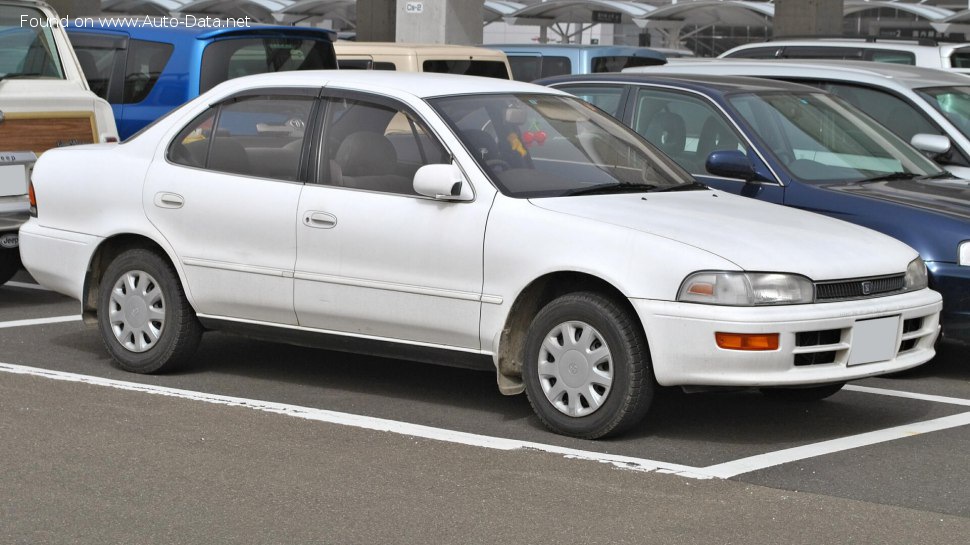
The Toyota Sprinter Trueno 1.5 i (105 Hp) sports a classic coupe body type, characterized by its sleek, two-door profile and a design language that was contemporary for the mid-to-late 1990s. Its compact dimensions were perfectly suited for the urban landscapes of Japan and other Asian markets, where maneuverability and efficient use of space are paramount. The vehicle measures 169.29 inches (4300 mm) in length, 66.73 inches (1695 mm) in width, and 51.38 inches (1305 mm) in height. These proportions, combined with a wheelbase of 97.05 inches (2465 mm), contribute to its agile stance and responsive handling. The relatively wide front track of 57.87 inches (1470 mm) and rear track of 57.48 inches (1460 mm) further enhance its stability and road-holding capabilities.
Despite its compact exterior, the Sprinter Trueno coupe was designed to accommodate five occupants, offering a practical interior for its class. The focus was on providing a comfortable yet sporty cabin environment, consistent with its target demographic. In terms of braking, the vehicle was equipped with ventilated discs at the front, offering superior heat dissipation and consistent stopping power, which is crucial for spirited driving. The rear utilized drum brakes, a cost-effective and reliable solution for a vehicle of this weight and performance class. The fuel tank capacity of 13.21 US gallons (50 liters) provided a decent range, making it suitable for both daily commuting and longer journeys. The overall design ethos of the Sprinter Trueno was one of understated sportiness, blending aerodynamic efficiency with a timeless aesthetic that continues to appeal to enthusiasts today. Its clean lines and compact footprint made it an ideal platform for personalization, a common trend within the JDM scene, further cementing its cult status.
Technical Specifications: Toyota Sprinter Trueno 1.5 i (105 Hp)
| Brand | Toyota |
| Model | Sprinter |
| Generation | Sprinter Trueno |
| Type (Engine) | 1.5 i (105 Hp) |
| Start of production | 1995 year |
| End of production | 2002 year |
| Powertrain Architecture | Internal Combustion engine |
| Body type | Coupe |
| Seats | 5 |
| Doors | 2 |
| Fuel Type | Petrol (Gasoline) |
| Weight-to-power ratio | 9.8 kg/Hp, 101.9 Hp/tonne |
| Weight-to-torque ratio | 8.1 kg/Nm, 123.3 Nm/tonne |
| Power | 105 Hp @ 6400 rpm. |
| Power per litre | 70.1 Hp/l |
| Torque | 127 Nm @ 3200 rpm (93.67 lb.-ft. @ 3200 rpm) |
| Engine layout | Front, Transverse |
| Engine displacement | 1497 cm3 (91.35 cu. in.) |
| Number of cylinders | 4 |
| Engine configuration | Inline |
| Cylinder Bore | 74 mm (2.91 in.) |
| Piston Stroke | 87 mm (3.43 in.) |
| Compression ratio | 9.4:1 |
| Number of valves per cylinder | 4 |
| Fuel injection system | Multi-port manifold injection |
| Engine aspiration | Naturally aspirated engine |
| Valvetrain | DOHC |
| Kerb Weight | 1030 kg (2270.76 lbs.) |
| Fuel tank capacity | 50 l (13.21 US gal | 11 UK gal) |
| Length | 4300 mm (169.29 in.) |
| Width | 1695 mm (66.73 in.) |
| Height | 1305 mm (51.38 in.) |
| Wheelbase | 2465 mm (97.05 in.) |
| Front track | 1470 mm (57.87 in.) |
| Rear (Back) track | 1460 mm (57.48 in.) |
| Drivetrain Architecture | The Internal combustion engine (ICE) drives the front wheels of the vehicle. |
| Drive wheel | Front wheel drive |
| Front brakes | Ventilated discs |
| Rear brakes | Drum |