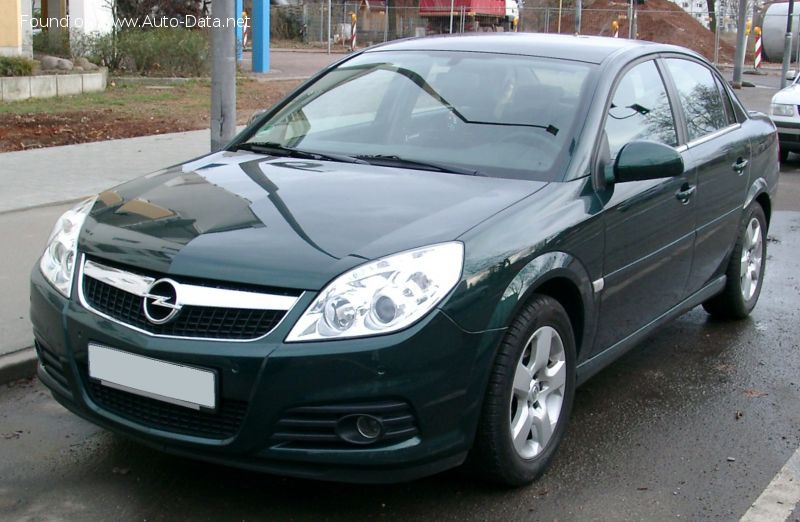
The Opel Vectra C, particularly the facelifted model introduced in November 2005, represented a significant iteration in Opel’s long-standing presence in the competitive European D-segment. Positioned as a mid-size family car, the Vectra C aimed to blend practicality, comfort, and efficient performance, catering to a broad demographic of buyers across the continent. This generation, specifically the Opel Vectra C (facelift 2005) 1.6i 16V (105 Hp) variant, served as an accessible entry point into the model range, offering a compelling package for those prioritizing economical operation and everyday usability. While never officially sold in the United States, the Vectra C was a common sight on European roads, competing fiercely with rivals such as the Ford Mondeo, Volkswagen Passat, and Renault Laguna. Its production run for this facelifted model spanned from November 2005 until June 2008, solidifying its role as a key player in Opel’s lineup during that period, delivering a balanced proposition for the discerning European motorist.
Engine and Performance: The Opel Vectra C (facelift 2005) Powertrain
At the heart of the Opel Vectra C (facelift 2005) 1.6i 16V (105 Hp) lies a robust 1.6-liter (1598 cm³ or 97.52 cu. in.) naturally aspirated inline-four gasoline engine, designated with the model code Z16XEP. This powertrain architecture, featuring a front, transverse layout, delivered a respectable 105 horsepower at 6000 rpm, a solid output for a naturally aspirated engine of its displacement at the time. Torque figures stood at 110.63 lb.-ft. (150 Nm) delivered at a relatively accessible 3900 rpm, ensuring adequate pull for daily driving scenarios. The engine’s design incorporated a Double Overhead Camshaft (DOHC) valvetrain with four valves per cylinder, facilitating efficient gas exchange and contributing to its smooth operation. Fuel delivery was managed by a multi-port manifold injection system, a proven technology that balanced performance with reliability and offered consistent power delivery throughout the rev range.
Paired with a 5-speed manual transmission, the 1.6i 16V directed its power to the front wheels, a conventional and efficient setup for a vehicle in this segment. This drivetrain configuration provided predictable handling characteristics and optimized traction under various driving conditions, a crucial aspect for a family sedan. In terms of acceleration, the Vectra C 1.6i 16V was capable of reaching 60 mph from a standstill in approximately 12 seconds, or 12.6 seconds for the 0-62 mph (0-100 km/h) sprint. While not designed for outright speed or track performance, these figures were entirely adequate for urban commuting and comfortable highway cruising, aligning perfectly with its intended market as a dependable daily driver. The top speed was rated at 120.55 mph (194 km/h), allowing for confident travel on autobahns and major European motorways.
Fuel efficiency was a key consideration for European buyers, and the Opel Vectra C (facelift 2005) 1.6i 16V (105 Hp) delivered competitive figures for its class. The combined fuel consumption was rated at 34.6 US mpg (6.8 l/100 km), with urban consumption at 25.6 US mpg (9.2 l/100 km) and extra-urban figures reaching an impressive 42.8 US mpg (5.5 l/100 km). These numbers underscored the engine’s balance of performance and economy, making it an attractive option for budget-conscious families and fleet operators seeking lower running costs. With a fuel tank capacity of 16.11 US gallons (61 liters), the Vectra C offered a commendable cruising range, reducing the frequency of fuel stops on longer journeys. The engine’s compression ratio of 10.5:1 was optimized for regular gasoline, further contributing to its cost-effectiveness and broad appeal. The weight-to-power ratio of 12.6 kg/Hp (79.2 Hp/tonne) further illustrates its practical, rather than performance-oriented, design philosophy.
Design and Features: The Practicality of the Opel Vectra C (facelift 2005)
The Opel Vectra C (facelift 2005), in its sedan body style, presented a refined and understated aesthetic that was characteristic of European mid-size cars of its era. The facelift brought subtle yet effective revisions to the exterior, typically including updated front fascias, grilles, and lighting elements, giving the car a more contemporary and sophisticated appearance that helped it stay competitive against newer designs. Its four-door, five-seat configuration emphasized practicality and passenger comfort, making it a suitable choice for families and business professionals alike who required ample space and a comfortable ride.
Measuring 181.54 inches (4611 mm) in length, 70.79 inches