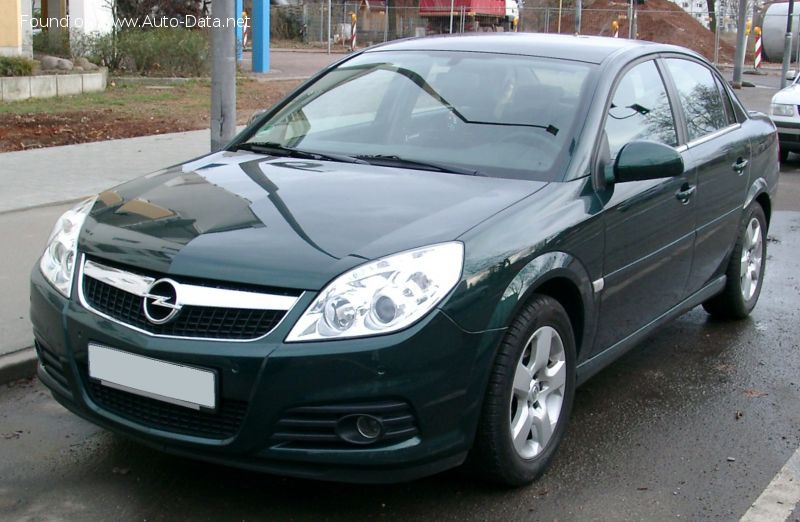
The Opel Vectra C, particularly the facelifted model introduced in November 2005, represented a significant offering in the competitive European D-segment, a category broadly equivalent to mid-size sedans in the North American market. While the Opel brand, a long-standing German marque under the General Motors umbrella, was not directly sold in the United States, its vehicles like the Vectra C played a crucial role in GM’s global strategy, serving as a benchmark for engineering and design across various international markets. The Opel Vectra C (facelift 2005) 1.8i 16V (140 Hp), specifically, was a popular choice for families and fleet operators due to its balance of performance, efficiency, and practicality. Produced from late 2005 until its discontinuation in June 2008, this iteration of the Vectra C embodied the era’s focus on refined driving dynamics, improved safety, and enhanced comfort in a conventional four-door sedan package. Its powertrain architecture relied on a conventional internal combustion engine driving the front wheels, a common and reliable configuration for its class.
Overview of the Opel Vectra C (facelift 2005) 1.8i 16V (140 Hp)
The Opel Vectra C, launched initially in 2002, received a substantial mid-cycle refresh in 2005, aiming to keep it competitive against rivals such as the Ford Mondeo, Volkswagen Passat, and Renault Laguna. This facelift brought a sharper, more contemporary aesthetic, aligning its design language with other newer Opel models of the time. The 2005 update included a redesigned front fascia with new headlights, grille, and bumper, giving the car a more assertive and modern presence. Rear light clusters also saw revision, contributing to a more cohesive overall design. Inside, minor updates to materials and trim aimed to improve perceived quality and ergonomics. The Vectra C was available in various body styles, but the 1.8i 16V (140 Hp) variant covered here is specifically a four-door sedan, designed to comfortably accommodate five occupants. Its robust construction and comprehensive feature set made it a compelling option for buyers seeking a reliable and spacious vehicle for daily commuting and longer journeys across Europe and other markets where Opel operated. The production run for this specific facelifted model lasted approximately two and a half years, indicating its transitional role before the introduction of its successor.
Engine & Performance of the Opel Vectra C (facelift 2005) 1.8i 16V (140 Hp)
At the heart of the Opel Vectra C (facelift 2005) 1.8i 16V (140 Hp) lies a naturally aspirated 1.8-liter (1796 cm3 or 109.6 cu. in.) gasoline engine, designated with the model code Z18XER. This inline four-cylinder unit, positioned transversely at the front of the vehicle, was a notable member of Opel’s Ecotec family, engineered for a balance of power, efficiency, and environmental compliance. Featuring a Double Overhead Camshaft (DOHC) valvetrain with four valves per cylinder, the engine delivered a respectable 140 horsepower at a peak of 6300 revolutions per minute. Its specific power output of 78 horsepower per liter was commendable for a non-turbocharged engine of its era. Torque production stood at 175 Nm, equivalent to 129.07 lb.-ft., available at 3800 rpm, providing a broad powerband suitable for varied driving conditions. The engine utilized a multi-port manifold injection system, a proven technology for precise fuel delivery and combustion efficiency. With a compression ratio of 10.5:1, it required standard petrol (gasoline) fuel. The powertrain was mated to a five-speed manual transmission, directing power efficiently to the front wheels, a configuration known for its reliability and direct driving feel. Performance figures for this sedan reflected its family-oriented nature rather than outright sportiness. Acceleration from 0 to 60 mph was achieved in a calculated 10.6 seconds (0-100 km/h in 11.2 seconds), with a maximum speed of 126.14 mph (203 km/h). Fuel economy, a critical factor for European consumers, was rated at an impressive 30.5 US mpg combined (7.7 l/100 km), with urban consumption at 21.8 US mpg (10.8 l/100 km) and extra-urban driving yielding 39.9 US mpg (5.9 l/100 km). These figures demonstrated the engine’s efficiency in typical driving scenarios, contributing to lower running costs and reduced emissions. The engine oil capacity was 4.5 liters, and the cooling system held 6.1 liters of coolant, indicating standard maintenance requirements for its class.
Design & Features of the Opel Vectra C (facelift 2005)
The 2005 facelift of the Opel Vectra C brought a refreshed aesthetic that enhanced its appeal in the mid-size sedan segment. Measuring 181.54 inches (4611 mm) in length, 70.79 inches (1798 mm) in width, and 57.48 inches (1460 mm) in height, the Vectra C maintained a substantial road presence. Its wheelbase of 106.3 inches (2700 mm) was generous for the class, contributing to a stable ride and ample interior space for its five occupants across four doors. The design incorporated Opel’s evolving corporate face, characterized by a prominent grille and distinctive headlight clusters that integrated seamlessly with the car’s sculpted lines. The overall silhouette remained classic sedan, prioritizing aerodynamic efficiency and passenger comfort. Inside, the cabin was designed for practicality and comfort, featuring ergonomic controls and durable materials. While specific luxury features are not detailed in the provided data, standard equipment for the D-segment in 2005 typically included air conditioning, power windows, central locking, and a competent audio system. Safety was a key consideration, with the inclusion of an Anti-lock Braking System (ABS) as standard, complemented by ventilated disc brakes at the front and solid disc brakes at the rear, ensuring confident stopping power. The suspension system was engineered for a balanced ride, utilizing a tried-and-true Spring Strut setup at the front and a sophisticated multi-link arrangement (described as “Several levers and rods”) at the rear. This combination provided a comfortable ride over varied road surfaces while maintaining competent handling characteristics. Steering was managed by a responsive rack and pinion system. The vehicle rode on 195/65 R15 tires mounted on 6.5J x 15 wheel rims, a common size for balancing ride comfort and grip. Practicality was further enhanced by a substantial trunk capacity, ranging from 17.66 cu. ft. (500 liters) with all seats in place, expanding to an impressive 37.08 cu. ft. (1050 liters) when the rear seats were folded, making it highly versatile for luggage and cargo. With a kerb weight of 3075.45 lbs. (1395 kg) and a maximum gross weight of 4122.64 lbs. (1870 kg), the Vectra C was a sturdy and capable vehicle designed to meet the demands of European drivers.
Technical Specifications
| Brand | Opel |
| Model | Vectra |
| Generation | Vectra C (facelift 2005) |
| Type (Engine) | 1.8i 16V (140 Hp) |
| Start of production | November, 2005 year |
| End of production | June, 2008 year |
| Powertrain Architecture | Internal Combustion engine |
| Body type | Sedan |
| Seats | 5 |
| Doors | 4 |
| Fuel consumption (economy) – urban | 10.8 l/100 km (21.8 US mpg) |
| Fuel consumption (economy) – extra urban | 5.9 l/100 km (39.9 US mpg) |
| Fuel consumption (economy) – combined | 7.7 l/100 km (30.5 US mpg) |
| Fuel Type | Petrol (Gasoline) |
| Acceleration 0 – 60 mph | 10.6 sec |
| Maximum speed | 126.14 mph (203 km/h) |
| Weight-to-power ratio | 10 kg/Hp, 100.4 Hp/tonne |
| Weight-to-torque ratio | 8 kg/Nm, 125.4 Nm/tonne |
| Power | 140 Hp @ 6300 rpm |
| Power per litre | 78 Hp/l |
| Torque | 129.07 lb.-ft. @ 3800 rpm (175 Nm) |
| Engine layout | Front, Transverse |
| Engine Model/Code | Z18XER |
| Engine displacement | 1.8 l (1796 cm3 / 109.6 cu. in.) |
| Number of cylinders | 4 |
| Engine configuration | Inline |
| Cylinder Bore | 3.17 in. (80.5 mm) |
| Piston Stroke | 3.47 in. (88.2 mm) |
| Compression ratio | 10.5:1 |
| Number of valves per cylinder | 4 |
| Fuel injection system | Multi-port manifold injection |
| Engine aspiration | Naturally aspirated engine |
| Valvetrain | DOHC |
| Engine oil capacity | 4.76 US qt (4.5 l) |
| Coolant | 6.45 US qt (6.1 l) |
| Kerb Weight | 3075.45 lbs. (1395 kg) |
| Max. weight | 4122.64 lbs. (1870 kg) |
| Max load | 1047.2 lbs. (475 kg) |
| Trunk (boot) space – minimum | 17.66 cu. ft. (500 l) |
| Trunk (boot) space – maximum | 37.08 cu. ft. (1050 l) |
| Fuel tank capacity | 16.11 US gal (61 l) |
| Length | 181.54 in. (4611 mm) |
| Width | 70.79 in. (1798 mm) |
| Height | 57.48 in. (1460 mm) |
| Wheelbase | 106.3 in. (2700 mm) |
| Front track | 60.47 in. (1536 mm) |
| Rear (Back) track | 60.04 in. (1525 mm) |
| Drivetrain Architecture | Internal combustion engine drives the front wheels |
| Drive wheel | Front wheel drive |
| Number of gears and type of gearbox | 5 gears, manual transmission |
| Front suspension | Spring Strut |
| Rear suspension | Several levers and rods (Multi-link) |
| Front brakes | Ventilated discs |
| Rear brakes | Disc |
| Assisting systems | ABS (Anti-lock braking system) |
| Steering type | Steering rack and pinion |
| Tires size | 195/65 R15 |
| Wheel rims size | 6.5J x 15 |