
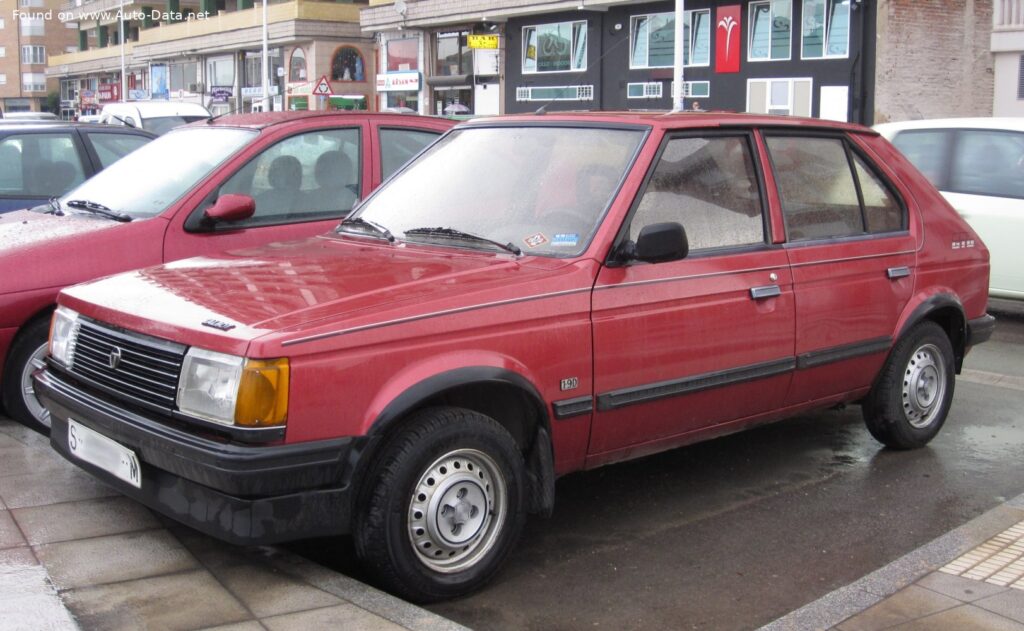
The Talbot Horizon 1.6 (90 Hp) represents a significant, if often overlooked, chapter in European automotive history, embodying the complexities and transitions of the compact car segment in the early 1980s. Launched in 1982, this particular variant of the Horizon, a five-door hatchback, was a product of the turbulent corporate landscape that saw the venerable Simca and later Chrysler Europe brands absorbed into the PSA Group (Peugeot Société Anonyme). Designed primarily for the European market, where it competed fiercely against established rivals like the Volkswagen Golf and Ford Escort, the Horizon was conceived as a practical, spacious, and economical family car. Its introduction marked a critical period for the Talbot brand, attempting to re-establish itself under PSA ownership following its acquisition of Chrysler’s European operations. The 1.6-liter engine, producing a respectable 90 horsepower, positioned this version as a well-rounded option within the Horizon lineup, offering a balance of performance and efficiency for the average European motorist.
The Genesis and Evolution of the Talbot Horizon
The story of the Talbot Horizon is deeply intertwined with the shifting alliances and corporate restructuring that characterized the European automotive industry in the 1970s and early 1980s. Originally conceived as Project C2 by Chrysler Europe, it was intended to replace the aging Simca 1100 and Chrysler Alpine (also known as the Simca 1307/1308). The Horizon debuted in 1978, first as a Simca, then as a Chrysler in Europe, and even briefly as a Dodge Omni/Plymouth Horizon in the United States, showcasing a rare transatlantic design. However, its European identity was firmly cemented when Chrysler Europe was sold to PSA Peugeot Citroën in 1978, leading to the resurrection of the Talbot brand. From 1979 onwards, the car was marketed exclusively as the Talbot Horizon across Europe, inheriting a legacy that spanned French, British, and American engineering influences.
This generational shift saw the Horizon evolve not just in branding but also in its market positioning. While its American counterparts were adapted for specific US regulations and consumer tastes, the European Talbot Horizon remained true to its original brief: a robust, front-wheel-drive compact car prioritizing interior space and practicality. The 1.6-liter variant, introduced in 1982, was a key offering during its production run until 1986. This period saw the Horizon facing increasing competition from newer, more aerodynamically styled designs, yet it maintained a loyal following due to its proven mechanics and value proposition. The car’s design, while somewhat dated by the mid-1980s, was a testament to the efficient packaging and clear sightlines that were valued in the earlier part of the decade.
Powertrain and Performance: The Talbot Horizon 1.6 (90 Hp)
At the heart of the 1982-1986 Talbot Horizon 1.6 (90 Hp) was a conventional yet reliable internal combustion engine, a staple of the era. This particular variant was equipped with a 1.6-liter (approximately 97.6 cubic inches) gasoline engine, which, through natural aspiration, delivered a healthy 90 horsepower. In the context of early 1980s compact hatchbacks, 90 horsepower was a respectable output, positioning the Horizon 1.6 as a capable performer for daily driving and longer journeys across European autobahns and country roads. The naturally aspirated design meant a simpler engine architecture, benefiting from lower manufacturing costs and generally easier maintenance compared to the more complex turbocharged engines that were just beginning to appear in some performance-oriented models of the time.
The powertrain architecture of the Horizon was entirely conventional for its class: a transversely mounted engine driving the front wheels. This layout was a hallmark of modern compact car design, offering excellent packaging efficiency, which translated directly into a spacious cabin and a relatively large cargo area for its footprint. While specific torque figures are not provided, a 1.6-liter engine of this vintage, producing 90 horsepower, would typically generate around 90-100 lb-ft of torque, delivered in a smooth, linear fashion characteristic of naturally aspirated units. This power delivery made the Horizon 1.6 tractable in city traffic and provided adequate acceleration for highway merging, though it was not designed for outright speed. Its fuel type was standard gasoline, reflecting the prevailing energy landscape before the widespread adoption of unleaded fuel in all markets. The emphasis was on reliability and economical operation, attributes that were highly valued by consumers in the wake of the 1970s oil crises.
Design Philosophy and Key Features
The Talbot Horizon’s design was a product of its time, characterized by a functional, almost boxy aesthetic that prioritized interior volume and practicality over aerodynamic sleekness. As a five-door hatchback, it offered a versatile body style that was rapidly gaining popularity in Europe for its blend of sedan-like comfort and wagon-like utility. The hatchback configuration allowed for easy access to the cargo area and flexible seating arrangements, making it ideal for families and individuals needing adaptable space. Its exterior styling, while not overtly flashy, featured clean lines and large glass areas, contributing to excellent outward visibility – a significant safety and convenience factor in the early 1980s.
Inside, the Horizon continued its theme of practicality. The cabin was designed to be spacious and user-friendly, with controls that were generally simple and logically arranged. While luxury amenities by today’s standards were non-existent, the Horizon typically offered comfortable seating, decent ventilation, and a functional dashboard. Safety features for the era included items like three-point seatbelts, robust body construction (designed to meet contemporary crash standards), and good braking systems. Power steering, while not universally standard, was often available on higher trims or with larger engines like the 1.6-liter, enhancing maneuverability. The interior materials, though durable, reflected the cost-conscious nature of a volume-selling compact car. Despite its utilitarian approach, the Horizon was often praised for its ride comfort and stable handling, making it a competent and reassuring vehicle for everyday use. Its role as a reliable workhorse for the European family car market was central to its design philosophy, focusing on longevity and low running costs rather than cutting-edge technology or performance.
Technical Specifications: Talbot Horizon 1.6 (90 Hp)
| Brand | Talbot |
| Model | Horizon |
| Generation | Horizon |
| Type (Engine) | 1.6 (90 Hp) |
| Start of production | 1982 year |
| End of production | 1986 year |
| Powertrain Architecture | Internal Combustion engine |
| Body type | Hatchback |
| Fuel Type | Petrol (Gasoline) |
| Power | 90 Hp |
| Engine aspiration | Naturally aspirated engine |
