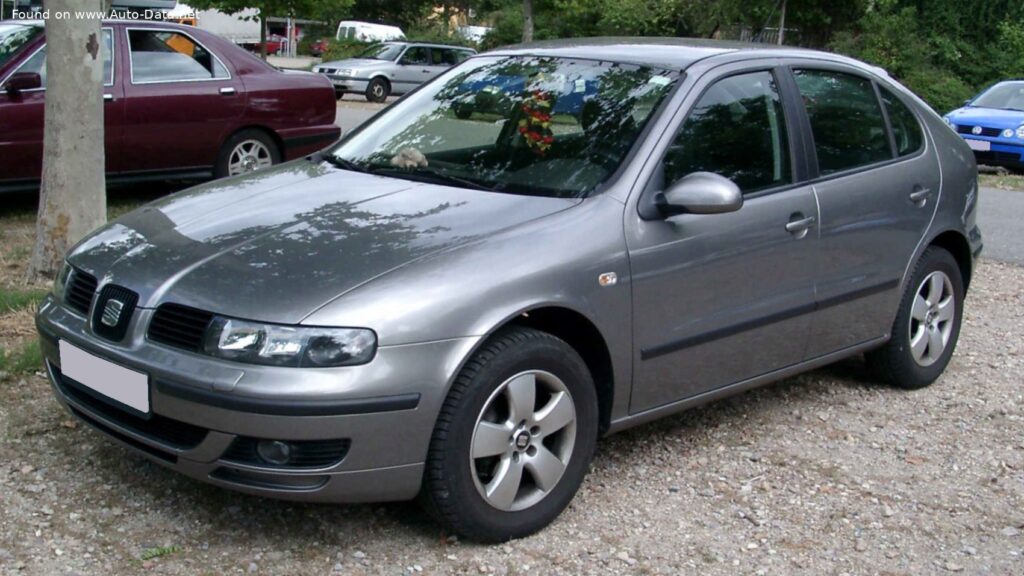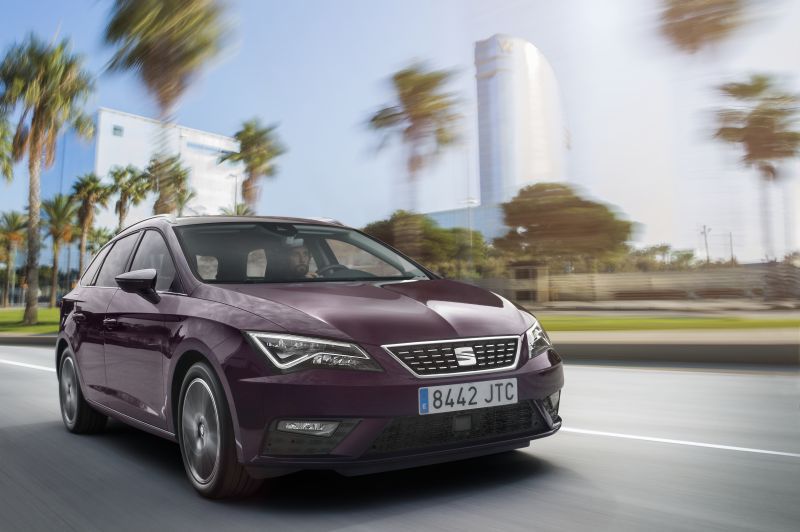
The Seat Leon III ST (facelift 2016) 1.0 TSI (86 Hp) represents a practical and efficient offering from the Spanish automaker SEAT, a brand renowned for its blend of Volkswagen Group engineering and Mediterranean flair. Primarily targeting the European market, where it competes in the highly contested compact segment, this particular variant is a facelifted model of the third-generation Leon, produced between 2018 and 2020. The “ST” designation signifies its Sport Tourer or station wagon body style, emphasizing versatility and cargo capacity, while the “1.0 TSI (86 Hp)” denotes a modern, small-displacement turbocharged gasoline engine. This iteration of the Leon ST was designed to cater to families and individuals seeking a cost-effective, fuel-efficient, and spacious vehicle without compromising on contemporary design or driving dynamics. Its role in the European landscape was to provide a more emotionally charged alternative to its platform siblings like the Volkswagen Golf Variant or Skoda Octavia Combi, offering a sportier aesthetic while maintaining core practicalities. The facelift in 2016 brought subtle but impactful updates to its exterior styling, interior finishes, and available technology, ensuring it remained competitive in a rapidly evolving market. This specific model, with its modest 86 horsepower output, was particularly geared towards urban commuting and economical long-distance travel, prioritizing low running costs and environmental compliance through its Euro 6 emission standard.
Engine and Performance: The Heart of the Seat Leon III ST (facelift 2016)
At the core of the Seat Leon III ST (facelift 2016) 1.0 TSI (86 Hp) lies a meticulously engineered 1.0-liter, inline three-cylinder engine, designated with the model code DKLB. This compact powerplant, utilizing a front, transverse layout, is a prime example of modern automotive downsizing, where advanced technology allows for impressive efficiency and adequate performance from a small displacement. Equipped with a turbocharger and intercooler, along with a direct fuel injection system, the engine generates a respectable 86 horsepower at a rotational speed between 5000 and 5500 rpm. This power output, while not designed for outright speed, is entirely suitable for its intended purpose as a practical family wagon. More crucially for everyday driving, the engine delivers 92.2 lb.-ft. of torque, available across a broad and accessible rev range from 1500 to 3000 rpm. This low-end torque is instrumental in providing responsive acceleration from a standstill and ensuring comfortable highway cruising without constant gear changes. The engine features four valves per cylinder and a compression ratio of 10.5:1, indicative of its sophisticated design aimed at optimizing combustion efficiency.
Mated to a 5-speed manual transmission, the powertrain drives the front wheels, a common and effective setup for vehicles in this segment. This combination allows the Leon ST to achieve a combined fuel economy of an impressive 49 US mpg (4.8 l/100 km), making it a highly economical choice for daily commutes and longer journeys alike. Urban driving yields approximately 41.3 US mpg (5.7 l/100 km), while extra-urban conditions can see figures as high as 54.7 US mpg (4.3 l/100 km). These figures underscore the vehicle’s commitment to efficiency, further complemented by its low CO2 emissions of 109-110 g/km and compliance with the stringent Euro 6 emission standard, which is aided by a particulate filter system. In terms of outright performance, the Leon ST 1.0 TSI (86 Hp) accelerates from 0 to 60 mph in a calculated 12.3 seconds, reaching a maximum speed of 108.74 mph (175 km/h). While not a performance car, these figures are more than adequate for typical European road conditions and highway speeds, reflecting a balanced approach to power and economy. The vehicle’s weight-to-power ratio of 13.4 kg/Hp and weight-to-torque ratio of 9.2 kg/Nm further highlight its efficient use of its compact engine to move its 2548.54 lbs. (1156 kg) kerb weight.
Design and Features of the Seat Leon III ST
The Seat Leon III ST (facelift 2016) is characterized by its station wagon (estate) body type, a design choice that prioritizes practicality and cargo versatility. With five doors and seating for five occupants, it offers a compelling package for families and individuals requiring substantial carrying capacity. The facelift introduced subtle yet impactful aesthetic enhancements, including revised bumpers, updated lighting signatures, and a refreshed grille, aligning its appearance with SEAT’s evolving design language which emphasizes sharp lines and a dynamic stance. Despite its practical nature, the Leon ST maintains a sporty profile, a hallmark of SEAT vehicles. Its dimensions are well-proportioned for the compact segment: a length of 179.09 inches (4549 mm), a width of 71.5 inches (1816 mm), and a height of 57.24 inches (1454 mm). The wheelbase of 103.78 inches (2636 mm) contributes to both interior space and stable handling characteristics.
A key feature of the ST variant is its expansive cargo area. With the rear seats in place, it offers a generous minimum trunk space of 20.73 cubic feet (587 liters). When the rear seats are folded down, this capacity expands significantly to a maximum of 51.91 cubic feet (1470 liters), transforming the Leon ST into a highly capable load-hauler. This flexibility is crucial for buyers in its segment, allowing for easy transport of luggage, sports equipment, or larger items. The maximum permissible roof load of 165.35 lbs. (75 kg) further enhances its utility for carrying bicycles or roof boxes. For towing needs, it boasts a permitted trailer load of 2204.62 lbs. (1000 kg) with brakes and 1344.82 lbs. (610 kg) without brakes, along with a towbar download limit of 176.37 lbs. (80 kg).
In terms of safety and driving dynamics, the Leon III ST is equipped with a robust set of features. The braking system comprises ventilated discs at the front and solid discs at the rear, complemented by an Anti-lock Braking System (ABS) to ensure controlled stopping power. Steering is managed via an electric power-assisted rack and pinion system, providing light and precise control, particularly beneficial in urban environments and for parking maneuvers. While specific interior features like infotainment systems and advanced driver-assistance systems (ADAS) are not detailed in the provided data, a facelifted model from 2018-2020 would typically include modern connectivity options, touchscreen displays, and a suite of passive and active safety features as standard or optional equipment in the European market, reflecting the prevailing technological trends of its production era. The focus for this vehicle remains on delivering a well-rounded, safe, and highly practical driving experience, underlined by its efficient powertrain and versatile design.
Technical Specifications
| Brand | Seat |
| Model | Leon |
| Generation | Leon III ST (facelift 2016) |
| Type (Engine) | 1.0 TSI (86 Hp) |
| Start of production | 2018 year |
| End of production | 2020 year |
| Powertrain Architecture | Internal Combustion engine |
| Body type | Station wagon (estate) |
| Seats | 5 |
| Doors | 5 |
| Fuel consumption (economy) – urban | 5.7 l/100 km (41.3 US mpg) |
| Fuel consumption (economy) – extra urban | 4.3 l/100 km (54.7 US mpg) |
| Fuel consumption (economy) – combined | 4.8 l/100 km (49 US mpg) |
| CO2 emissions | 109-110 g/km |
| Fuel Type | Petrol (Gasoline) |
| Acceleration 0 – 60 mph | 12.3 sec |
| Maximum speed | 175 km/h (108.74 mph) |
| Emission standard | Euro 6 |
| Weight-to-power ratio | 13.4 kg/Hp, 74.4 Hp/tonne |
| Weight-to-torque ratio | 9.2 kg/Nm, 108.1 Nm/tonne |
| Power | 86 Hp @ 5000-5500 rpm. |
| Power per liter | 86.1 Hp/l |
| Torque | 125 Nm (92.2 lb.-ft.) @ 1500-3000 rpm. |
| Engine layout | Front, Transverse |
| Engine Model/Code | DKLB |
| Engine displacement | 999 cm3 (60.96 cu. in.) |
| Number of cylinders | 3 |
| Engine configuration | Inline |
| Cylinder Bore | 74.5 mm (2.93 in.) |
| Piston Stroke | 76.4 mm (3.01 in.) |
| Compression ratio | 10.5:1 |
| Number of valves per cylinder | 4 |
| Fuel injection system | Direct injection |
| Engine aspiration | Turbocharger, Intercooler |
| Engine oil capacity | 4 l (4.23 US qt) |
| Engine systems | Particulate filter |
| Kerb Weight | 1156 kg (2548.54 lbs.) |
| Max. weight | 1770 kg (3902.18 lbs.) |
| Max load | 614 kg (1353.64 lbs.) |
| Trunk (boot) space – minimum | 587 l (20.73 cu. ft.) |
| Trunk (boot) space – maximum | 1470 l (51.91 cu. ft.) |
| Fuel tank capacity | 50 l (13.21 US gal) |
| Max. roof load | 75 kg (165.35 lbs.) |
| Permitted trailer load with brakes (12%) | 1000 kg (2204.62 lbs.) |
| Permitted trailer load without brakes | 610 kg (1344.82 lbs.) |
| Permitted towbar download | 80 kg (176.37 lbs.) |
| Length | 4549 mm (179.09 in.) |
| Width | 1816 mm (71.5 in.) |
| Width including mirrors | 1975 mm (77.76 in.) |
| Height | 1454 mm (57.24 in.) |
| Wheelbase | 2636 mm (103.78 in.) |
| Front track | 1534-1549 mm (60.39 – 60.98 in.) |
| Rear (Back) track | 1501-1520 mm (59.09 – 59.84 in.) |
| Front overhang | 861 mm (33.9 in.) |
| Rear overhang | 1052 mm (41.42 in.) |
| Drivetrain Architecture | Front wheel drive. Internal Combustion engine. |
| Drive wheel | Front wheel drive |
| Number of gears and type of gearbox | 5 gears, manual transmission |
| Front brakes | Ventilated discs |
| Rear brakes | Disc |
| Assisting systems | ABS (Anti-lock braking system) |
| Steering type | Steering rack and pinion |
| Power steering | Electric Steering |