
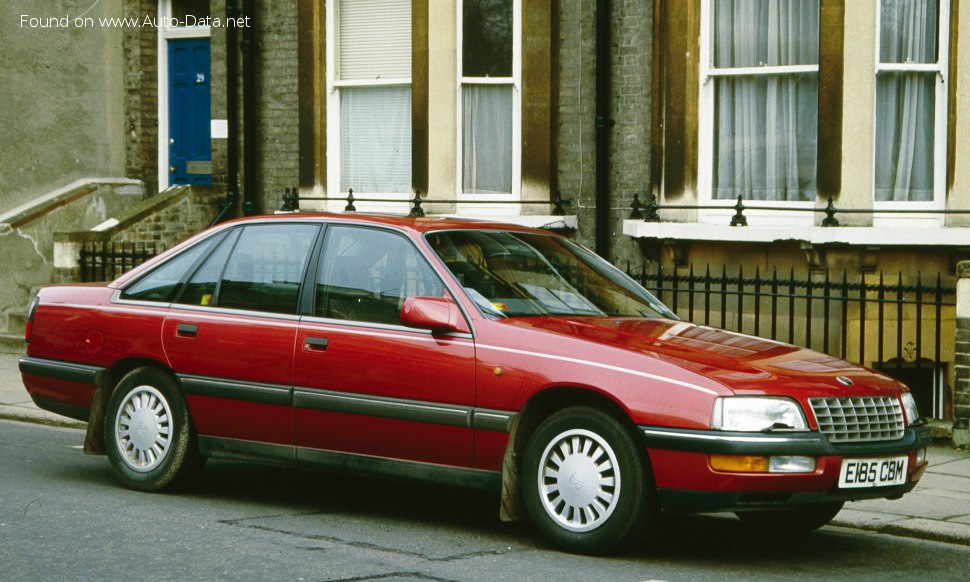
The Vauxhall Senator B 3.0i CAT (177 Hp) represents a significant chapter in the history of European executive sedans, particularly for the United Kingdom market where the Vauxhall brand held sway. Launched in 1988 as the second generation of the Senator, this model was Vauxhall’s flagship offering, designed to compete with established luxury marques by providing a compelling blend of comfort, performance, and sophisticated engineering at a more accessible price point. While never officially sold in the United States, the Senator B was essentially a rebadged Opel Senator B (or Opel Omega A-based Senator) for the UK and Irish markets, embodying the best of General Motors’ European design and engineering prowess during its production run from 1988 to 1993. It was a car that prioritized smooth, long-distance cruising and refined power delivery, catering to business executives and discerning private buyers seeking a substantial and capable vehicle without the premium badge of German rivals.
Engine & Performance: The Heart of the Vauxhall Senator B 3.0i CAT (177 Hp)
At the core of the Vauxhall Senator B 3.0i CAT (177 Hp) lies a robust and well-regarded 3.0-liter inline-six engine, designated by the code C30NE. This naturally aspirated powerplant, with an exact displacement of 2969 cm³ (181.18 cu. in.), was a testament to GM Europe’s commitment to smooth, linear power delivery. Configured with a front, longitudinal layout, the engine’s inline-six design inherently offered excellent balance and refinement, qualities highly valued in an executive sedan. It featured a multi-port manifold injection system and a CIH (Cam-In-Head) valvetrain with two valves per cylinder, a common and reliable setup for the era.
The “CAT” in the model name signifies the inclusion of a catalytic converter, a crucial emission control device that became increasingly standard in the late 1980s as environmental regulations tightened across Europe. This addition helped the 3.0i CAT (177 Hp) meet emerging standards while still delivering impressive performance for its class. The engine produced a respectable 177 horsepower at 5800 rpm, translating to a power-per-liter figure of 59.6 Hp/l. Torque output was equally robust, peaking at 177.01 lb.-ft. at 4200 rpm, providing ample pulling power across a broad rev range.
Mated to a precise 5-speed manual transmission, the drivetrain architecture channeled power efficiently to the rear wheels, offering a traditional, engaging driving experience that was favored by enthusiasts. Performance figures for the Vauxhall Senator B 3.0i CAT (177 Hp) were commendable: it could accelerate from 0 to 60 mph in a brisk 8.6 seconds, and its top speed reached 139.81 mph (225 km/h). These figures underscored its capability as a high-speed cruiser, perfectly suited for the autobahns and motorways of Europe. Despite its size and performance, the Senator B also demonstrated reasonable fuel efficiency for its time, with an extra-urban economy rating of 29.8 US mpg (7.9 l/100 km), though urban consumption naturally increased to 15.1 US mpg (15.6 l/100 km). The vehicle’s weight-to-power ratio stood at 8.3 kg/Hp (120.1 Hp/tonne), indicating a well-balanced power delivery for its curb weight of 3249.61 lbs. (1474 kg).
Design & Features: Executive Comfort and Engineering
The design of the Vauxhall Senator B was characterized by its understated elegance and functional aerodynamics, achieving a commendable drag coefficient (Cd) of 0.30. As a four-door sedan with seating for five, it exuded a sense of mature sophistication rather than overt flashiness. Its dimensions were substantial for its class, with a length of 190.75 inches (4845 mm), a width of 69.41 inches (1763 mm), and a height of 57.09 inches (1450 mm). The generous 107.48-inch (2730 mm) wheelbase contributed significantly to both interior space and ride comfort, providing a stable platform for high-speed cruising.
Inside, the Senator B was designed with occupant comfort and practicality in mind. The cabin offered ample space for five adults, with a focus on quality materials and ergonomic controls. The trunk (boot) space was particularly impressive, ranging from a minimum of 18.72 cu. ft. (530 l) to a maximum of 32.84 cu. ft. (930 l) with the rear seats folded, highlighting its versatility for long trips and luggage. A substantial fuel tank capacity of 19.81 US gallons (75 l) further emphasized its touring credentials.
From a chassis perspective, the Senator B was engineered for a refined and composed ride. The front suspension featured an independent McPherson strut setup with coil springs and an anti-roll bar, providing precise steering and good road holding. The rear suspension was also independent, utilizing coil springs, a transverse stabilizer, and trailing arms, a configuration chosen to optimize comfort and stability. Braking performance was handled by ventilated discs at the front and solid discs at the rear, complemented by an Anti-lock Braking System (ABS), which was a significant safety feature for its era, preventing wheel lock-up under heavy braking and maintaining steering control. The hydraulic power steering system, employing a cone worm with recirculation balls, offered a comfortable and predictable steering feel. The car rode on 205/65 R15 tires mounted on 6J x 15 wheel rims, a combination that balanced grip, comfort, and durability.
Overall, the Vauxhall Senator B 3.0i CAT (177 Hp) was more than just a large sedan; it was a carefully engineered executive car that combined a powerful and refined inline-six engine with a comfortable, spacious interior and advanced features for its time. It represented a strong contender in the competitive European executive segment, offering a compelling alternative to its more premium German rivals by focusing on tangible quality, robust engineering, and a smooth driving experience.
Technical Specifications
| Brand | Vauxhall |
| Model | Senator |
| Generation | Senator B |
| Type (Engine) | 3.0i CAT (177 Hp) |
| Start of production | 1988 year |
| End of production | 1993 year |
| Powertrain Architecture | Internal Combustion engine |
| Body type | Sedan |
| Seats | 5 |
| Doors | 4 |
| Fuel consumption (economy) – urban | 15.1 US mpg (15.6 l/100 km) |
| Fuel consumption (economy) – extra urban | 29.8 US mpg (7.9 l/100 km) |
| Fuel Type | Petrol (Gasoline) |
| Acceleration 0 – 60 mph | 8.6 sec |
| Acceleration 0 – 100 km/h | 9 sec |
| Maximum speed | 139.81 mph (225 km/h) |
| Weight-to-power ratio | 8.3 kg/Hp, 120.1 Hp/tonne |
| Weight-to-torque ratio | 6.1 kg/Nm, 162.8 Nm/tonne |
| Power | 177 Hp @ 5800 rpm. |
| Power per litre | 59.6 Hp/l |
| Torque | 177.01 lb.-ft. @ 4200 rpm. (240 Nm @ 4200 rpm.) |
| Engine layout | Front, Longitudinal |
| Engine Model/Code | C30NE |
| Engine displacement | 181.18 cu. in. (2969 cm³) |
| Number of cylinders | 6 |
| Engine configuration | Inline |
| Cylinder Bore | 3.74 in. (95 mm) |
| Piston Stroke | 2.75 in. (69.8 mm) |
| Compression ratio | 9.2:1 |
| Number of valves per cylinder | 2 |
| Fuel injection system | Multi-port manifold injection |
| Engine aspiration | Naturally aspirated engine |
| Valvetrain | CIH |
| Engine oil capacity | 5.81 US qt (5.5 l) |
| Coolant | 10.67 US qt (10.1 l) |
| Kerb Weight | 3249.61 lbs. (1474 kg) |
| Max. weight | 4420.27 lbs. (2005 kg) |
| Max load | 1170.65 lbs. (531 kg) |
| Trunk (boot) space – minimum | 18.72 cu. ft. (530 l) |
| Trunk (boot) space – maximum | 32.84 cu. ft. (930 l) |
| Fuel tank capacity | 19.81 US gal (75 l) |
| Max. roof load | 220.46 lbs. (100 kg) |
| Permitted trailer load with brakes (12%) | 3747.86 lbs. (1700 kg) |
| Permitted trailer load without brakes | 1587.33 lbs. (720 kg) |
| Permitted towbar download | 165.35 lbs. (75 kg) |
| Length | 190.75 in. (4845 mm) |
| Width | 69.41 in. (1763 mm) |
| Width including mirrors | 76.06 in. (1932 mm) |
| Height | 57.09 in. (1450 mm) |
| Wheelbase | 107.48 in. (2730 mm) |
| Front track | 57.09 in. (1450 mm) |
| Rear (Back) track | 57.8 in. (1468 mm) |
| Drag coefficient (Cd) | 0.30 |
| Minimum turning circle (turning diameter) | 35.93 ft. (10.95 m) |
| Drivetrain Architecture | The Internal combustion engine (ICE) drives the rear wheels of the vehicle. |
| Drive wheel | Rear wheel drive |
| Number of gears and type of gearbox | 5 gears, manual transmission |
| Front suspension | Independent, type McPherson with coil spring and anti-roll bar |
| Rear suspension | Independent coil spring, Transverse stabilizer, Trailing arm |
| Front brakes | Ventilated discs |
| Rear brakes | Disc |
| Assisting systems | ABS (Anti-lock braking system) |
| Steering type | Cone worm with recirculation balls |
| Power steering | Hydraulic Steering |
| Tires size | 205/65 R15 |
| Wheel rims size | 6J x 15 |
