The Toyota Sprinter Trueno 1.6 (85 Hp), produced from 1983 to 1987, represents a significant chapter in Toyota’s compact car lineage, particularly within the Japanese Domestic Market (JDM) and select international markets where it carved out its niche. This particular generation, often referred to by its chassis codes, was part of the broader Sprinter series, which served as a sportier counterpart to the popular Corolla. While the Sprinter Trueno nameplate is most famously associated with its rear-wheel-drive, 4A-GE-powered variants, the 1.6 (85 Hp) model detailed here specifically refers to a front-wheel-drive (FWD) iteration, embodying Toyota’s strategic shift towards FWD platforms for its mass-market compacts in the mid-1980s. This model, a two-door coupe, offered a blend of practicality, efficiency, and a touch of sporty styling, appealing to a demographic seeking reliable transportation with a hint of driving enjoyment, albeit in a more accessible and economical package than its higher-performance siblings. Its design and engineering reflected the prevailing automotive trends of the era, prioritizing compact dimensions, lightweight construction, and fuel-conscious powertrains.
Engine & Performance: The {Toyota Sprinter Trueno 1.6 (85 Hp)} Powertrain
At the heart of the Toyota Sprinter Trueno 1.6 (85 Hp) lies the 3A-U engine, a naturally aspirated inline-four gasoline unit designed for efficiency and dependable performance. With an engine displacement of 1452 cubic centimeters (approximately 1.5 liters or 88.61 cubic inches), this powerplant delivered a respectable 85 horsepower at 5600 revolutions per minute. This output translated to a power per liter figure of 58.5 horsepower per liter, a solid showing for a non-turbocharged engine of its time. Torque production was equally practical, peaking at 118 Newton-meters (equivalent to 87.03 pound-feet) at a relatively low 3600 rpm. This low-end torque characteristic made the Sprinter Trueno 1.6 (85 Hp) particularly tractable in urban driving conditions and offered sufficient responsiveness for everyday commuting.
The performance figures, while not groundbreaking by today’s standards, were competitive for a compact coupe in the mid-1980s. The vehicle’s curb weight of 915 kilograms (2017.23 pounds) contributed to its nimble feel and efficient power utilization. This resulted in a weight-to-power ratio of 10.8 kilograms per horsepower (or 92.9 horsepower per tonne) and a weight-to-torque ratio of 7.8 kilograms per Newton-meter (129 Newton-meters per tonne). These metrics highlight the car’s lightweight construction, which was a key factor in its perceived sprightliness and fuel economy. The naturally aspirated design of the 3A-U engine ensured linear power delivery and a simpler, more robust mechanical setup, contributing to Toyota’s reputation for reliability. Paired with a standard 5-speed manual transmission, the driver had direct control over the engine’s output, allowing for optimal use of the available power and torque. This combination offered an engaging, if not outright sporty, driving experience that was characteristic of many Japanese compacts of the period.
Powertrain Architecture and Drivetrain
A defining characteristic of this specific Toyota Sprinter Trueno 1.6 (85 Hp) variant is its front-wheel-drive (FWD) powertrain architecture. Unlike its more celebrated rear-wheel-drive siblings that would become icons in drifting and motorsport, this model was engineered with the engine driving the front wheels. This configuration, which became increasingly common across the automotive industry during the 1980s, offered several advantages, including improved packaging efficiency, enhanced interior space, and generally better traction in adverse weather conditions due to the engine’s weight over the drive wheels. The decision to employ FWD for this generation of the Sprinter Trueno reflected a broader industry trend towards more practical and cost-effective vehicle designs. The power was channeled through a precise 5-speed manual transmission, providing a direct and involving connection between the driver and the vehicle. This gearbox was well-matched to the engine’s power band, allowing drivers to extract the most from the 1.5-liter engine, whether navigating city streets or cruising on highways. The FWD setup, combined with the lightweight chassis, contributed to predictable handling characteristics and a comfortable ride quality, making it a versatile daily driver for its target market.
Design & Features: The Sprinter Trueno Coupe Aesthetic
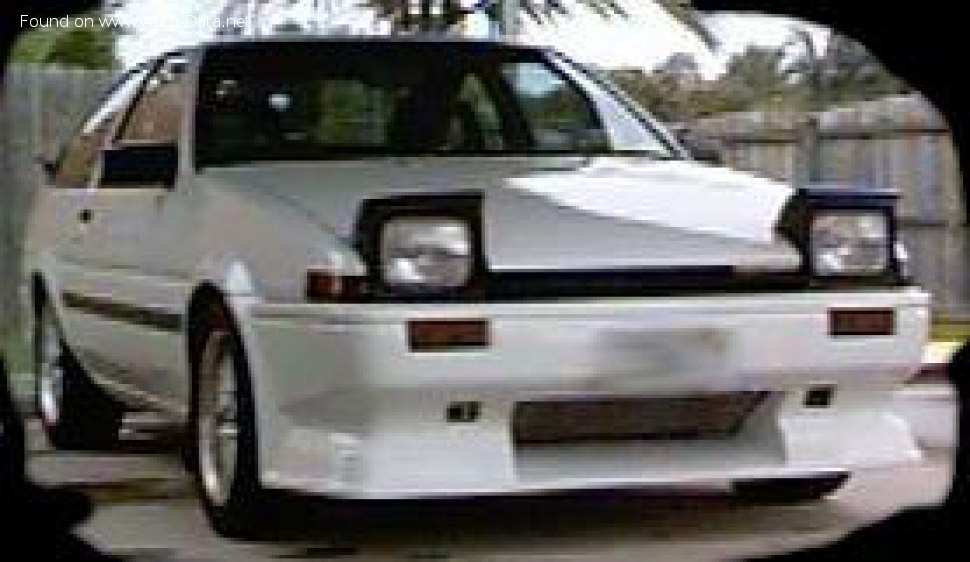
The Toyota Sprinter Trueno 1.6 (85 Hp) was offered exclusively as a two-door coupe, a body style that exuded a sense of sportiness and youthfulness within Toyota’s compact lineup. Its dimensions were typical for a compact car of the mid-1980s: a length of 4205 millimeters (165.55 inches), a width of 1625 millimeters (63.98 inches), and a height of 1335 millimeters (52.56 inches). These compact dimensions, coupled with a wheelbase of 2400 millimeters (94.49 inches), contributed to the car’s agile handling and ease of maneuverability in congested urban environments. The coupe body style, while inherently more focused on aesthetics, still managed to offer a practical interior with seating for five occupants, a common configuration for compact coupes of that era, though the rear seats were naturally more suited for occasional use or smaller passengers.
From a design perspective, the Sprinter Trueno of this generation featured a clean, angular aesthetic that was prevalent in 1980s Japanese automotive design. Its lines were purposeful, without excessive ornamentation, emphasizing aerodynamics and a modern, albeit restrained, appearance. While specific feature lists would vary by trim level in its home market, standard amenities would have included a functional dashboard layout, clear instrumentation, and basic comfort features expected of a compact car of the period. Safety features, by 1980s standards, would have focused on passive elements such as seatbelts and a sturdy body structure. The fuel tank capacity of 50 liters (13.21 US gallons or 11 UK gallons) ensured a reasonable cruising range, further enhancing its practicality for daily use and longer journeys. The overall design language of the Sprinter Trueno 1.6 (85 Hp) reflected Toyota’s commitment to producing well-engineered, aesthetically pleasing, and reliable vehicles that met the demands of the global market in the mid-1980s. Its lightweight construction, combined with its compact footprint, made it an efficient and enjoyable vehicle to operate, embodying the spirit of accessible sportiness.
The Sprinter Trueno’s Place in History
While the Toyota Sprinter Trueno 1.6 (85 Hp) may not possess the same cult following as its more powerful, rear-wheel-drive counterparts, it played a crucial role in Toyota’s product strategy during the 1980s. It represented the broader Sprinter lineup’s evolution, offering a more mainstream and volume-oriented option alongside the specialized performance variants. This FWD model catered to a significant segment of buyers who valued fuel efficiency, reliability, and a practical coupe body style over outright performance. It shared its underpinnings with the contemporary Corolla, leveraging Toyota’s extensive engineering and manufacturing capabilities to deliver a dependable and affordable vehicle. The Sprinter Trueno name, despite the drivetrain differences, continued to evoke a sense of youthful appeal and driving engagement, even in its more economical configurations. Its legacy is tied to the era of compact Japanese cars that offered an excellent balance of quality, value, and driving pleasure, cementing Toyota’s reputation as a global automotive powerhouse capable of producing a diverse range of vehicles for various market demands.
Technical Specifications: Toyota Sprinter Trueno 1.6 (85 Hp)
| Brand | Toyota |
| Model | Sprinter |
| Generation | Sprinter Trueno |
| Type (Engine) | 1.6 (85 Hp) |
| Start of production | 1983 year |
| End of production | 1987 year |
| Powertrain Architecture | Internal Combustion engine |
| Body type | Coupe |
| Seats | 5 |
| Doors | 2 |
| Fuel Type | Petrol (Gasoline) |
| Weight-to-power ratio | 10.8 kg/Hp, 92.9 Hp/tonne |
| Weight-to-torque ratio | 7.8 kg/Nm, 129 Nm/tonne |
| Power | 85 Hp @ 5600 rpm. |
| Power per litre | 58.5 Hp/l |
| Torque | 118 Nm @ 3600 rpm. (87.03 lb.-ft. @ 3600 rpm.) |
| Engine Model/Code | 3A-U |
| Engine displacement | 1452 cm3 (1.5 Liters, 88.61 cu. in.) |
| Engine aspiration | Naturally aspirated engine |
| Kerb Weight | 915 kg (2017.23 lbs.) |
| Fuel tank capacity | 50 l (13.21 US gal | 11 UK gal) |
| Length | 4205 mm (165.55 in.) |
| Width | 1625 mm (63.98 in.) |
| Height | 1335 mm (52.56 in.) |
| Wheelbase | 2400 mm (94.49 in.) |
| Drivetrain Architecture | The Internal combustion engine (ICE) drives the front wheels of the vehicle. |
| Drive wheel | Front wheel drive |
| Number of gears and type of gearbox | 5 gears, manual transmission |