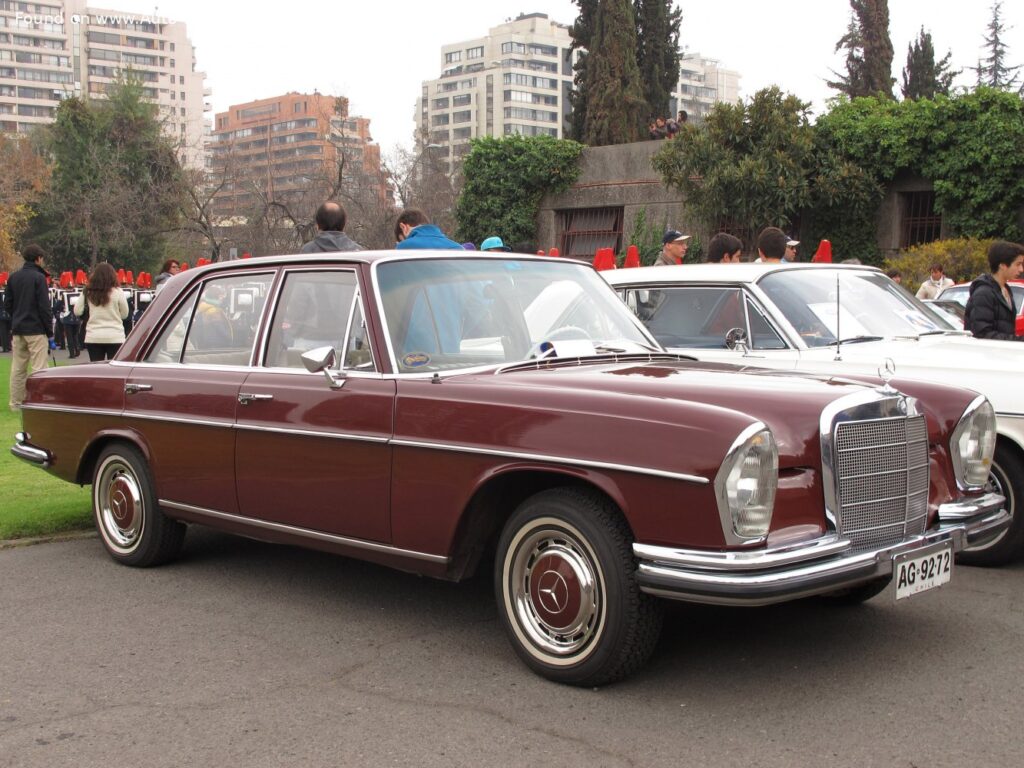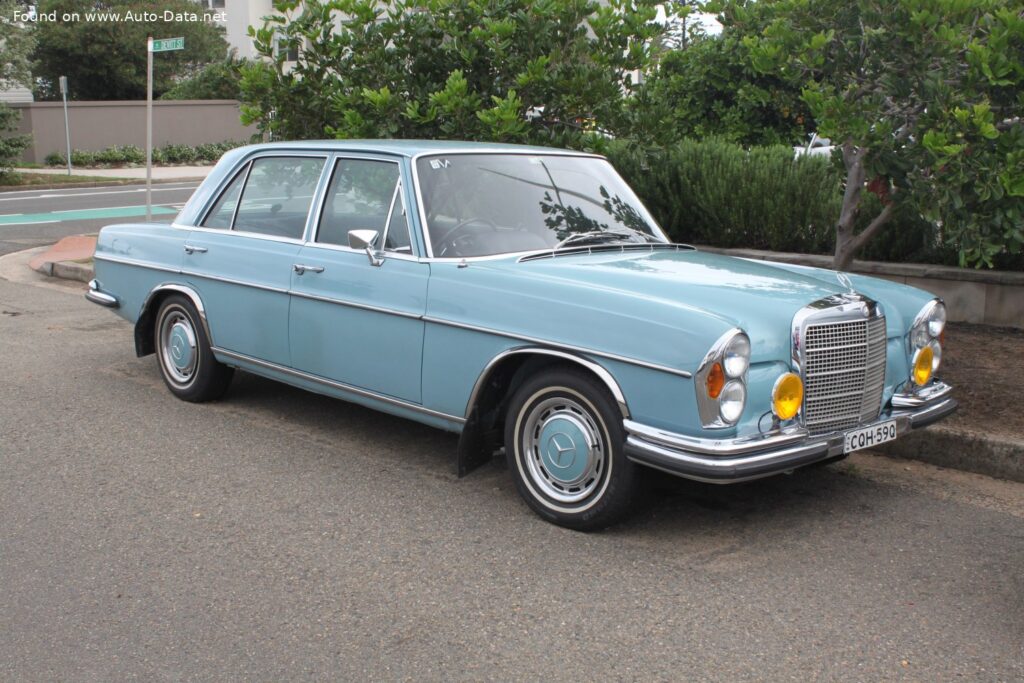
The Mercedes-Benz W108 SEL 280 SEL 3.5 V8 (200 Hp), produced from July 1970 to August 1972, represents a zenith in automotive luxury and engineering from the early 1970s. As part of the iconic W108/W109 series, this particular model, the 280 SEL 3.5 V8, stood out as a significant evolution, marrying the refined elegance of the W108 chassis with a powerful new V8 engine. The W108 generation itself, succeeding the “Fintail” W111/W112 models, was a testament to Mercedes-Benz’s commitment to understated luxury, robust build quality, and advanced safety for its time. Designed primarily for the discerning European and American markets, these vehicles were not merely modes of transport but symbols of status and engineering excellence, setting benchmarks for comfort, performance, and durability in the luxury sedan segment. The “SEL” designation indicates a long-wheelbase variant, offering enhanced rear passenger legroom and comfort, a hallmark of Mercedes-Benz’s top-tier offerings. The introduction of the 3.5-liter V8 engine marked a pivotal moment, providing a level of performance that complemented the car’s stately presence and sophisticated ride characteristics.
The Enduring Legacy of the Mercedes-Benz W108 SEL 280 SEL 3.5 V8
Powertrain and Performance
At the heart of the Mercedes-Benz W108 SEL 280 SEL 3.5 V8 lies its formidable M 116 E 35 V8 engine, a marvel of engineering for its era. This naturally aspirated, front-longitudinal 3.5-liter (3499 cm³ or 213.52 cu. in.) unit was a significant step up from the inline-six engines that dominated the W108 range. It delivered a robust 200 horsepower at 5800 rpm, translating to a specific output of 57.2 horsepower per liter, an impressive figure for a luxury sedan engine of the period. Torque output was equally compelling, peaking at 286 Nm (210.94 lb.-ft.) at 4000 rpm, ensuring effortless acceleration and cruising capability. This substantial power and torque allowed the 280 SEL 3.5 V8 to achieve a 0-60 mph sprint in a brisk 8.6 seconds, with 0-100 km/h taking 9 seconds. Its top speed was rated at 210 km/h (130.49 mph), making it one of the faster luxury sedans available at the time and perfectly suited for sustained high-speed autobahn cruising or comfortable long-distance travel on American highways.
The engine featured an advanced multi-port manifold injection system, a sophisticated technology for the early 1970s, which optimized fuel delivery for improved efficiency and performance compared to carbureted systems. With a compression ratio of 9.5:1 and a SOHC (Single Overhead Camshaft) valvetrain with two valves per cylinder, the engine was designed for smooth operation and longevity. Power was transmitted to the rear wheels via a 4-speed manual transmission, offering an engaging driving experience for those who preferred direct control over the vehicle’s considerable power. The powertrain architecture, driving the rear wheels, was classic for a luxury sedan, providing balanced handling and a refined ride. Despite its performance capabilities, the vehicle maintained a fuel consumption rate of approximately 18.1 US mpg (13 l/100 km combined), which was respectable for a large V8 luxury car of its weight and power.
Design, Engineering, and Features
The W108 series, and particularly the long-wheelbase SEL models, are celebrated for their timeless and elegant design. The 280 SEL 3.5 V8 embodied the quintessential Mercedes-Benz aesthetic of the early 1970s: clean lines, a stately grille, and a commanding presence without being ostentatious. The sedan body type featured four doors and seating for five, making it an ideal choice for executive transport or luxurious family travel. With a length of 196.85 inches (5000 mm), a width of 71.26 inches (1810 mm), and a height of 56.69 inches (1440 mm), the car exuded an imposing yet graceful stance. The wheelbase of 112.2 inches (2850 mm) contributed significantly to its ride comfort and interior spaciousness, particularly for rear passengers.
Underneath its elegant exterior, the W108 SEL 3.5 V8 boasted advanced engineering for its time. The suspension system was designed to provide a supremely comfortable and controlled ride. The front featured an independent double-wishbone setup, while the rear utilized a sophisticated hydro-pneumatic element combined with trailing arms, allowing for self-leveling capabilities and superior road holding. Braking performance was handled by disc brakes on both the front and rear wheels, a significant safety feature for a vehicle of its size and performance. Steering was managed by a cone worm with recirculation balls system, augmented by hydraulic power steering, ensuring ease of maneuverability despite the car’s substantial weight. The vehicle rolled on 6J x 14-inch wheel rims, providing a classic look and sufficient grip. With a curb weight of 3494.33 lbs. (1585 kg) and a maximum permissible weight of 4596.64 lbs. (2085 kg), the W108 SEL was a solidly built machine, reflecting Mercedes-Benz’s commitment to structural integrity and passenger safety. Its 21.66 US gallon (82-liter) fuel tank provided an excellent cruising range, further cementing its status as a grand touring automobile.
Technical Specifications: Mercedes-Benz W108 SEL 280 SEL 3.5 V8
| Brand | Mercedes-Benz |
| Model | W108 |
| Generation | W108 SEL |
| Type (Engine) | 280 SEL 3.5 V8 (200 Hp) |
| Start of production | July, 1970 year |
| End of production | August, 1972 year |
| Powertrain Architecture | Internal Combustion engine |
| Body type | Sedan |
| Seats | 5 |
| Doors | 4 |
| Fuel consumption (combined) | 13 l/100 km (18.1 US mpg) |
| Fuel Type | Petrol (Gasoline) |
| Acceleration 0 – 60 mph | 8.6 sec |
| Acceleration 0 – 100 km/h | 9 sec |
| Maximum speed | 210 km/h (130.49 mph) |
| Weight-to-power ratio | 7.9 kg/Hp, 126.2 Hp/tonne |
| Weight-to-torque ratio | 5.5 kg/Nm, 180.4 Nm/tonne |
| Power | 200 Hp @ 5800 rpm |
| Power per liter | 57.2 Hp/l |
| Torque | 286 Nm (210.94 lb.-ft.) @ 4000 rpm |
| Engine layout | Front, Longitudinal |
| Engine Model/Code | M 116 E 35 / 116.980 |
| Engine displacement | 3499 cm³ (213.52 cu. in.) |
| Number of cylinders | 8 |
| Engine configuration | V-engine |
| Cylinder Bore | 92 mm (3.62 in.) |
| Piston Stroke | 65.8 mm (2.59 in.) |
| Compression ratio | 9.5:1 |
| Number of valves per cylinder | 2 |
| Fuel injection system | Multi-port manifold injection |
| Engine aspiration | Naturally aspirated engine |
| Valvetrain | SOHC |
| Engine oil capacity | 7.5 l (7.93 US qt) |
| Coolant | 13.2 l (13.95 US qt) |
| Kerb Weight | 1585 kg (3494.33 lbs.) |
| Max. weight | 2085 kg (4596.64 lbs.) |
| Max load | 500 kg (1102.31 lbs.) |
| Fuel tank capacity | 82 l (21.66 US gal) |
| Length | 5000 mm (196.85 in.) |
| Width | 1810 mm (71.26 in.) |
| Height | 1440 mm (56.69 in.) |
| Wheelbase | 2850 mm (112.2 in.) |
| Front track | 1482 mm (58.35 in.) |
| Rear (Back) track | 1485 mm (58.46 in.) |
| Drivetrain Architecture | The Internal combustion engine (ICE) drives the rear wheels of the vehicle. |
| Drive wheel | Rear wheel drive |
| Number of gears and type of gearbox | 4 gears, manual transmission |
| Front suspension | Double wishbone |
| Rear suspension | Hydro-pneumatic element, Trailing arm |
| Front brakes | Disc |
| Rear brakes | Disc |
| Steering type | Cone worm with recirculation balls |
| Power steering | Hydraulic Steering |
| Wheel rims size | 6J x 14 |